


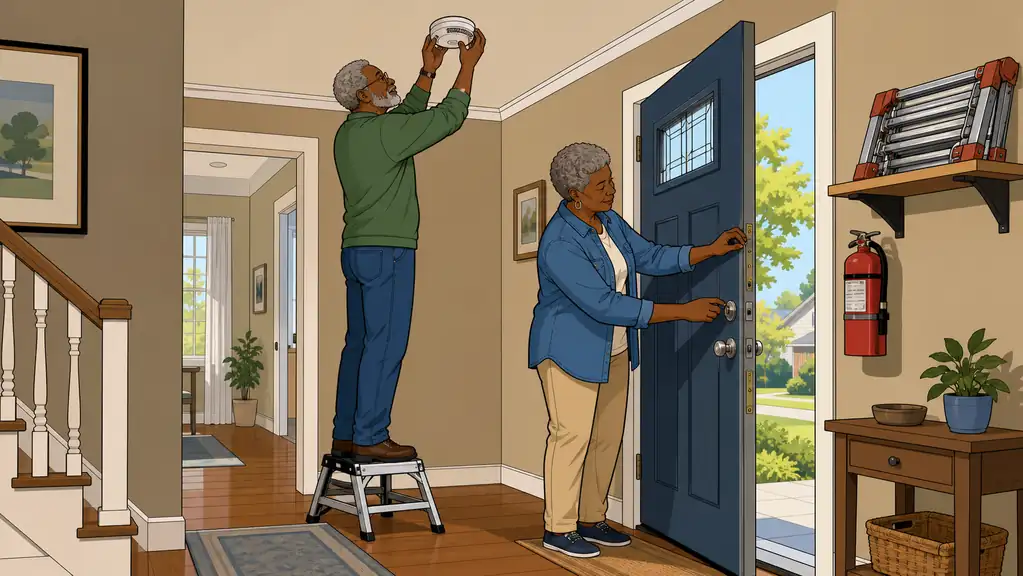
Say “harden my home” and most people picture a buried concrete bunker with a blast door. It’s a fine thing to daydream about and a terrible place to start — because the bunker almost never gets built, and while you’re pricing blast doors, the actual house sits with a smoke alarm that chirps and a back door a teenager could shoulder open.
Here’s the reframe: your house is already 80% of a shelter. It has walls, a roof, doors that lock, a basement hopefully. Hardening isn’t starting over in the backyard — it’s finishing the building you already own, in the order the threats actually reach you.
A bunker is the last five percent of home hardening. Almost everyone dies to something in the first ninety-five — and skips it to shop for the last five.
Harden in the order of the Rule of 3s
The survival hierarchy tells you the sequence: three minutes without oxygen, three hours without shelter, three days without water. Your house should be hardened in that same priority — and the top of the list is boring, cheap, and the thing people skip.
Air comes first. The fastest way your home kills you isn’t an intruder or a tornado — it’s a house fire, and the failure is being unable to get out. This means collapsible escape ladders for the upstairs windows matter more than another fire extinguisher. Working smoke and CO alarms, two ways out of every room, a family that has actually walked the exits — that’s home hardening, and it costs a weekend. Do it before anything else.
Then harden for the disaster your area actually gets
Only after the universal stuff do you spend on the specific. And “specific” means your threats, not the internet’s. A county threat report will tell you whether you’re a tornado county, a flood county, a wildfire county, or a quake county — and each one hardens differently:
- Tornado / high wind — a basement room, purpose-built safe room or a reinforced interior space. FEMA’s design guidance (FEMA 320, Taking Shelter from the Storm) exists precisely so this isn’t guesswork.
- Flood — elevation and keeping the mechanicals (furnace, panel, water heater) out of the basement matter more than any wall you can build.
- Wildfire — the house is lost or saved at the edges: embers in the gutters, vents, and the first five feet of landscaping, not the front door.
Harden for the one your ground actually hands you. A tornado safe room in a floodplain county is effort spent on the wrong threat.
Then the people problem
Only now does the intruder — the thing people wanted to start with — earn attention. And even here it isn’t a fortress; it’s layers that buy time. Most break-ins go through a door or a ground-floor window, so the cheap wins are the real ones: solid-core exterior doors, long screws in reinforced strike plates, window film, lighting, a dog, a house that plainly isn’t the easy one on the street. You’re not building a fort. You’re making yourself slower to get into than the neighbor — buying minutes for the plan to matter.
A bunker is the last 5%, not the first
If you’ve done all of the above and still have money and land, then sure — a hardened room, a shelter, deeper mass. But that’s the finish, not the foundation. The person with escape ladders, a CO alarm, a threat-appropriate safe space, and reinforced doors is dramatically harder to kill than the person with a half-finished bunker and a chirping smoke detector.
Bottom Line
- Skip the bunker fantasy. Your existing home is most of the shelter — finish it, don’t replace it.
- Harden in Rule-of-3s order. Fire escape and alarms first; they’re cheap and they’re what actually kills people.
- Match the hardening to your county’s real threat. Tornado, flood, fire, and quake each need a different fix — find out which is yours.
- Doors and windows are the intrusion answer, not walls. Buy time in layers; you only have to be harder than the next house.
Start from the real list, not the imagined one — pull your county Threat Report, then turn each threat into a concrete plan with Threat Planning.