


Note: This is an advanced how-to prepare for EMPs and CMEs. If you’re new to these subjects, I recommend you start with the introduction articles:
- EMP - A calm, engineering-grade look at electromagnetic pulse — what the physics actually says, how likely it is, and what rational preparation looks like.
- CME - A look into what coronal mass ejections really are and how they matter to preparedness.
There are essentially three options for mitigation of EMP or CME effects:
- Unplug - eliminates conducted exposure
- Shield - eliminates radiated exposure
- Suppress - when the other two aren’t possible
Unplug it
The biggest source of damaging voltages from CME and all three waveforms of EMP is long wires. Therefore, the simplest precaution is to simply keep things unplugged - if they don’t have a long wire to conduct large voltages, they will be largely unaffected. This is true for all except for the EMP E1 component and easy/free to implement. It requires no special hardware, but does require vigilance to ensure essential devices are kept unplugged from power wiring or antennas.
It’s worth noting that this is the only method to mitigate CMEs or the EMP E3 component. The long duration renders suppression ineffective and the slow frequencies means they suffer from minimal radiated coupling.
Shield it
The next line of defense is against radiated exposure. Fortunately, there’s an easy fix for this as well, and while not free it is relatively inexpensive. The best type of shielding is what is typically called a Faraday cage. When constructed properly, a Faraday cage can reduce the radiated signal by 80dB (x 0.00000001) or more. For reference, only about 20dB (x 0.01) is required to stop a cellular phone signal from working.
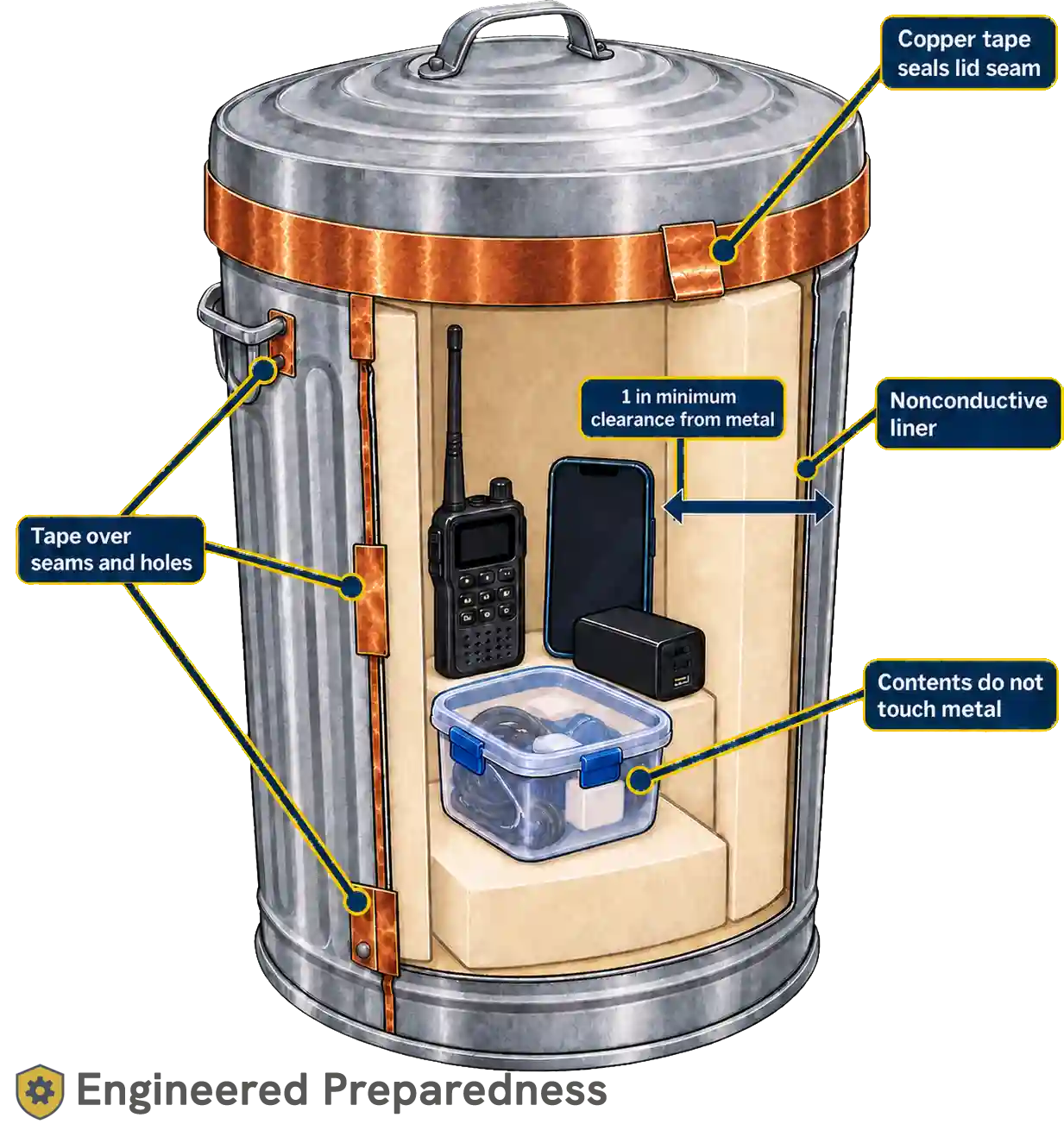
While it sounds complex, it’s actually really simple - a conductive container. There are a few general rules to keep in mind:
- The box must be made of a highly conductive material. Steel or copper are common materials. The go-to is a metal trash can or 55 gallon drum with a removable lid.
- While professional Faraday cages are usually made from a mesh, solid materials actually work even better and across all frequencies.
- The object being protected must be insulated away from the conductive box sides. The general rule is to maintain more than 1 inch separation to prevent capacitative coupling. This can be done by plastic, cardboard, bubble wrap, etc.
- No cords, wires, etc. can enter the cage. While it’s possible to do this, it’s way outside the scope of this document and is too big of a risk unless you do things exactly right.
- Cover all seams, potential holes, etc. with conductive copper tape.
- The box doesn’t need to be grounded, etc. to work.
This is the best protection method overall and the only one that ensures no damage from EMP E1 effects.
Suppress it
Unplugging and shielding are the best options. But, there are certain things that just aren’t reasonable or possible to do these for:
- Solar power systems
- Cars and trucks
- Things used daily
For these items, the only option left is to suppress the effects. This normally means some sort of electrical device that clamps the voltage to a safe level. While possible to build these yourself, it’s out of the scope to cover this here (check out the EMP Reference Library for more info). Fortunately, there are several commercial products available to help here, starting with the options oriented toward personal preparedness:
- EMP Shield - The best known in the prepper space with devices for home, vehicles, radio, etc.
- Faraday Defense - What I consider the “professional” option within the options marketed to preppers. They can protect your home or build a SCIF if you need one…
- Bad Wolf - The relative newcomer in this space.
- Siemens Boltshield FSPD140 - A whole-house surge protector that is supposedly fast enough to handle EMP E1 spikes as well.
- Siemens Boltshield FSPD036 - The little brother of the FSPD140. Same capabilities, just smaller capacity for smaller systems (and considerably cheaper).
Then you get into the ones oriented toward military and industrial uses:
- Alpha Delta
- Captor Corporation
- Emprimus
- ETS Lindgren
- Fischer Custom Communications
- Glenair
- Huber+Suhner
- LCR Electronics
- NexTek
- PolyPhaser
- Transtector
I only have first-hand experience with the EMP Shield and Siemens products. They were both easy to install and thankfully I’ve never had to see if they work… Someday, I would love to do some objective testing of these devices to see how they stack up against one another, but at this point we just have to trust their claims.
Bottom Line
There are three steps to preparing for the direct threat of EMP or CME:
- Unplug it. Keep things unplugged as much as possible.
- Shield it. Place critical items inside Faraday cages.
- Suppress it. If all else fails, install devices to clamp the voltages to safe levels.