


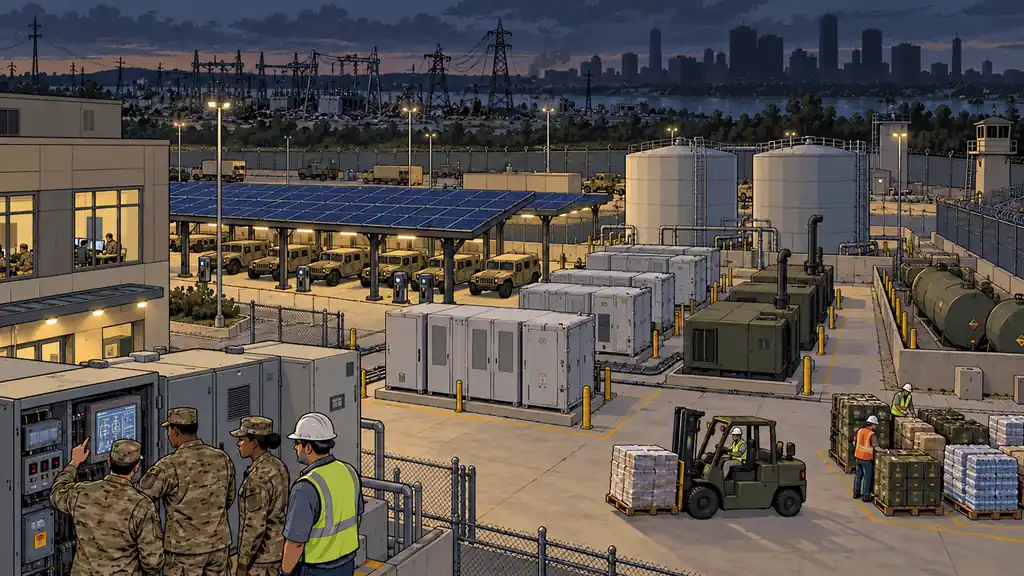
If you’re not familiar with the FORTRESS America directive, or the Next Great American Base, this article from October 5, 2026 covers the announcements.
When I wrote about these two programs earlier this month, the details were thin. This week they filled in — and one of them should get every American’s attention, not because it’s dramatic, but because of what it quietly assumes.
Fortress America
On October 25, Fox News reported the specifics of what the directive actually requires: every U.S. military base must be able to operate without the civilian power grid for 90 days, and to be self-sufficient for water and fuel across that same period. It’s part of the initiative the Pentagon is calling FORTRESS — Federal Operations for Resilience, Troop Resources, Energy, Supply and Survivability.
Sit with the premise for a second, because the premise is the story. The U.S. military is telling its own installations to assume the civilian grid, civilian water, and civilian fuel supply could be gone for three months and to be able to fight through it anyway. The Pentagon does not plan around things it considers impossible. A 90-day self-sufficiency mandate is an institution with the best threat intelligence on earth concluding that a prolonged loss of civilian infrastructure — grid, water, fuel — is plausible enough to engineer around at enormous expense.
When the military stops assuming it can rely on the civilian grid, that’s your cue to stop assuming it too.
Here’s the uncomfortable corollary for the rest of us: if the military no longer trusts civilian infrastructure to stay up for 90 days, neither should you — and the military has backup generation, fuel farms, and water treatment that your neighborhood does not. I’m not saying go build 90 days of off-grid power this weekend. I am saying the institution with the clearest view just set its own floor at 90 days, and that should move your sense of “how long could this realistically last” in one direction. See the EMP threat brief and multi-day grid failure for what drives a loss like that.
Next Great American Base
The second program is less alarming on its face and more interesting in its timeline. On October 26 the Department of Defense released the requirements for a brand-new U.S. military base and called on every state to nominate candidate locations by December 1, 2026. Candidates must be in the continental U.S., offer 100,000–250,000 contiguous acres, be able to host up to 25,000 service members, and — notably — are not required to be on the coast.
The size numbers only mean something in comparison, so here’s the context:
| Base | Approx. acreage | Approx. active-duty population |
|---|---|---|
| Next Great American Base | 100,000–250,000 | up to 25,000 |
| Fort Leonard Wood, MO | ~61,000–63,000 | ~5,400 permanent (+ ~12,000–13,000 students/recruits) |
| Fort Bragg, NC | ~160,000–172,000 | 54,000+ (largest by population in CONUS) |
| Fort Bliss, TX/NM | ~1.12 million (largest by area) | ~28,000–33,000 |
So the new base would be a genuinely large installation — Bragg-scale in land, with a sizable garrison — and the “not required to be on the coast” line is its own quiet signal in an age of long-range missiles: the Pentagon wants depth, not shoreline.
What surprised me most is the speed. A nomination deadline of December 1, 2026 is crazy given the announcement at the end of October — this leaves only a month to develop the proposals. Selection will be in the middle of next year, with acquisition and construction expected to follow quickly. On that schedule, a base of this size could be well underway — possibly even partly operational — before President Trump leaves office in January 2029. That is a fast clock for a project this large, and fast clocks on military infrastructure usually means that the timeline is based on a perceived external deadline.
I’ll also go out on a limb and make a prediction — I believe that this base will be found in the geographic center of the nation. Specifically, I expect it to be in Oklahoma, Kansas or Nebraska, with Missouri and Iowa in the second tier of candidates. If they’re building a castle, you put it in the safest place you can, which is in the middle of the country where you can see threats coming from a long way off.
Does this change China’s timeline?
As I argued in the earlier piece, I believe it does — and FORTRESS sharpens the point. If China intends to move on Taiwan, it wants to move before the United States is ready, and “ready” now has a concrete meaning: before FORTRESS has actually hardened U.S. bases to fight through a 90-day infrastructure loss, and before a new continental stronghold is built. Every month the U.S. spends hardening is a month that argues for Beijing moving sooner rather than later. I’m not predicting a date. I’m pointing out that American preparation and Chinese incentive are now pulling in opposite directions on the same calendar.
Bottom Line
- FORTRESS is the real headline. The U.S. military is engineering its bases to run 90 days with no civilian grid, water, or fuel. Institutions don’t spend that kind of money on scenarios they think are fantasy.
- Take the military’s floor as a hint for yours. If the Pentagon won’t assume the grid stays up, quietly move your own “how long could this last” estimate up. You have less backup than a base does.
- The new base’s timeline is the tell. A December 1 nomination deadline and a build that could be operational before 2029 is a fast clock — and fast clocks signal urgency.
- Preparation and incentive are diverging. Every month the U.S. hardens is a month China has reason to move sooner. Watch the pace, not a predicted date.
Put a real number on your own resilience with the Food & Water Storage tool and the Heating & backup-power calculators, and rate the scenario with the War with China threat brief.