


We are currently within a societal transformation that’s being called the “fourth industrial revolution”. Even though the name contains the word “revolution”, this name does a poor job at articulating exactly how transformational this process may be to society at large, and understanding how the world is changing is critical to being able to prepare for it.
The background
This fourth industrial revolution (4IR), also commonly called Industry 4.0 (I4.0), is a societal transformation that’s been underway for a few years, and only appears to be accelerating. Before we get into the details of this current transformation, it’s important to understand the past events so they can be adequately compared.
- Steam Power — 1776—1840s — Steam engines, early railroad and manufacturing. The initial shift from agrarian hand-made economies to machine-driven factory production.
- Production & transportation — 1870—1914 — Assembly lines, railroads, internal combustion engines, electrification, telegraphs and telephones. Mass-scale manufacturing of goods, mass-scale transport of goods via railroads, and the start of modern conveniences.
- Compute & Telecomm — 1969—2010s — Nuclear power, electronics, telecommunications, computing, the internet. Dramatically changed how data is collected, used and shared.
- Fusion of systems — 2010s to Present — Solar power, mobile computing, artificial intelligence (AI), smart factories, big data, cloud computing, robotics.
The first and second transformed the way things were made and transported, and the third changed how we communicated and utilized data. Even though they were extremely impactful individually, it’s important to realize that there was also a progression at work — these three built upon one another. While the fourth wouldn’t be possible without the three that preceded it, it is also unique as it is poised to undo or replace everything those previous revolutions put into place — a true revolution.
Artificial intelligence (AI)
AI is the piece of this revolution most people already have their eyes on, so I’ll keep it focused on what it means for the rest of the picture. In just a few years, AI has gone from a novelty to something quietly rewiring how work gets done. The most visible shift is in how we find information: for twenty years the default was to search — type keywords, get a list of links, do the reading yourself. Increasingly, people simply ask, and a large language model (LLM) answers in plain language. That’s a fundamental change in how knowledge moves.
Behind the headlines about chatbots and AI-generated images and video, the deeper changes are in raw capability. Machine vision — a computer’s ability to interpret what a camera sees — has matured to the point that it drives cars, inspects parts on a production line, and reads a scene in real time. AI can now write software, sift mountains of data, and control physical machines. Each of those abilities feeds the sections below: the vision that drives a car is the same vision that runs a smart factory; the coding ability that builds an app is the same ability that writes a cyber exploit. AI isn’t one technology sitting beside the others in this revolution — it’s the force that amplifies all of them at once.
For more details on the potential direct impact of AI specifically, I recommend you check out this article.
Mobile computing
It’s easy to forget how recent the smartphone is, and how completely it rewired daily life. In well under two decades, a supercomputer in everyone’s pocket changed how we communicate, how we get information, how we navigate, how we pay, and how we’re entertained — and put all of it behind a single always-connected screen. The practical effect is that most people are now reachable, trackable, and informed (or misinformed) continuously, wherever they are.
For preparedness, mobile computing cuts both ways. It’s an extraordinary tool — maps, weather, alerts, references, and communication all in one device. It’s also a single point of dependence: when the cell network or the grid goes down, a household that has outsourced its maps, its phone numbers, its documents, and its payments to one glass rectangle suddenly has none of them. The more of life that moves onto the phone, the more it matters to keep paper and offline backups for the things you can’t afford to lose.
Distributed storage and computing
The phone in your pocket and the AI answering your questions don’t run in isolation — they lean on a vast, invisible backbone of cloud computing and big data. Instead of your files and programs living on your own machine, they increasingly live on someone else’s servers, reachable from anywhere. The same model has spread into the physical world as the Internet of Things (IoT): thermostats, doorbells, cameras, TVs, speakers, cars, and appliances, all networked and all streaming data back to a company’s cloud.
The upside is convenience and capability. The downside is that an enormous amount of information about your household now lives on infrastructure you don’t control, gathered by devices you may not realize are gathering it. A “smart” TV can watch what you watch; a smart speaker keeps a record of what it hears; and the brochure rarely spells out how much is kept, for how long, or who can reach it (your TV may be listening more than you think). For a household that values privacy and self-reliance, this is worth treating as a deliberate decision rather than a default — a subject I dig into in the case against the smart home.
Power generation
Much of the developed world is replacing dependable, dispatchable generation — coal, and in some places nuclear — with weather-dependent sources like wind and solar. On a calm, sunny, mild day these work well and cost little to run. The trouble is the days that aren’t calm, sunny, and mild — which are exactly the days you need power the most.
Germany is the clearest cautionary example. Over the past two decades its Energiewende (“energy transition”) pushed hard in that direction: it built out wind and solar aggressively while deliberately shutting down its nuclear fleet, retiring its last three reactors in April 2023. The catch was what it leaned on to cover the gaps when the wind didn’t blow and the sun didn’t shine — heavy imports of natural gas, much of it from Russia. When that gas was cut off after Russia’s 2022 invasion of Ukraine, the fragility became obvious: energy prices spiked, the country scrambled to fire coal plants back up, and a modern industrial economy found itself rationing power and bailing out utilities to keep the lights on. A transition built on the assumption that dependable backup power would always be there to cover the intermittent kind turned out to be only as strong as that assumption.
Wind and solar share two hard limitations. First, they’re weather-dependent: the sun doesn’t shine at night or through heavy cloud, turbines stop in a dead calm, and both can be knocked out entirely by extreme cold. Second, and less obvious, they can’t be scaled to meet demand. A conventional plant can be told to produce more when a cold snap drives up heating load; the wind can’t be told to blow harder. When demand spikes and the weather won’t cooperate, the gap has to be filled by something — and if the dependable plants that used to fill it have been retired, there may be nothing there to do it.
Texas shows the acute version of the same problem. During the February 2021 deep freeze (Winter Storm Uri), the grid came within minutes of a total, weeks-long collapse as generation failed in the cold at the exact moment heating demand hit a record. It’s worth being precise about why, because the honest version is more damning than the partisan one: it wasn’t only frozen wind turbines — un-winterized natural-gas, coal, and even nuclear plants froze and tripped offline too. Weather-exposed generation of nearly every kind failed together, right when it was needed most. That’s the real lesson — not “renewables bad,” but that a grid leaning on sources vulnerable to the same weather, without enough winterized, dispatchable backup, is a grid that fails precisely when the stakes are highest.
For a prepared household, the takeaway isn’t a side in the energy debate — it’s a planning assumption: the grid is getting less predictable, not more. Build for outages that are more frequent and longer, especially during extreme weather, rather than fewer.
Smart factories
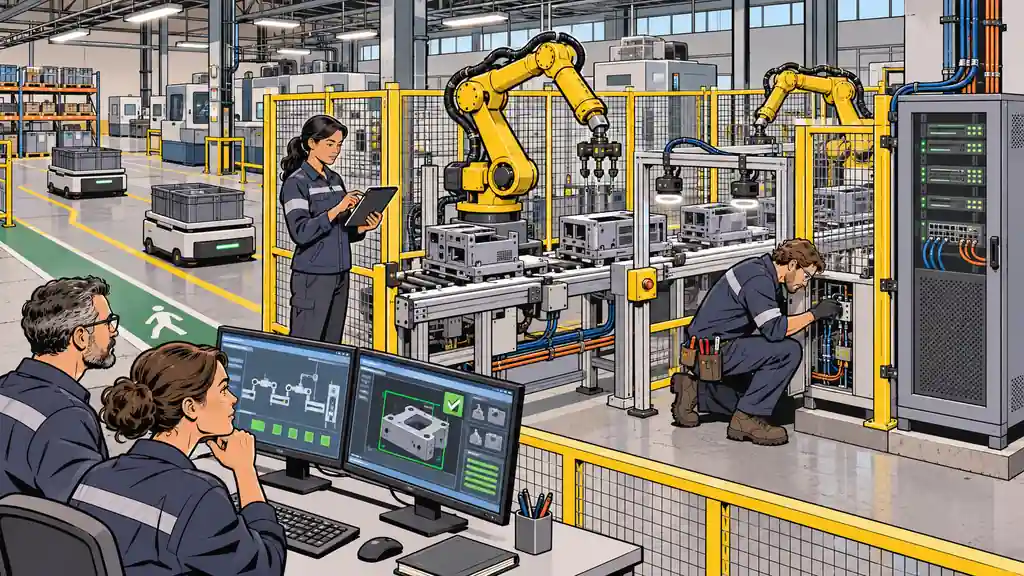
Pull AI, machine vision, and networked devices together and aim them at a factory, and you get what’s often called Industry 4.0 — the “smart factory.” Machines, robots, sensors, and controllers are wired together (the Industrial Internet of Things, or IIoT), their data pooled and analyzed in real time, and increasingly AI is used to program, optimize, and even run them. A robot that used to take an engineer weeks to teach can now be set up in days; a production line can flag its own failing parts before they break.
I touched on this at a high level in the AI layoff trap; here it’s worth naming the stakes. The same connectivity that makes a factory efficient makes it reachable, and the same AI that optimizes a line can be turned against it. More importantly for a household, these are the systems that make everything you buy — food, fuel, medicine, parts. As they grow more automated, more connected, and more concentrated, the supply chain they feed becomes both more efficient in good times and more brittle when something goes wrong. Efficiency and resilience are usually a trade-off, and Industry 4.0 is buying a great deal of the former.
What a household actually does about it
You can’t opt out of a revolution, and I won’t pretend a prepared household can wall itself off from one. What you can do is see it clearly and plan around it, because nearly every thread above points at the same handful of practical conclusions.
- Expect more capability and more fragility at the same time. The systems you depend on — power, water, food, finance, communication — are getting smarter, more connected, and more efficient, which also makes them more complex and more exposed. Plan for the outages and disruptions that complexity brings, not fewer of them.
- Keep offline fallbacks for anything you can’t afford to lose. Maps, important phone numbers, documents, cash, and the knowledge in your head don’t depend on a network, a cloud, or a charged battery. The more life moves into the cloud, the more valuable the paper copy becomes.
- Decide what you let into the house. Every “smart” device is a convenience and a cost — a sensor and a data stream you don’t control. Choose deliberately, keep them off your main network, and keep the truly private things on infrastructure you own.
- Build for a less predictable grid. Backup heat, stored water, food that needs no refrigeration, and a way to charge essentials all matter more as generation leans harder on the weather.
- Invest in skills, not just gadgets. The one capability no revolution can take offline is what you know how to do without the machine. In a world increasingly run by automated systems, hands-on competence — growing, fixing, navigating, communicating — is the ultimate backup.
Bottom Line
- We just finished one revolution and started another. The third — computing and the internet — is barely a generation old; the fourth (AI, mobile, cloud, IoT, robotics, and a shifting energy mix) is already underway and accelerating.
- This one is different in kind. The first three built on each other and extended how we make, move, and communicate. The fourth fuses those systems and is poised to replace how many of them work — a genuine revolution, not just an upgrade.
- More capable also means more fragile. The same connectivity and automation that make modern life efficient concentrate risk: a single outage, attack, or failure now cascades further than it used to.
- Preparedness is the hedge. You can’t stop the transformation, but you can refuse to be wholly dependent on it — offline fallbacks, a resilient home, deliberate choices about technology, and real skills are how a household stays steady while the ground shifts.
Actually create the plans to deal with these changes in the threat planning tool.