


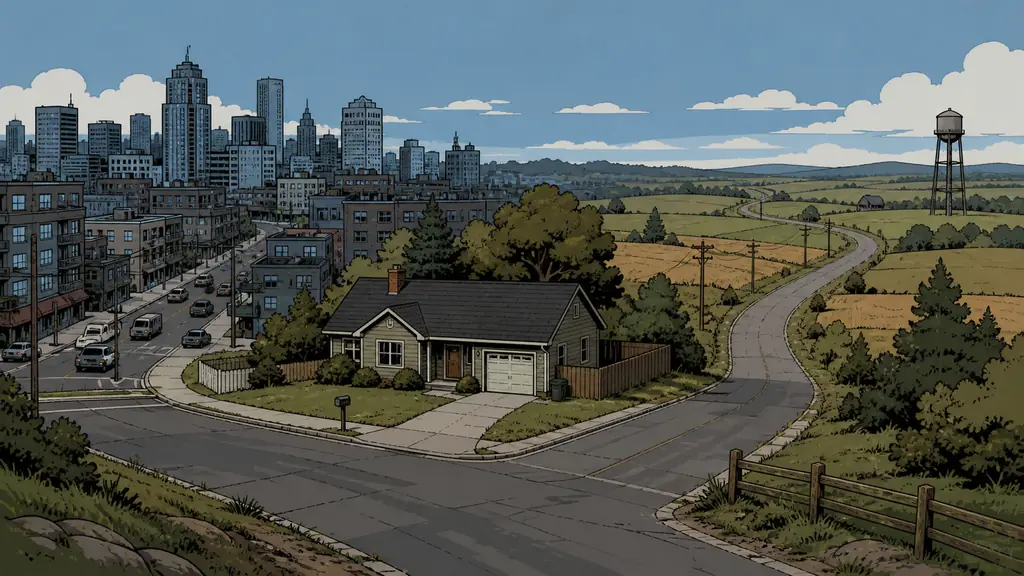
Most “getting started” prep advice is a universal checklist — the same list of items handed to everyone, whether they live on forty acres or on the fourteenth floor. It’s an appealing idea because it’s simple. It’s also wrong. The single biggest factor in how much you need to prepare, and for what, isn’t on any checklist. It’s your address.
Where you live sets the size of the problem. Two families with identical stockpiles can face wildly different odds in the same disaster, purely because one is surrounded by ten neighbors and the other by ten thousand. Understanding that starts with how the country got arranged the way it is — and what’s holding it up.
The city is a recent, load-bearing invention
For most of American history, people lived where the food was. In 1790, only about 5% of the population lived in cities. The industrial revolution changed that, and by 1920 the country crossed the tipping point — more people in cities than out of them. Today roughly 83% of Americans live in urban areas, with only about 17% rural.
That concentration only works because three systems quietly hold it up. Pull any one and the city stops being livable:
- Sanitation. Before large-scale water delivery and waste removal, people simply couldn’t pack together — density bred disease and self-regulated. Modern sanitation removed that ceiling. If it fails at scale, a city becomes uninhabitable fast.
- Food production. Mechanized farming and modern fertilizer let a shrinking number of people feed everyone else, which is what freed the rest to move to cities. Remove the fertilizer or the fuel for the equipment and yields collapse.
- Food transportation. Trains and trucks let food be grown far from where it’s eaten. Before them, a city could only grow as large as the farmland around it could feed. That physical limit still exists — it’s just hidden behind a supply chain.
A city, in other words, is a place that cannot feed itself and depends on a continuous inflow to stay alive. That’s not a criticism of cities. It’s a design fact you need to plan around if you live in or near one.
A city is a place that can’t feed itself. Its safety is borrowed from three systems running perfectly, every day, without you noticing.
Density is a number you can plan against
Strip away those modern enablers and land can only support so many people long-term. The rough figure is 10 to 100 people per square mile, depending on climate, soil, water, and how much is woods versus open ground — with something like 40 per square mile a reasonable average to plan against.
Now compare that to where you actually live. A dense urban core runs thousands of people per square mile — one to two orders of magnitude above what the surrounding land could sustain without the supply chain. That gap is the real threat metric. It tells you how fast local resources get stripped in a crisis, how large the population pressing on them is, and how far you’d have to get for the math to change. It’s the same arithmetic behind why a stalled city empties outward under pressure, and why the road you live on matters as much as the gear in your garage.
This is why the checklist approach fails. The rural family’s threat is isolation and self-reliance; the urban family’s is density and dependence. Same country, different problems, different plans.
Bottom Line
- There’s no universal checklist. Your address sets the size and shape of the problem — plan for your ground, not a generic list.
- If you live in a city, you live on three borrowed systems. Sanitation, food production, and food transport hold it up; know which one failing hurts you first.
- Density is your headline threat number. Compare your local density to the ~40-per-square-mile the land could actually sustain — the gap is your exposure.
- Let location drive the plan. Isolation and self-reliance for the rural; density and an exit for the urban. Assess before you assemble.
Stop guessing and read your actual ground: the Threat Report turns your county’s density, hazards, and infrastructure into a ranked list of what to prepare for first and the Recon tool lets you map the threats around you, including pressure from nearby population centers.