


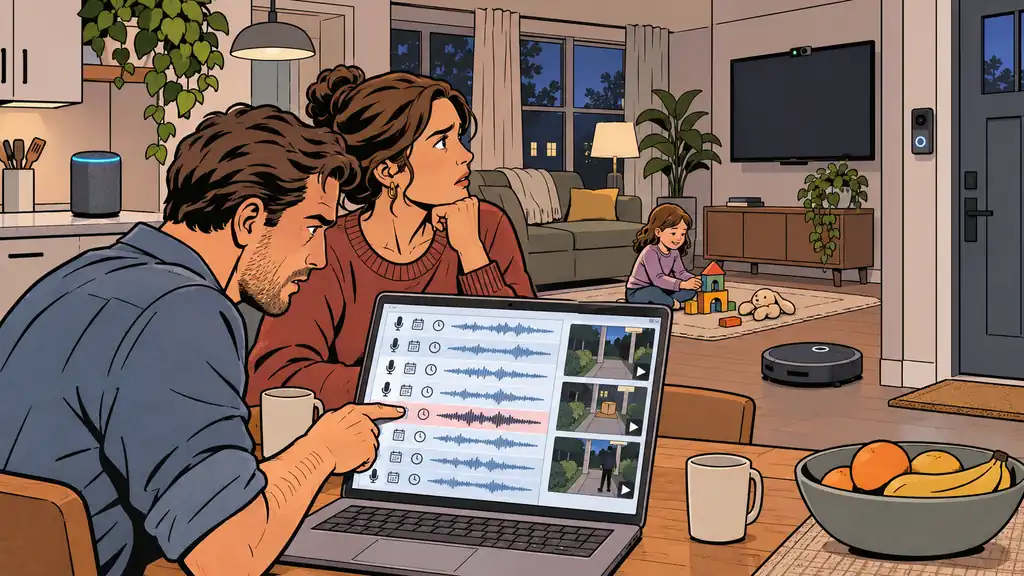
There’s a microphone on your kitchen counter, and you bought it. It listens for a wake word around the clock, and when it thinks it hears one, it records and ships audio to a company’s servers, where it can sit for a very long time. That’s not the dark reading. That’s the brochure. An Amazon Echo, a Google Nest, an Apple HomePod — the whole category — works exactly this way by design, because it has to in order to do the one trick you wanted.
I’m not here to tell you a smart speaker is secretly recording your every word and beaming it to a data center in real time. That overclaim is both wrong and lazy, and it lets you dismiss the real problem along with it. The real problem is narrower and harder to wave off: you have installed a networked sensor in your home, and the record it creates lives somewhere you don’t control — reachable by the company, by a court, and, if things go wrong, by someone who shouldn’t have it. And the speaker is only the most obvious one. The same bargain now sits in the doorbell camera at your door, the TV on your wall, and half the other “smart” devices you’ve plugged in. For a household that thinks about privacy and self-reliance the way a prepper does, that’s worth looking at squarely.
What’s actually true about how it works
Strip out the hype and here is the honest technical picture.
The device is always listening locally for its wake word, but it isn’t supposed to record and upload until it hears one. The catch is that wake-word detection is imperfect — it false-triggers on TV dialogue, a similar-sounding phrase, a snatch of conversation — and every false wake can capture and send a few seconds of audio you never meant to share. Those clips, and the transcripts made from them, land on the company’s servers and, depending on your settings and the era, can persist for a long time.
We don’t have to speculate about where that stored audio goes, because two kinds of real-world events have already shown us: criminal courts have reached for it, and a federal regulator has punished how it was kept.
The courts have already come for the recordings
Arkansas, 2015–2017. After Victor Collins was found dead in a hot tub at James Bates’ home in Bentonville, prosecutors obtained a warrant for the audio from Bates’ Amazon Echo. Amazon initially pushed back, moving to quash the warrant on First Amendment grounds before the recordings were ultimately turned over — after Bates himself consented. The murder charge was later dropped, but the precedent was set: an Echo’s data is evidence, and the state will ask for it.
New Hampshire, 2018. In the prosecution of Timothy Verrill for the stabbing deaths of Christine Sullivan and Jenna Pellegrini in Farmington, a Strafford County judge ordered Amazon to produce the Echo recordings from the days around the killings, finding probable cause that the device may have captured the attack. This time there was no consent — a court compelled it. Amazon’s position was that it won’t release customer data “without a valid and binding legal demand properly served on us.” A court order is exactly that.
Sit with the structure of these cases for a second. It isn’t that the speaker is a snitch. It’s that the speaker creates a record you don’t hold, and whether that record is produced is a decision made by a company and a judge — not by you. In a criminal case that may serve justice. The point for your own planning is simpler: a thing you own has quietly become a witness whose testimony you can’t control.
You didn’t install a convenience. You installed a record — one that a company stores, a court can compel, and you can’t unmake. The question isn’t whether it’s listening. It’s who gets to read the transcript, and when.
The company has already been caught mishandling it
The subpoenas tell you the data is reachable. A 2023 federal action tells you the company’s own handling of it couldn’t be trusted to the letter.
In May 2023 the FTC announced that Amazon would pay a $25 million civil penalty to settle charges that Alexa violated the Children’s Online Privacy Protection Act. According to the FTC, Alexa’s defaults kept children’s voice recordings and transcripts indefinitely — held, in part, to train Amazon’s voice-recognition algorithms — and when parents asked for their kids’ data to be deleted, Amazon in some cases deleted the recordings but kept the transcripts. The settlement forced Amazon to delete inactive children’s profiles and barred it from using that deleted data to improve its products. (The same day, Amazon settled a separate case over its Ring cameras for $5.8 million.)
Note what that case establishes, and what it doesn’t. It doesn’t prove anyone is listening to your dinner conversation. It does prove, in a court filing the company settled, that the default was to keep more than you’d assume, longer than you’d assume, for purposes you weren’t told about — and that deletion didn’t always mean deletion. That’s the realistic threat model: not a live eavesdropper, but a quietly accumulating archive you were trusting someone else to manage honestly.
It’s the whole house, not just the speaker
The smart speaker is the clearest case because its entire job is a microphone. But the pattern — a networked device that quietly collects more than its label implies and ships it somewhere you don’t control — now runs through the whole house, and the receipts aren’t hypothetical.
The doorbell camera. The same day the FTC fined Amazon over Alexa, it hit Amazon’s Ring with a separate $5.8 million settlement — and the allegations are uglier than the speaker’s. The FTC said that for years, every Ring employee and hundreds of outside contractors had unrestricted access to customers’ private video, and that one employee spent months in 2017 watching the feeds of at least 81 women from cameras pointed into bedrooms and bathrooms. Worse, the FTC said Ring’s lax security let outside attackers hijack cameras on roughly 910 accounts and use them to taunt and threaten the families on the other end — including children spoken to through cameras in their own bedrooms. A device you installed for security became a window strangers, and staff, could climb through.
The television. The TV has been caught twice over. In 2017 the FTC and New Jersey fined Vizio $2.2 million for secretly tracking what was watched on about 11 million of its sets — second-by-second viewing data, tied to the household’s IP address and sold to marketers, with no real consent. And it’s no longer just what you watch: in 2026 a security researcher who opened up his own Samsung set found it collecting a startling amount of data — audio, periodic screenshots of the screen, and other usage — fed to an on-device AI model for ad targeting. A screen that watches what you watch, and listens while it does.
Even the vacuum. If that still sounds abstract, consider the robot vacuum. As MIT Technology Review reported, images captured by iRobot’s Roombas — including one of a woman sitting on a toilet — ended up in private social-media groups after the gig workers hired to label the training data shared them. iRobot said those came from special pre-production units, not retail products; the uncomfortable part is that a machine mapping your floors is also taking pictures, and that humans you’ll never meet may be the ones looking at them.
And the record gets heard by people. It’s tempting to picture “the recording” as just a file in a database. But in 2019, Apple, Google, and Amazon all confirmed — after leaks and whistleblowers, not voluntarily — that they employed human contractors to listen to clips from their voice assistants to improve accuracy, including snippets people never meant to trigger. The record isn’t only stored and searchable. Sometimes a stranger is listening to it.
The uncomfortable through-line is that “smart” increasingly means instrumented. The speaker, the doorbell, the TV, the thermostat, the vacuum — each is a small networked computer with a sensor pointed at your life, and each defaults to collecting and uploading, because the data is the business model. You don’t have to refuse all of it. You do have to stop assuming any of it is passive.
What this means for a prepared household
Preparedness people already understand operational security in other domains — not broadcasting when the house is empty, not oversharing on social media, keeping the sensitive stuff off other people’s servers. An always-on sensor that writes to a cloud you don’t own is the same principle — whether it sits on the counter, the doorframe, or the wall.
You don’t have to throw the thing in a drawer. You have to decide, deliberately, what it’s allowed to be:
- Know the difference between convenience and record. The value is real — timers, lights, a weather report. The cost is a record of household audio held off-premises. Price both before you decide, room by room.
- Change the defaults; the FTC case is proof they weren’t set for you. Turn off indefinite voice-recording storage, set recordings to auto-delete, and review (and purge) your history. Treat “deleted” as “deleted from the obvious place,” not necessarily everywhere.
- Mind the sensitive rooms. A mic in the kitchen is a different decision than a mic in a bedroom, a home office where you talk business, or a room where you’d discuss anything you wouldn’t want transcribed and stored.
- Remember it’s also an attack surface. It’s a networked, microphone-equipped computer on your home Wi-Fi. Patch it, segment your network if you can, and count it among the things that can fail or be reached, not just the things that help.
- Keep what’s truly private on infrastructure you control. The opposite of a cloud mic is the stuff that never leaves your hands. (It’s the same reason our Digital Binder is built zero-knowledge — encrypted so that even we can’t read it. Different device, identical principle: if it matters, hold the keys yourself.)
The honest bottom line isn’t fear. It’s authorship. Decide what records your household creates and who can reach them — rather than letting the devices you plugged in make that decision for you by default.
Bottom Line
- The listening isn’t the scandal — the stored record is. By design, a smart device captures audio, video, or usage and ships it to a server you don’t control, where it can persist. The speaker is just the clearest case; the doorbell, the TV, and even the vacuum keep records too.
- Courts have already reached for it. Prosecutors warranted Echo data in the Arkansas Bates case, and a New Hampshire judge ordered Amazon to produce Echo recordings in a double-murder case. Your device can become a witness whose testimony you can’t control.
- The companies have already been caught mishandling it. In 2023 the FTC fined Amazon $25M over Alexa keeping kids’ recordings forever and $5.8M over Ring staff and hackers watching customers’ cameras; back in 2017 it fined Vizio for secretly tracking 11 million TVs. This is a pattern, not a one-off.
- Treat it as OPSEC, not décor. Keep the convenience if you want it, but change the defaults, respect the sensitive rooms, segment and patch the devices, and keep anything truly private on infrastructure you actually control.
Hold what matters where only you can read it — see how the Digital Binder does zero-knowledge encryption, and think through your household’s exposure on the threat framework.