


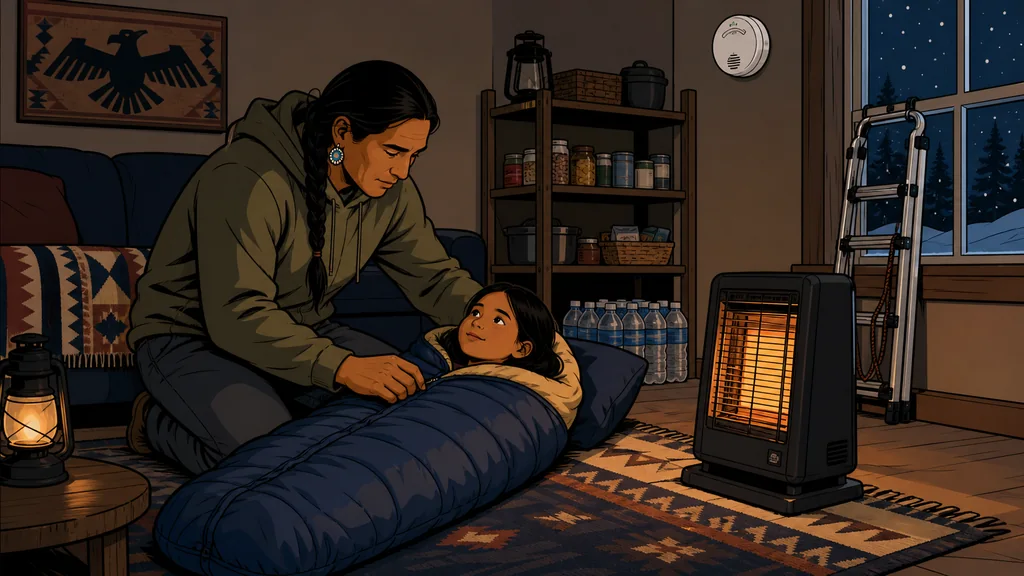
Ask someone what they’d buy first to get prepared and you’ll almost always hear “food and water.” It’s the instinct behind every pantry wall and every case of bottled water in the garage. It’s a fine instinct — and it’s aimed at the fourth-most-urgent thing on the list.
The problem is order. Survival has a hierarchy, and it’s not a matter of opinion — it’s a matter of how fast each missing thing kills you. Prep against that clock and your money goes to the right place. Prep against your gut and you end up with a year of rice and no way to stay warm through a single cold night.
The Rule of 3s
The hierarchy of human needs — commonly called the Rule of 3s — is the order in which the absence of something kills you. Roughly, a person can survive about:
- 3 minutes without oxygen
- 3 hours without shelter or heat in a hostile environment
- 3 days without water
- 3 weeks without food
These are rules of thumb, not lab constants — cold, exertion, and health move every one of them. But the ranking is what matters, and the ranking is stable. Your preparations should follow this same order.
Store for the thing that kills you in minutes and hours before the thing that kills you in weeks. Almost everyone does it backwards.
Look at where the average stockpile actually goes: food, then water, then maybe a first-aid kit. That’s the bottom half of the list, well-funded, while the top half — breathable air and staying warm — gets nothing. It feels productive because a full pantry is visible. A working plan to not freeze is not.
Reading the list top to bottom
Oxygen (3 minutes). This is the one nobody thinks of as a “prep” because we breathe for free — until we don’t. It’s the smoke in a house fire, the carbon monoxide from a generator run indoors, the drowning, the choking. The prep here is smoke and CO detectors, escape routes, an egress ladder for upstairs windows, knowing where the exits are. Take a house fire: the priority isn’t a second fire extinguisher to protect the structure — it’s getting your kids out the window alive. Oxygen beats shelter, every time.
Shelter and heat (3 hours). In real cold, exposure kills before thirst gets a vote. This is your ability to hold a survivable temperature when the furnace is off — a way to heat one room, the clothing and sleeping systems to ride out a night, a plan for a multi-day winter outage. For most of the country this is a bigger, more likely killer than any food shortage, and it’s badly under-prepped. See backup heat for the load math.
Water (3 days). Now we reach the thing people buy second. It genuinely is third — critical, urgent, and still behind air and warmth. Store to your number, then learn to source and treat more.
Food (3 weeks). The most-stored, slowest-acting item on the list. You have weeks, which is exactly why food should be built out after you can breathe, stay warm, and drink — not before.
None of this means food and water don’t matter. They matter enormously. It means they’re not the emergency — the top of the list is, and the top of the list is where most preparations are thinnest.
Bottom Line
- Prep in survival order: oxygen, shelter/heat, water, food. The list is ranked by how fast each gap kills you, not by how satisfying it is to buy.
- Fund the top first. Detectors, escape plans, and a way to stay warm outrank another month of rice. They’re cheaper, too.
- Water is third, not first. Store to your number — then keep going down the list, not back up it.
- Check your own stockpile against the ranking. If it’s all food and water, you’ve prepped the bottom half of the list and skipped the half that acts in minutes.
Turn that hierarchy into action — rate the threats you face and see which gap to close first — with Threat Planning.