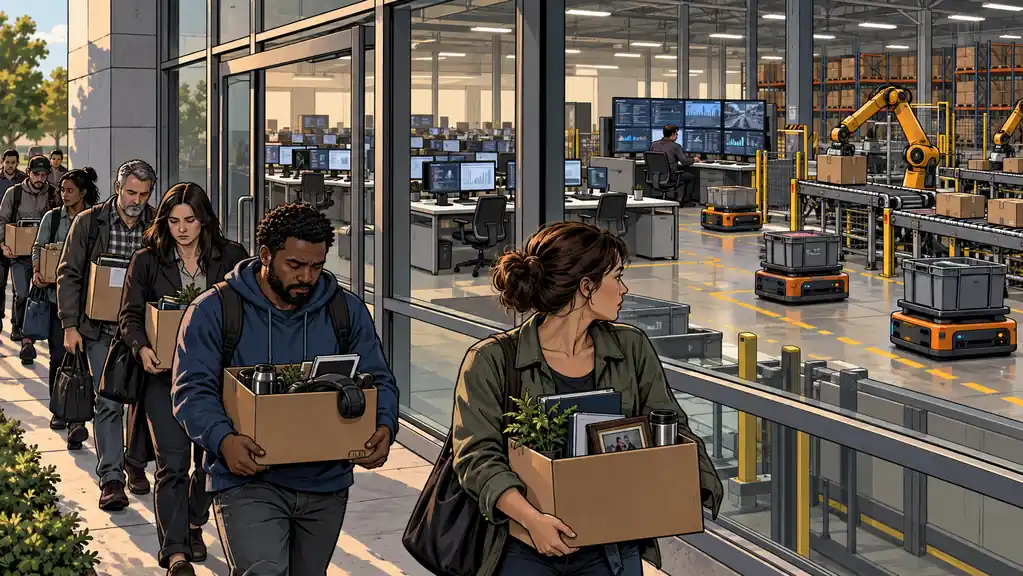
Every time a technology has wiped out an industry, a bigger one grew back in its place. The automobile ended the buggy makers, the wheelwrights, the blacksmiths, and the farriers — and in a short time it employed far more people than all of those trades combined. That pattern is real, it’s historical, and it’s why most people file AI under “disruption” and move on. The problem is that the pattern depends on a mechanism, and with AI that mechanism runs backward.
When the automobile displaced the buggy trade, the displaced labor could shift to building and maintaining cars. When AI displaces a worker, the thing that replaces them is a computer or a robot — and the work of building the next computer or robot goes to the robots too. There’s no new sector to switch into. That’s a difference in kind, not degree, and it’s why this threat earns a place on your list even if you think the science-fiction version is overblown.
This is a threat analysis, not a forecast. I can’t tell you the timeline and neither can anyone else. What I can do is separate the parts already happening from the parts that are speculation — and land on what a household actually does about it.
Why AI improves faster than past technology
For sixty years, computing has followed Moore’s Law — the observation that the number of transistors on a chip roughly doubles every two years while the cost drops. It’s not a physical law; it’s a trend that has held remarkably well. If AI were only a hardware story, that alone would mean the machines get roughly twice as capable every couple of years. That’s fast, but it’s bounded, and it’s the kind of curve we’ve learned to live with.
AI isn’t only a hardware story, and this is the part most people miss. The models are taught — you show them examples and outcomes, and they learn to connect the two, much the way you’d teach a child. And like a child who’s taught well, a model can end up “smarter” than its teacher. Here’s where it stops resembling anything we’ve dealt with before:
- Humans only have to teach the first one. Once a model is more capable than its human teachers, you use it to teach the next generation instead of a person. Each round can improve on the last without waiting on human instruction.
- You can clone it. A trained model is software and data, not a person. Make one expert model and you can copy it a hundred times, or train a hundred models on a hundred different specialties and point all of them at teaching the next generation.
- The two compound. Self-teaching plus cloning means the improvement isn’t limited by how fast a human can teach — which is the ceiling that held every prior technology in check.
As a benchmark, let’s look at “Humanity’s Last Exam.” This test is a benchmark of human knowledge and contains 2500 questions across over a hundred different subjects. All the questions are of a difficulty at or above PhD level – only true experts in a subject can answer them, and true understanding is required - using a search engine won’t help. I’ve heard estimates that the smartest people on earth might only get 5% correct due to this.
As I write this article, Claude Fable 5.1 Max has the highest score at 59.1%. If the 5% number for humans is correct, this would make it about 12x smarter than any human. For example of how fast AI is improving, about a year ago, they launched Claude Opus 4.1, which only scored 12.5%. This demonstrates a 4x increase in “intelligence” in the last year. If this trend continues, Claude should be able to score 100% on the test early next year.
The other milestone worth naming is the Turing Test — Alan Turing’s proposal that if a human, chatting by text, can’t reliably tell a machine from another human, the machine has reached human-level conversational intelligence. Recent models have reportedly passed it under certain conditions.
The economic disruption is the part already underway
Software running on a screen is one thing. AI attached to a machine that acts in the world is another, and that’s where the economic weight lands. Self-driving features and the autonomous taxi services now being tested in several U.S. cities are the visible edge of it. Pair the same capability with a robot and the right tools and it can do physical, repetitive work — assembling a product, or, less comfortably, fighting a war — more consistently than a person.
The economic ramifications are hard to size, and I don’t think it’s anything anyone can truly forecast. But the direction is already visible. In the summer of 2025, Microsoft laid off roughly 15,000 workers in what it described as an “AI-first” overhaul, part of a U.S. tech sector that shed over 177,000 workers that year. A few years ago these were exactly the jobs young people were pushed toward — best pay, best benefits, best outlook. The reversal is the signal, not the raw count.
The list of exposed roles is long, and it isn’t limited to factory floors — it reaches deep into white-collar and professional work: programmers, data analysts and scientists, design engineers, doctors, pharmacists, lab technicians, purchasing and logistics, stock traders, accountants and actuaries, corporate law and paralegals, researchers, teachers, and drivers of taxis, delivery vehicles, and semis. You won’t lose all of these at once, and some will hold longer than others. The point is the breadth.
There’s a useful precedent in the book Dark Pools: The Rise of the Machine Traders and the Rigging of the U.S. Stock Market (2013), which documents how algorithms and early AI reshaped the stock market over decades using comparatively simple math. If that’s what crude tools did to one industry, it’s reasonable to ask what today’s systems do to the rest.
There will be some jobs that will remain firmly with humans. But, I fear that they will be much fewer than most of us realize at this time. AI safety expert Dr. Roman Yampolskiy claims that there will be almost no human jobs left by 2035. At this point, he’s treated as the “fringe”, but he might not be.
From a timing standpoint, I do believe that the impact won’t be as rapid as many people believe. I say that because of two main factors that I’m seeing:
- Bubble — It’s looking more and more likely that we’re in an AI “bubble” that’s similar to the “Dot Com” bubble from around the year 2000. If I’m right, and this bubble “pops”, it will have a slowing effect on the implementation of AI in the same way it slowed internet development for a period of time.
- Implementation — Replacing people with AI is a job unto itself and takes time. There are only so many people to implement these changes, so that factor will limit the overall implementation rate to some degree. I’ve implemented automation in manufacturing for most of my career, so I’m familiar with what it takes. Over the last year, I’ve been using AI with cameras quite a bit to try and detect quality defects and safety issues and both have been extremely slow to get working at a satisfactory level. There have been drastic improvements in speed and quality over the last year, but it’s still a time consuming process.
I want to note that the slow implementation may cause the AI “bubble” to pop. If it does, it’s likely it will create a recession like we saw with the last two “bubbles” (2000 and 2008), so that’s worth noting unto itself.
The economic counter-argument
It would be intellectual dishonest if I didn’t also address the counter-arguments that are being made. While AI is unique in many ways, computers aren’t new and there are historical examples to evaluate.
In January 1965, Newsweek published a famous cover story titled The Challenge of Automation. In this article, it examined the economic anxiety that surrounded the adoption of mainframe computers and automation within business. This article cited elevator operators and other examples of the disruption caused by computers and automation in the day, claiming that roughly 35,000 jobs per week were being lost. At the time, many were convinced that mainframes would eliminate accountants, actuaries and countless other professions. This obviously didn’t come to pass.
The early 1980’s saw a similar fear with the proliferation of the desktop computer. Many feared that these new computing devices would allow one person to do the work of 50, eliminating countless clerical and secretarial jobs. This actually did come to pass. While executives still have administrative assistants today, the secretarial pools and other clerical jobs have essentially been eliminated. While those jobs were eliminated, the jobs created by the technology greatly offset the losses.
Some are saying that AI will be similar - yes, it will be disruptive, but ultimately the new industries and opportunities will outpace the jobs eliminated.
My observations
I’ve been using AI quite a bit over the last year. As I mentioned above, I’ve been using it at work on vision systems for quality and safety detection and the technology is still pretty rough. It’s getting better by the day and I’ve seen tremendous gains over the last 3 years. As a result, I believe it’s going to be extremely capable inside the next few years, enabling it to replicate the visual inspection tasks that currently require humans.
I’ve been designing and implementing automation for over 25 years. The process for AI implementation at this point is actually slower than other automation. Most of the reason is because it’s no new and immature from a technology standpoint - there’s still a big learning curve. Again, this gets better every day, but this is definitely an area that I feel many of the “experts” are missing. No matter how advanced the AI, there will still be people involved in the implementation for any physical task and these engineers will be the speed bottleneck for the foreseeable future (job security for me).
My last datapoint is this website. I’m a pretty good programmer and know more than a dozen programming languages across a variety of disciplines, including web development. Regardless, I can safely say that without AI, this website would not exist. While I could have built it on my own, the speed at which I can develop using AI has saved me thousands of hours in development time. This is the thing that gives me the greatest pause as I’ve seen an AI do things in a few minutes that would take me a week or more to complete on my own. This kind of acceleration of development and compounding of resources will definitely lead to disruption in areas that don’t have a physical component (purely digital like a website, research, accounting, etc.).
The speculative tail — reasoned, but unproven
Once we move past the economic ramifications, we need to examine the effects to other sectors of society. The following is a list of “could happen”, not “will happen”, but they are worth consideration so I’m including them here:
- Universal basic income (UBI). If AI and robots displace enough work, some argue the government will have to pay people simply to exist, because there won’t be enough jobs. I believe UBI would become necessary in that scenario. To be clear, I don’t endorse this option, but I feel it’s likely if AI is as disruptive as some claim. If UBI were implemented, the economic and societal ramifications will be massive.
- The “singularity.” Futurist Ray Kurzweil has long predicted the point where machine intelligence surpasses all of humanity’s combined, and places it around 2045 — a mainstream-enough marker to note, whether or not that date holds.
- Man-machine integration. Companies like Neuralink are working to link the brain directly to machines. The upside is real — restoring sight, hearing, and limb control. The downside is worth considering: a device that can read your mind rather than just hear what you say is a privacy and security problem with no precedent, and “what happens if it gets hacked, or you stop paying the subscription” is not a rhetorical question.
- Military autonomy and subjugation. The war in Ukraine has shown how fast drone warfare evolves. Once one military lets AI target, and then run, its operations, every other military has to follow suit or fall behind. Handing that much capability to a superintelligent system is a short step from that system using it against people.
The reason to include the tail at all isn’t to predict it. It’s the same logic that governs every major threat: low-probability events with severe-enough impact still earn a spot on the list. You rate them later; you don’t dismiss them now.
What a household actually does about it
Here’s the honest part: you cannot prep your way out of a civilization-scale transition with a pantry. What you can do is prepare for the version of this threat that is already arriving and is squarely within your control — the economic one.
The AI story and the job-loss story are the same story told at different speeds. A layoff is an income shock you expect to recover from. The AI scenario is the same shock with a slower — possibly no — recovery, because the role may not come back and the “switch to a new field” escape hatch may be narrower than it’s ever been. That changes the math in one direction: more runway, and more durable skills.
- Extend the runway. Cash buffer measured in months, not weeks. The lower your fixed costs, the longer any buffer lasts — the same lesson that carries a household through a layoff carries it through a structural one.
- Own skills that are hard to automate and easy to barter. The trades, hands-on repair, growing food, medical basics, and anything that requires physical presence and judgment age better against this threat than a screen-bound task does.
- Build income that doesn’t depend on a single employer or a single automatable role. Redundancy in how money comes in lowers both the likelihood and the impact of the hit.
- Watch the indicators, then rate it. Layoff waves in your field, automation reaching your specific tasks, and the pace of model capability are the signals to track. Feed what you see into your own threat planning so this gets the weight it deserves relative to everything else on your list — no more, no less.
Every prior technology gave the displaced somewhere to go. The prudent bet isn’t that AI will be the exception — it’s to build the runway and the skills that keep your household standing whether it is or not.
Bottom Line
- The “technology always creates more jobs” pattern depends on the displaced having somewhere to switch — and AI’s mechanics may remove the somewhere. Treat it as a possible break in the pattern, not a guaranteed repeat of it.
- The economic disruption is already underway and is the part you can act on — the science-fiction tail is worth listing but not worth planning your week around.
- Prepare for it like a job loss that might not reverse: deeper cash runway, lower fixed costs, hard-to-automate and barterable skills, and income that isn’t tied to one automatable role.
- Track the real indicators and rate the threat honestly — put it on the list, watch it, and give it its proper share of your attention instead of dismissing it or panicking over it.
Turn this into your household’s number with the threat planning tool, and read Job loss is an emergency for the runway math that applies whether the paycheck disappears for six months or for good.