


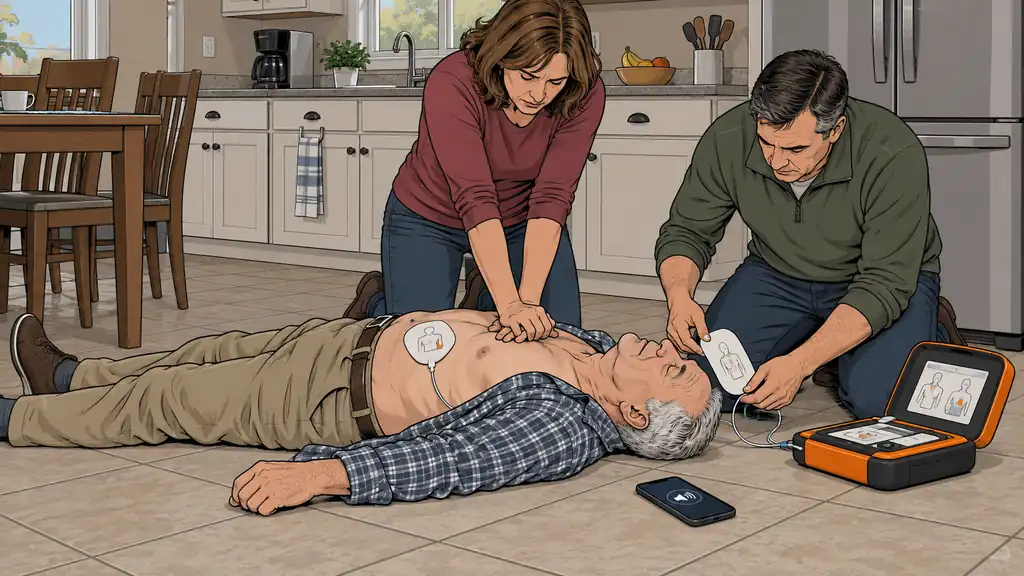
Ask a prepper to rank their threats and they usually start with the dramatic ones: grid-down, natural disaster, civil unrest. Weigh how hard each one would actually hit, and the ranking flips. The threat that can do the gravest damage the fastest isn’t any of those. It’s the medical emergency — the fall, the cardiac event, the severe allergic reaction, the diabetic crisis, the arterial bleed.
It scores a moderate likelihood because it can strike any household. It scores at the very top for impact because it can kill in minutes. A real chance of the most lethal outcome on the list is why this one earns your attention before the exotic scenarios do. If you already keep a bug-out bag and a water supply, you’ve accepted the logic of preparedness. This just points that logic at the emergency that can hurt you the worst.
The clock is the whole problem
Emergency medicine runs on time windows, and they’re short. Uncontrolled arterial bleeding can be fatal in single-digit minutes. Brain cells start dying within minutes of the heart stopping — which is why the American Heart Association estimates cardiac-arrest survival falls by roughly 7 to 10 percent for every minute that passes without CPR and defibrillation. A blocked airway is the same story: minutes.
Now put that next to how long professional help takes to reach you. Published NEMSIS data puts the median EMS response at about 6 minutes in urban areas but roughly 13 minutes in rural ones, and the rural 90th percentile reaches 26 minutes. Do the subtraction. A bleed that kills in 5 minutes against a rural ambulance that averages 13 leaves an 8-minute gap that nobody in a uniform is going to fill. That gap belongs to whoever’s already in the room. That person is you.
That’s the reframe: the interventions that save the fastest-killing emergencies have to happen before the ambulance arrives. So preparedness here isn’t about owning a hospital. It’s about shrinking your own response time and raising your own capability inside that gap.
What the record shows
You don’t need invented numbers to see the pattern — the public-health data does the work. Heart disease is the number-one cause of death in the United States (about 681,000 deaths in 2023, per CDC), and unintentional injury ranks third (about 222,000). Falls are the leading cause of injury for adults 65 and older, and the CDC reports that about 1 in 4 older adults falls each year. Motor-vehicle crashes, kitchen and workshop injuries, severe allergic reactions, and diabetic and seizure emergencies fill emergency departments every day.
Two lessons come out of that record over and over. First, bystander action changes the outcome. The AHA counts roughly 350,000 out-of-hospital cardiac arrests a year in the US, with overall survival under 10 percent — yet immediate bystander CPR can double or triple the odds. Second, the failures aren’t exotic. They’re mundane: no kit, no training, no plan, the wrong information given to the dispatcher, minutes lost to confusion. The threat is real because the causes are common, and the tragedies are common because the gaps are common. Those gaps are the part you can close.
How likely — and for whom
On our scale this rates a moderate likelihood — a real, live possibility rather than a distant one. Over a span of years, a household of several people — driving, cooking, aging — has a genuine chance of meeting at least one serious medical emergency. The question is whether you’ll be ready when it comes.
The risk isn’t spread evenly. It concentrates around known risk factors: age, existing heart and vascular disease, diabetes, severe allergies, seizure disorders, and jobs or hobbies that involve tools, heights, water, or vehicles. If your household includes any of those, your personal odds are higher and your prep should be tighter and more specific to them.
Kids increase the odds
Maybe my boys are more active than others, but we’ve had multiple emergency medical events over the years. My oldest son learned that gloves and monkey bars aren’t a good combination and broke both bones in one arm. A couple years later, my youngest fell from a different set of monkey bars and suffered a skull fracture and severe concussion (what is it with them and monkey bars?). For both, we rendered first aid and got them to proper medical care promptly, so it turned into a hospital bill and nothing more serious. But the key there was that we knew what to do, so that we could in the moment.
But cutting wood is much worse
I thankfully have never been injured seriously while cutting wood, but I know of several people that have been. I know more than one person that’s had a tree fall on them, one that got a bad cut from the chainsaw when it kicked back, and one that was permanently injured when a limb fell from the tree he was cutting down and hit him in the head. These are just the ones I can think of in 30 seconds - I’m sure I know of more I’m not even remembering. The point is that hazards exist and injuries are much more common than many believe they are.
The mistakes people make
- Buying a kit and calling it done. A kit with no training is a comfort object. Under pressure, you don’t rise to the occasion — you fall to your level of practice.
- Boo-boo kits instead of trauma kits. A drugstore box of bandages does nothing for the bleed, the airway, or the arrest that are what actually kill fast.
- One kit, one location. The emergency happens in the car, or the yard, or on a trip — and the kit’s in a closet at home. A kit you can’t reach in the moment isn’t a kit.
- Training once and never again. Certification is not capability. Skills decay, and a two-year card says nothing about whether your hands still know the sequence today.
- No information ready. The patient can’t speak, and nobody can tell the paramedic what meds they take or what they’re allergic to. Minutes and safety lost to a blank.
Building real capability
Think in four layers: skills, supplies, information, and access.
Skills — the layer that matters most. Take a hands-on first-aid and CPR/AED course as a household, not a video you half-watch. You want to be able to control external bleeding with direct pressure and a tourniquet, do CPR, use an AED, clear a choking airway, recognize the signs of stroke and heart attack, and handle your own family’s specific conditions (an epinephrine auto-injector for anaphylaxis, glucose for a low, a seizure plan). Then refresh it. The research is clear that CPR and first-aid hands-on skills begin measurably decaying within 3 to 6 months of training — well before the standard two-year certification renewal — so brief practice in between is what keeps the skill real.
Supplies — trauma-first, not boo-boo-first. Upgrade from a bandage box to a real trauma kit: a commercial tourniquet, hemostatic or plain gauze for wound packing, a pressure bandage, gloves, trauma shears, tape, and a CPR barrier. Then add the everyday layer (wound care, OTC meds, blister and burn care) and the personal layer (your family’s prescriptions and rescue meds, kept current). Stage it: one comprehensive kit at home, a compact trauma kit in each vehicle, and a small carry kit for trips.
Information — the cheap, overlooked layer. Keep a current one-page medical sheet for each family member: conditions, medications and doses, allergies, blood type if known, and emergency contacts. In a crisis, someone else may have to speak for the patient. Let the sheet do it.
Access — plan the route before you need it. Know your nearest emergency room and the nearest one that handles trauma or cardiac cases, and the fastest route to each. Post emergency numbers where a sitter or guest can find them. If you’re rural, know your realistic response times and whether an air ambulance serves your area — because that 13-minute median (and 26-minute tail) is exactly how far into the danger window you’re on your own.
Measure all of it in capability and time, not spend. The test: can any adult in the house stop a bleed, run CPR, use the AED, and get the patient moving toward definitive care — without hunting for supplies or information? That’s the metric.
Bottom Line
- A real chance of the most lethal outcome makes the medical emergency one of the highest-priority threats a household faces. Rank it accordingly.
- The lethal interventions live in the minutes before EMS arrives — so your own response time and skill are the deciding variables.
- Skills first. Hands-on first aid, CPR, AED, and bleeding control — because supplies without training don’t save anyone.
- Carry a real trauma kit, staged at home, in each vehicle, and for travel, backed by a current per-person medical sheet.
- Pre-plan access: nearest appropriate hospital, fastest route, realistic EMS times, posted numbers.
An ambulance is minutes away. So is the outcome. Preparedness for a medical emergency is simply the decision to be useful in the gap between the two.
Keep every family member’s conditions, medications, allergies, and emergency contacts current and at hand in the Digital Binder.