


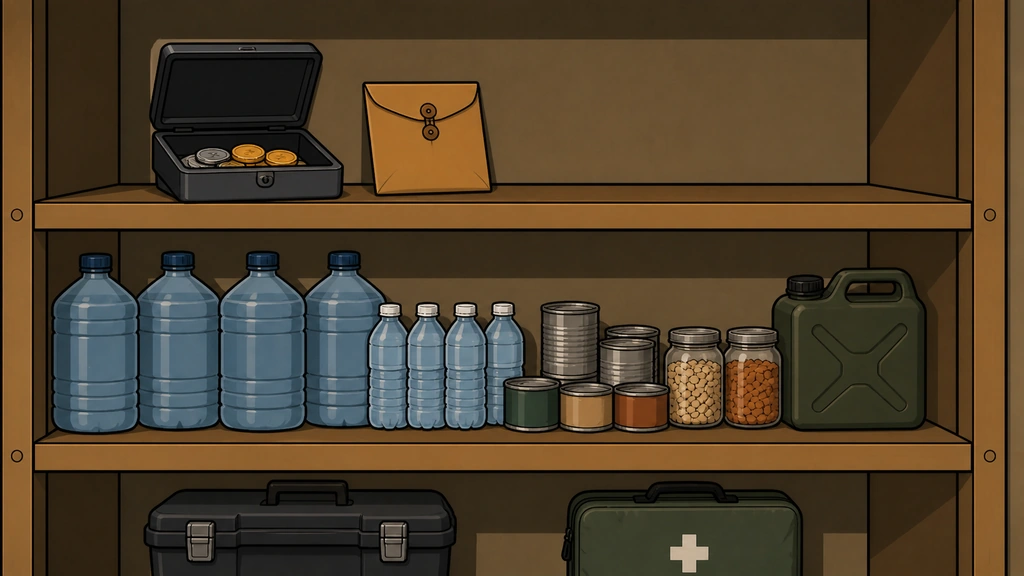
Spend an afternoon in prepper corners of the internet and you’ll come away convinced that stacking silver and gold is the financial center of gravity of being prepared. It’s a compelling story — paper money dies, the shiny stuff endures, the person with a coffee can of coins rules the wasteland. It’s also backwards. Metals aren’t the plan. They’re the insurance you buy after the plan is funded.
Here’s the tell: in almost every emergency a household actually faces — a layoff, a storm, a supply crunch, a medical bill — you cannot spend gold. You can spend cash, and you can consume food, water, and fuel. Precious metals only matter in one specific, slow, later scenario: a prolonged currency crisis that erodes the value of the dollars you’re holding. That scenario is real, but it’s the last problem you’ll have, not the first.
The asset ladder, in the order you’ll use it
Preparedness assets aren’t interchangeable. They pay out on different timelines, and a smart stack fills them bottom-up:
- Consumables — food, water, fuel, medicine. The assets you draw down in week one. Nothing above this rung matters if this one is empty.
- Cash buffer — physical and accessible, the universal prep that turns most emergencies into errands.
- Skills and tangible goods — tools, spares, the ability to fix and produce. These hold value in any economy because they do something.
- Hard assets / metals — the inflation hedge. This rung protects the value of your surplus once the first three are full. It does not feed you, warm you, or pay a bill next Tuesday.
Gold doesn’t keep you alive in the emergency. It keeps your savings alive through the emergency — a very different, and much later, job.
Buying rung four before rung one is the classic mistake: a stack of silver in a house with two weeks of food. When the likely crisis comes, you’re melting-rich and dinner-poor.
But I’ll just use my metals to buy what I need…
“But I’ll just use my metals to buy what I need,” is the typical rebuttal. Let’s think this through for a minute with a scenario. Let’s say we’ve had whatever major disaster you’re preparing for - it’s here. You need food and you find someone that has food. You offer them a silver coin for some. They refuse. You offer a gold coin instead. They still refuse. You offer them all your gold coins, and they still refuse. Before you say, “that will never happen,” let’s think this through.
“Why would someone say no?” isn’t the correct question. The real question is, “why would they say yes?”
In this theoretical scenario, it’s clear that supplies are scarce. If someone comes up to you wanting something you have, you might trade if you’re getting something in trade that you need. Precious metals aren’t a need - it’s not something you eat, wear, shoot, or burn. As a result, people will turn down a million ounces of gold if taking it meant their child went hungry. In this scenario, food just became more valuable than gold.
What metals are actually for
Used correctly, metals do one thing well: preserve purchasing power against a devaluing currency. History gives us the case studies — Weimar Germany, Zimbabwe, Venezuela — where the money became toilet paper and hard assets held their worth. If you judge a long, slow inflation or a currency restructuring to be a real threat for your household, a hedge makes sense. The currency doesn’t have to fail completely to make holding some value outside of dollars prudent.
But size it as insurance, not as a portfolio:
- It’s a hedge on your surplus, not your survival stack. Fund the consumables, the cash, and the skills first. Metals are for what’s left over.
- Divisibility matters. A one-ounce gold coin is a terrible way to buy a week of groceries. Smaller denominations and silver are far more usable if it ever comes to real transactions.
- It’s for the slow crisis, not the fast one. In a hurricane or a layoff, you’ll reach for cash and stored supplies every time.
Bottom Line
- Metals are rung four, not rung one. Consumables, cash, then skills come first — every time.
- They preserve value; they don’t sustain life. Gold protects your savings through a currency crisis. It doesn’t feed you during a storm.
- If you hold them, hold usable forms. Smaller and divisible beats one big shiny coin you can’t make change for.
Before you buy an ounce of anything, make sure the base is real: size your household’s food and water in the Food & Water planner and fill rung one first.