


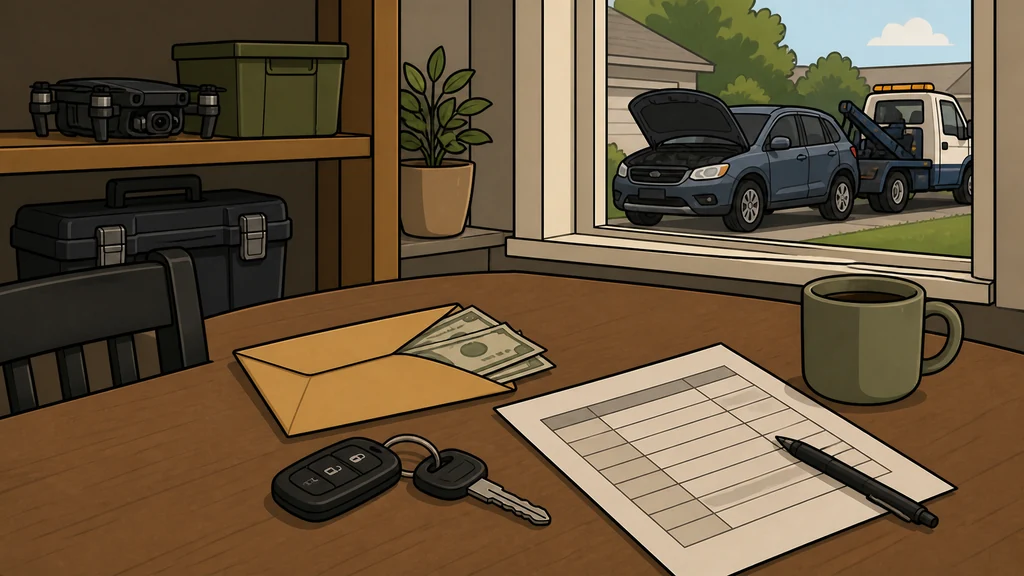
Preparedness is easy to see when it’s a wall of buckets or a rack of gear. So that’s what most people buy. The prep that actually catches the most probable emergency your household will ever face is invisible: it’s a cash buffer, sitting in a boring account, doing nothing — right up until the day it does everything.
Gear is a fine place to spend money — and a terrible place to stop. A month’s worth of runway in the bank protects you against layoffs, medical bills, a dead transmission, and a hundred other setbacks that no amount of stored rice can pay the mortgage through. Gear solves one scenario. Cash is the universal prep — it converts almost any emergency into an errand.
Size it in time, not dollars
The standard advice is usually $1,000 or $5,000 cash on hand. That’s a useless target, because it’s measured in the wrong unit. The real question isn’t how much do I have — it’s how long does it last:
Runway = cash buffer ÷ monthly burn rate.
Your burn rate is your true monthly floor: housing, food, utilities, insurance, minimum debt payments — the number you can’t go below without something breaking. Divide your buffer by that and you get your answer in the only unit that matters: weeks and months of survival with zero income. Two weeks is a start. One month turns a catastrophe into an inconvenience. Three-plus is real resilience.
Money is a supply like any other, and supplies are measured in time. Not “I have $6,000” — “I have four months.”
Tier it by how fast you can reach it
A buffer you can’t get to when you need it isn’t a buffer. Think in layers, from instant to slow:
- Physical cash at home — a few hundred to a couple weeks’ floor, in small bills. This is the layer that survives a grid-down, a bank outage, or a card network going dark. When the power’s out, the card reader is a brick and the ATM is a box on a wall. This cash lets you buy stuff at the store when few others can.
- Checking / instant-access savings — the working layer. Same-day, no penalty, this is what you actually spend from in the first weeks.
- Short-term savings — a high-yield or money-market account you can pull from in a day or two. The bulk of the runway lives here, earning a little instead of nothing.
Notice what’s not on this list: your 401(k), your home equity, the truck you’d have to sell. Those are net worth, not runway. In a fast emergency they’re slow, penalized, or gone below market — the opposite of what a buffer is for.
Why some of it has to be paper
The digital layers assume the system is up. Most of the time it is. But a real prepper plans for the tail: a multi-day outage, a bank holiday, a cyber event that freezes card networks for a weekend. In every one of those, the person with a few hundred dollars in twenties keeps buying gas and groceries while everyone else stares at a “declined” screen.
You don’t need a safe full of cash. You need enough small bills to buy essentials for the days it takes the digital world to come back — kept somewhere fire-resistant, discreet, and known to the people who’d need it.
I learned my lesson years ago when I pulled up to a gas station late at night with my truck on empty and their card reader wouldn’t work. I only had a little cash on me, and it was thankfully enough to get me a few miles down the road to a station with a working card machine. But this near miss taught me to always carry cash, because you never know when you’ll need it.
Bottom Line
- Cash is the universal prep. It catches the most likely emergencies you’ll face, and it does it without knowing which one showed up.
- Measure it in time. Buffer ÷ burn rate = runway. Report your readiness in months, not dollars.
- Tier it by speed. Physical cash, instant savings, short-term savings. Retirement and equity are net worth, not runway.
- Keep a paper layer. When the grid or the banks blink, small bills are the only prep that still spends.
Turn it into a target you can hit: set your runway goal in months, and record where every layer lives in your Digital Binder so your household can find it without you.