


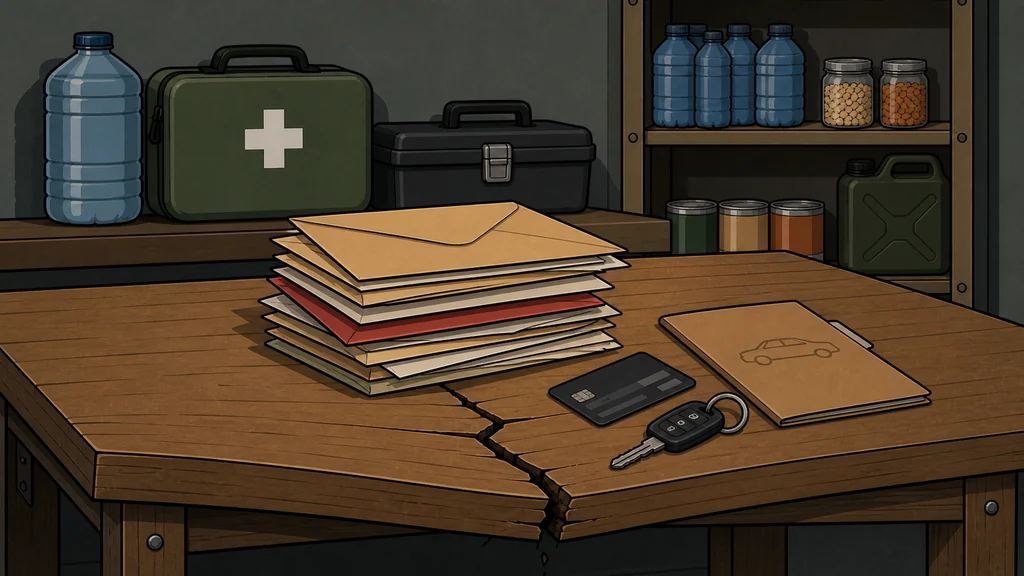
Ask a prepper about their weak points and they’ll talk about the pantry gap, the water number, the hole in their medical kit. They almost never name the biggest one, because it doesn’t sit on a shelf. It’s the stack of fixed monthly payments that has to be fed whether or not the paychecks keep coming.
Debt isn’t just a money problem. It’s a fragility problem — the engineering kind. A fragile system is one that fails hard from a small shock. Two households can look identical: same house, same cars, same income. Load one with car payments, credit-card minimums, and buy-now-pay-later, and a single lost paycheck cracks it. The other bends and holds. Same shock, opposite outcome. The difference is the debt.
Debt raises both Likelihood and Impact
If you’ve run the threat-rating math, you know a threat’s weight is Likelihood times Impact. Debt is unusual: it pushes both up at once.
- It raises Impact because every dollar of required payment is a dollar your emergency has to cover before it buys a single calorie. Your monthly floor — the number you must hit to keep the lights on and the keys to the house — rises with every obligation.
- It raises Likelihood because debt shortens the fuse on every other threat. A job loss, a medical bill, a busted transmission, a rate hike — any one of them tips a leveraged household into crisis far sooner than a paid-off one.
Preparedness is measured in time — how long you last when income stops. Debt doesn’t just shrink your runway. It burns fuel while you’re standing still.
”Gradually, then suddenly”
In The Sun Also Rises, a character is asked how he went bankrupt. His answer: “Gradually, then suddenly.” The debt builds quietly for years and feels manageable right up until the month a single payment gets missed. Then the snowball starts: a late fee, a rate hike, a ding on the credit score, a second missed payment. The collapse looks sudden, but the fragility was there the whole time.
The preparedness lesson is that you don’t get to choose the shock, only whether you’re brittle when it lands. You can’t schedule the layoff or the diagnosis. You can decide, in the calm years beforehand, how many mandatory payments will be standing between you and stability when it hits.
Not all debt is the same shape
This isn’t a sermon about cutting up every card. Debt is a tool, and some of it buys real resilience — a modest, affordable mortgage on a place you can shelter in is not the same liability as three financed vehicles. Rank yours by how much fragility each piece adds:
- The floor-raisers — car payments, personal loans, financed toys, revolving credit-card balances. These are pure fixed cost with no resilience in return. Every one you kill lowers your monthly floor permanently.
- The high-interest traps — anything compounding against you fast enough that the balance grows while you sleep. In a real income gap these are the first to snowball.
- The structural debt — an affordable mortgage on your primary shelter. Still a payment, still a risk if the runway runs dry, but it’s buying you the roof itself. Treat it as a floor to minimize over time, not an emergency.
Every fixed payment you retire does something no gadget can: it lowers the number you have to survive on, for the rest of your life, in every future emergency at once. That’s why paying down a card can out-prep buying another month of freeze-dried food — it stretches the runway on everything you’ve already stored.
I lived through this with an unexpected job loss. What should have been a month turned into 18. If I hadn’t put major effort into reducing debt beforehand, what was a difficult situation would have become something much, much worse - not just for me, but for my entire family.
Bottom Line
- Debt is fragility, not just cost. It decides whether a small shock bends your household or breaks it.
- It raises Likelihood and Impact together. Fewer mandatory payments means a longer fuse and a smaller crisis.
- Kill floor-raisers first, traps fastest. Retiring a payment lowers your survival number permanently — in every future emergency, not just this one.
- Do it in the calm. You can’t schedule the shock. You can decide now how brittle you’ll be when it comes.
Make it concrete: set a debt-payoff goal with a real number and a date, and watch your monthly survival floor drop as you hit it.