


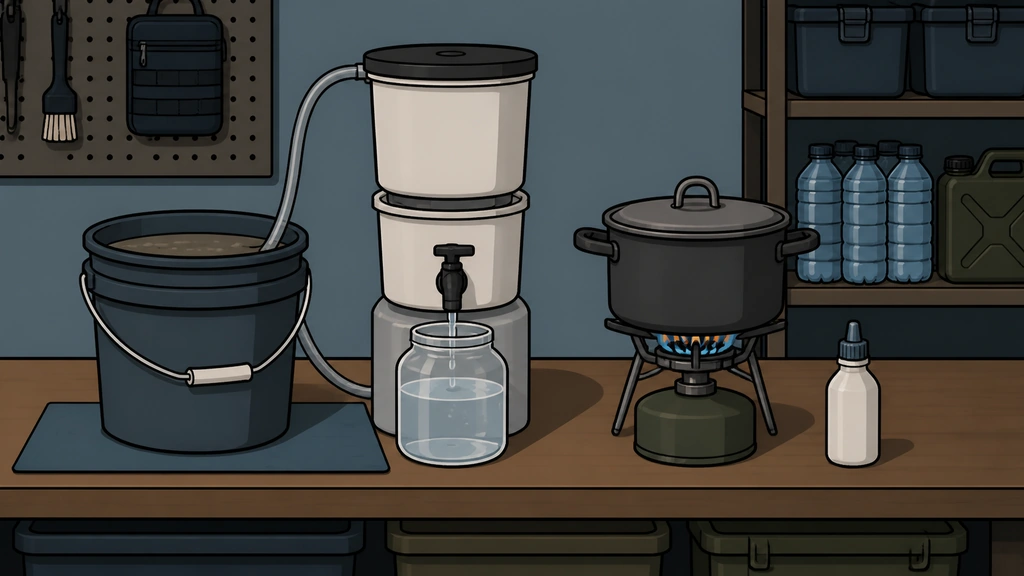
“I ran it through my filter, so it’s safe” is one of the most common — and most dangerous — assumptions in preparedness. Filtering and purifying are two different jobs, and confusing them is how careful people end up sick on water they thought was clean.
The distinction is simple once you see it. A filter works by physical size. Purifying kills what’s alive. Some threats are too small for the first and only die to the second.
What a filter does — and the gap it leaves
A good filter is a mechanical sieve. Push water through a fine enough pore and it strains out:
- Sediment — the mud, grit, and cloudiness.
- Protozoa — Giardia and Cryptosporidium, the classic “beaver fever” of untreated backcountry water. These are relatively large and a quality filter stops them cold.
- Most bacteria — also large enough for a good filter to catch.
Here’s the gap: viruses are far smaller than a standard filter’s pores. Hepatitis A, norovirus, rotavirus — a typical hollow-fiber or ceramic filter that crushes protozoa will pass viruses straight through, unless it’s specifically rated for them (few backpacking filters are).
A filter clears the water and stops the bugs that cause the classic backcountry illness. It does not, on its own, make virus-contaminated water safe.
In clean North American backcountry, viruses are a lower risk and a good filter alone is often enough. After flooding, sewage contamination, or anywhere overseas, treat viruses as present — which means filtering is step one, not the finish line.
What purifying does
Purifying kills or inactivates the living contaminants — including the viruses a filter misses. The common methods:
- Boiling — the most reliable there is. A rolling boil for 1 minute (3 minutes above ~6,500 ft) kills bacteria, viruses, and protozoa alike. It does not remove sediment, chemicals, or salt — filter cloudy water first.
- Chemical — plain, unscented household bleach (5–6% sodium hypochlorite), correctly dosed, or purification tablets. Effective against most pathogens; Crypto is the stubborn exception for some chemicals.
- UV — a pen-style UV light inactivates pathogens in clear water; useless in cloudy water it can’t penetrate.
The full method-by-method dosing lives in the water purification reference, including what to do about the one thing none of these fix — chemical or radioactive contamination, which needs special filtering (activated carbon, distillation, reverse osmosis), not disinfection.
The rule that ties it together
For any water you didn’t store yourself: filter to clear it, then purify to kill what’s left. The two are a pair, not a choice.
If you’re not certain it’s safe, treat it. Unknown source, after an advisory or a flood, cloudy, off-smelling, or past its rotation date — when in doubt, filter and purify.
Bottom Line
- Filter ≠ safe. A filter removes sediment, protozoa, and most bacteria — but not viruses, unless it’s rated for them.
- Purify to close the gap. Boiling, correctly-dosed bleach, or UV kills what the filter passes.
- Do both on found water. Filter to clear it, then purify to make it safe — especially after floods or sewage.
- Neither fixes chemicals or radiation. That needs carbon, distillation, or reverse osmosis — a different problem entirely.
Build your treatment plan around the water sources near you — map them in Area Recon and size your daily need with the Food & Water planner.