


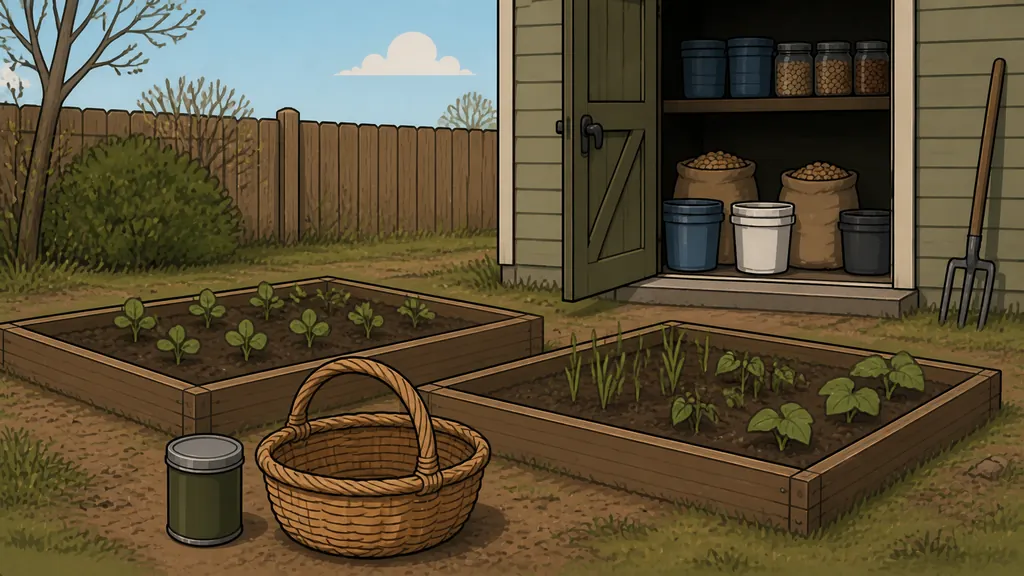
A tin of survival seeds is one of the most reassuring things you can buy and one of the most misleading. It looks like a food supply you can deploy the moment the stores empty. It isn’t. It’s a bet that you’ll have the soil, the skill, the water, the season, and the time to turn seeds into calories — and the emergency that empties the stores is exactly when you have the least of all four.
Growing food isn’t a switch you flip in a crisis. It’s a skill you either already have or you don’t, and the learning curve is measured in years, not days.
The garden that feeds you isn’t the garden on the seed rack
Walk a garden center and you’ll be sold tomatoes, lettuce, peppers, herbs — the fun stuff. It’s delicious and it’s nearly worthless as survival food, because it’s mostly water. You cannot eat enough salad to hold your weight.
What actually feeds a person is calorie-dense staples: potatoes, corn, dry beans, winter squash, sweet potatoes. They’re boring, they store, and they return real calories per square foot.
A survival garden is a calorie operation, not a variety operation. If a crop won’t return meaningful calories per square foot, it’s a garnish, not a food supply.
The calorie-yield table shows the gap plainly — how many calories 100 square feet of each crop actually returns. Do that math against a person’s ~2,000-a-day need and the scale of a real food garden becomes clear fast: it’s measured in thousands of square feet, not a raised bed or two.
Skill and soil are the slow parts
Seeds are cheap. The things seeds need are not, and none of them can be bought in a hurry:
- Soil — living, fertile soil takes years to build. A first-year garden in poor ground underperforms badly, right when you need it most.
- Skill — every region, every crop, every pest is a lesson you pay for with a failed season. The gardener who’s grown food for ten years and the one who cracked the seed tin last week are not remotely the same.
- Water — a garden is thirsty, and it’s thirsty in the exact drought-and-grid-down scenarios where water is already tight. Plan the garden and the water together or neither works.
- Time to maturity — even in a perfect season, most staples are months from seed to harvest. Nothing you plant the week the crisis hits feeds you that same month.
Emergencies aren’t on your schedule
The other factor that must be discussed is timing. What happens if disaster strikes in the fall? Realistically, you’re looking at 6-9 months before you can get produce out of a garden, assuming all the above considerations. This means even if you can garden self-sufficiently, you must have enough food storage to carry you until you can rely on it. And hopefully enough to hold you if you have a drought or other issue that first year that reduced your yield.
So what’s it actually for?
Not year one — year two and beyond. Gardening is how you replenish, the same way sourcing replenishes your water: stored food carries you through the acute event, and food you can grow is what turns a supply into sustainability. The move is to start now, while mistakes are cheap and the grocery store is still there to cover them.
Start the garden while failure just means a smaller harvest — not while it means going hungry.
Bottom Line
- A seed bank is not a food plan. It’s an option that only pays off with skill, soil, water, and time you have to build in advance.
- Grow calories, not salad. Potatoes, corn, beans, squash, sweet potatoes — the boring staples are the ones that feed you.
- It’s a year-two solution. Stored food covers the acute crisis; a garden is how you keep eating after it.
- Practice now. Every skill and every square foot of good soil is bought one season at a time — start before you need it.
Plan a garden sized to real calories with the Garden Planner — it turns your crops and plant counts into yields, bed space, and a planting calendar for your frost dates.