


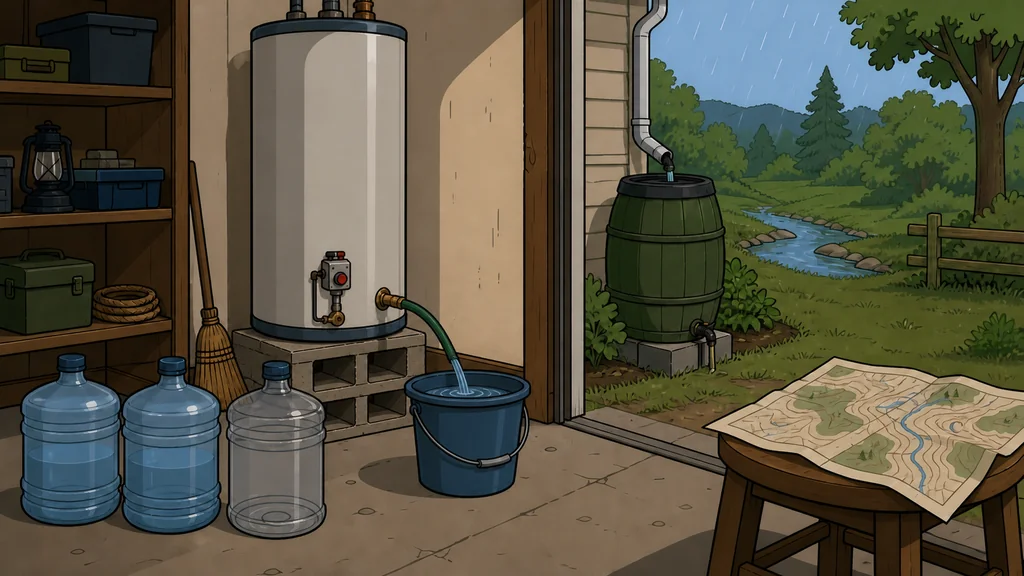
Stored water is the easiest prep there is. Fill food-grade containers, keep them cool and dark, rotate them, done. If you’ve run the math you know your number, and a couple weekends gets you a two-week supply.
The trouble is that stored water is a fixed amount that only goes down. It’s a bridge, not a well. The real skill — the thing that separates a two-week supply from an open-ended one — is knowing where the next gallon comes from when the tap is dry. And most of that knowledge has to exist before the emergency, because you won’t be researching well depths by flashlight.
Your house already holds a week of water
Before you go looking outside, account for what’s already plumbed in. In a grid-down or contamination event, the water that’s already inside your walls is clean — if you capture it before it’s lost:
- Water heater — 40–50+ gallons of drinkable water. Kill the power or gas first, then draw from the bottom drain valve.
- Pipes — open the highest faucet in the house to vent, then drain the lowest.
- Toilet tanks (the tank, not the bowl) — clean water, as long as there’s no drop-in chemical tablet.
- The obvious stuff — ice in the freezer, the liquid in canned vegetables.
The first move in a water emergency isn’t to open your stored water. It’s to shut the main off the instant you hear “contaminated” — that traps every gallon in your heater and pipes on the clean side.
See Water Already in Your House for the full list, including what not to drink (the toilet bowl, waterbeds, pools and spas).
Then map your sources — before you need them
Past your own walls, water is everywhere and none of it is safe until you treat it. What matters is knowing your options now, ranked by reliability:
- A well — the gold standard if you have one, but a typical well pump is electric. A grid-down well needs a hand pump, a generator, or a solar setup, or it’s just a hole in the ground. Unless your water table is very close to the surface, a hand pump isn’t an option outside of special and very expensive options. As a result, plan on sizing a generator or solar system that can run your well.
- Rain catchment — a roof and a barrel turn every storm into gallons. Simple, legal in most places, and scales with your roof area. Use our water planning tool to help calculate what you can get from your roof.
- Surface water — creeks, ponds, lakes. Always there, always needs filtering and purifying, and it can dry up or freeze.
- Open public water — a neighbor’s pool, a pond, a fountain — situational and worth noting on a map before a crisis, not during one.
This is exactly what the Area Recon map is for: mark the water sources within reach of your home so the map already knows them when you don’t have time to think.
Storage that you’ll actually use
Two rules keep stored water honest:
- Containers you can move, clean, and refill. Food-grade, opaque, and a size you can actually carry when full — a wall of thin store bottles you’ll never rotate is worse than a few proper containers you will.
- Cool, dark, off concrete, away from chemicals. Light grows algae; concrete and solvents leach. Clean tap water stored this way keeps 6–12 months easily; rotate it on a schedule you’ll remember.
Bottom Line
- Storage is the bridge, sourcing is the destination. Store to your number, but plan to replenish from day one.
- Inventory your home’s hidden water — heater, pipes, tanks — and shut the main the moment contamination is possible.
- Rank and map your outside sources now. Well, rain, surface, public — reliability and access decided in advance, not during the crisis.
- Every found gallon needs treating. Sourcing and purification are one chain, not two hobbies.
Open Area Recon and drop your water sources on the map — home well, the creek, the neighbor’s pond — so your plan already knows them.