


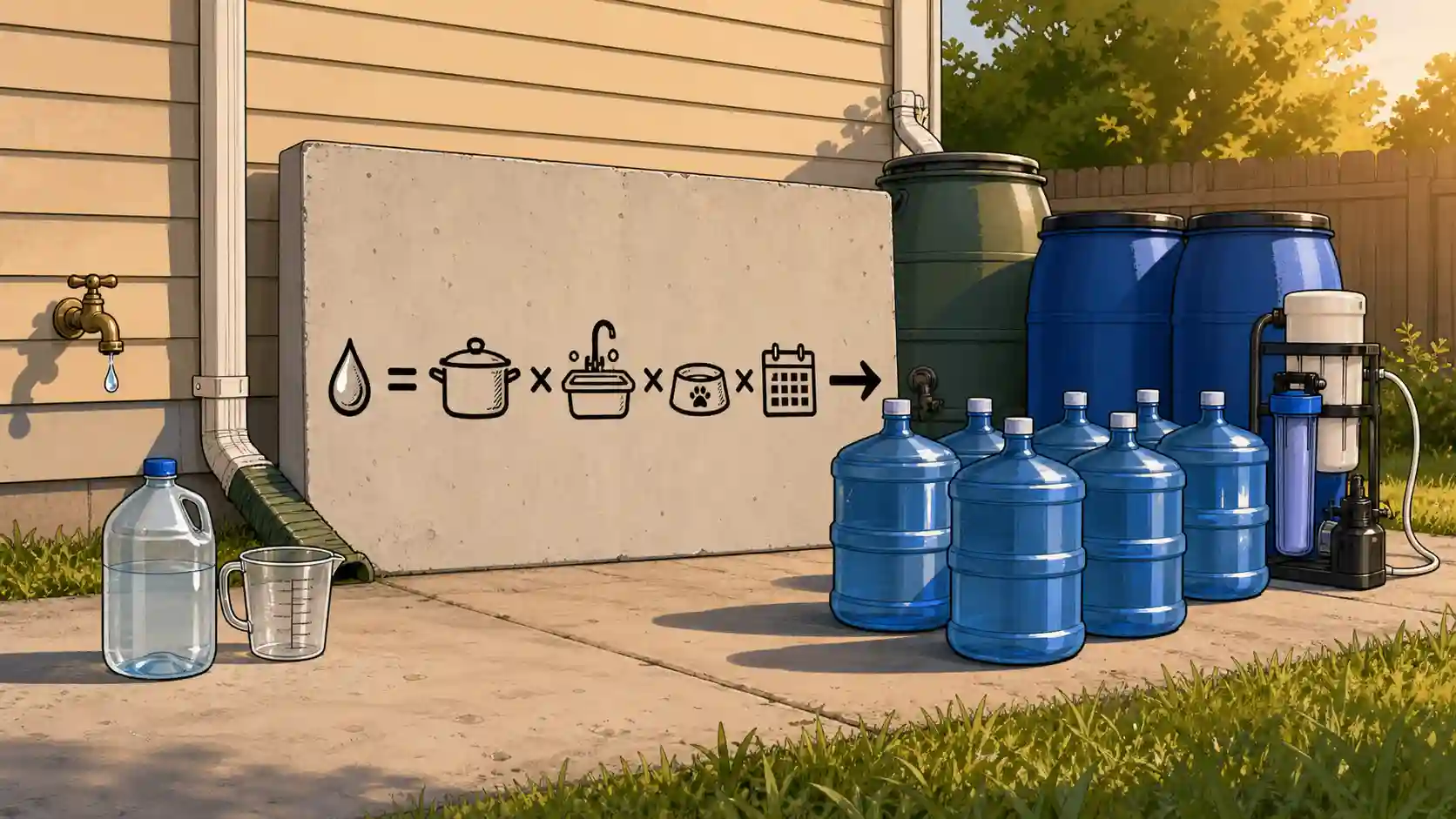
Most water guidance starts and stops with a single number: one gallon, per person, per day. It’s a fine place to start and a terrible place to stop — because that gallon only covers drinking and basic food prep. It assumes the tap still runs for everything else.
When the tap doesn’t run, the rest of your day shows up on the ledger: washing hands, cleaning dishes, flushing toilets, basic hygiene, the dog, the garden. That’s where households get caught short.
Start with the floor, then add reality
Work it in three layers:
- Hydration & cooking — ~1 gallon/person/day. Non-negotiable.
- Sanitation & hygiene — roughly 1–2 gallons/person/day, depending on how you handle waste.
- Dependents & special cases — infants, the elderly, medical needs, pets, and hot climates all push the number up.
The honest planning number for most families is closer to two to four gallons per person per day, not one. Plan for the household you actually have, not the one on the back of the water-brick label.
Turn the rate into a target
Pick a duration that matches your threat picture — your Threat Report will tell you whether you’re in an earthquake, wildfire, or grid-fragile county and you can approximate based on the threats you are at risk for experiencing. This duration is the time that you would need water without being able to replenish it. Once you have this, it becomes simple math:
people × gallons/day × days = your water target.
A family of four planning two weeks at 2 gal/person/day needs ~112 gallons. That’s not a stack of store-bought bottles; that’s a couple of proper containers and a plan to refill them.
For grid-down and other severe emergencies, you can use your water heater to supplement your water storage. Don’t plan on this for simple emergencies though.
Replenishment
Having water storage is just the first step. It gets you over the hump of an emergency, but doesn’t set you up for long-term sustainability. To achieve this, you need a way to replenish your water stockpile. Specifically, you need:
- A reliable and safe source of water
- A means to transport water
- A means to filter and purify water. Keep in mind you’re purifying most of the daily rate you calculated above.
Bottom Line
Three rules keep this sane:
- Store water you’ll actually rotate. Food-grade containers you can move, clean, and refill beat a wall of flats you’ll never touch.
- Separate storage from sourcing. Stored water buys you time; a way to make more water (filtration, a known local source) is what carries you past it.
- Protect the supply. Cool, dark, off concrete, away from chemicals.
The point isn’t to win a stockpiling contest. It’s to know your real number, store to it, and have a way to extend it. Everything past that is detail.
Turn this math into a plan with the Food & Water Storage worksheet — set your water target and track how many days of water you can actually cover.