


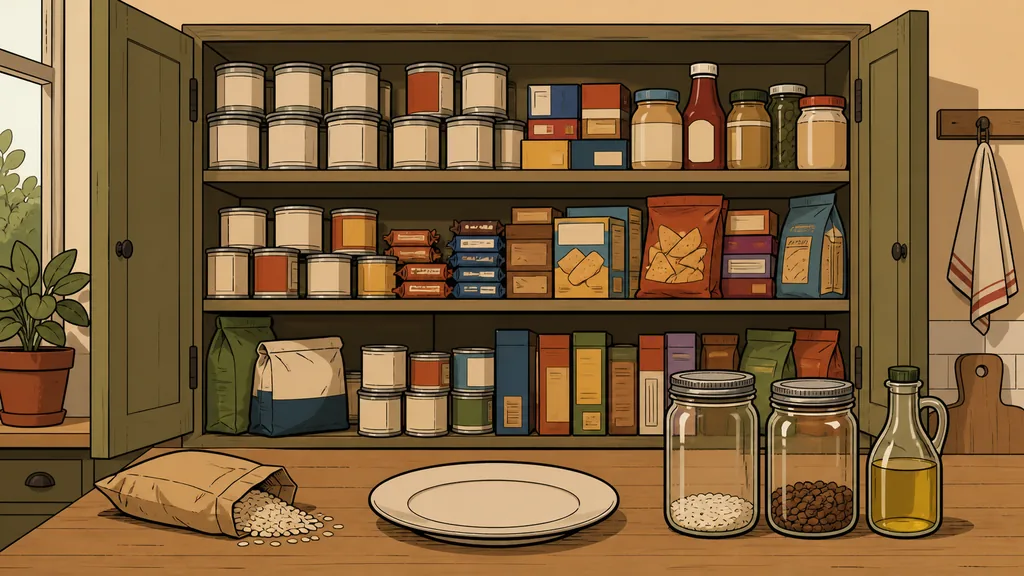
Walk most people’s “prepper pantry” and you’ll find a wall of variety: three kinds of pasta, a shelf of canned soup, snacks, condiments, the good coffee. It looks like a lot. Then you do the arithmetic and find nine hundred calories a day for two weeks — a crash diet, not a survival supply.
The problem isn’t effort. It’s the unit. A stockpile built by the shelf measures how full the shelves look. A stockpile that keeps you alive is measured one way only: calories, per person, per day, times days.
Count the calorie, not the can
An adult doing real physical work needs roughly 2,000–2,500 calories a day to hold weight — more in the cold, more when the work is splitting wood instead of sitting at a desk. Drop well below that and you don’t just get hungry; you get slow, cold, and stupid - exactly when you can least afford to.
The honest planning number is calories × people × days. A family of four planning 30 days at 2,000 calories needs 240,000 calories on hand.
A can of soup only has about 160 calories, so unless you want to stock 1,500 cans of soup, you need a different approach.
Calories per dollar and calories per cubic foot both point the same direction: dense, boring staples. Rice, beans, oats, wheat, pasta, flour, sugar, fats and oils, powdered milk. This is why a five-gallon bucket of rice outperforms a pantry of variety — it’s not better food, it’s more fuel in less space for less money. Variety and comfort still matter (morale is a real supply), but they’re the frosting, not the cupcake.
Packaging decides the shelf life, not the label
A “25-year” shelf life on a bag of beans is a claim about ideal storage, not about the bag on your shelf. Left in its original packaging in a warm garage, that same food is stale and buggy in a couple of years. Three things run the clock:
- Oxygen — oxidizes fats and lets insects and mold live. Remove it with oxygen absorbers in a sealed mylar bag or food-grade bucket, and dry staples last for decades. See the guidelines for oxygen absorbers for how many to use for different foods.
- Moisture — anything above ~10% moisture content isn’t a candidate for long-term storage without freeze-drying or canning - it will spoil (botulism can kill you).
- Heat and light — every ~18°F warmer roughly halves shelf life. Cool, dark, and off the concrete floor is worth more than any label.
Most stored food doesn’t die of old age. It dies of a warm garage, a torn bag, and a shelf nobody rotated.
See the shelf-life and calorie table for how long each staple keeps once it’s packaged properly — and how many calories it actually delivers.
Rotate what you eat; store what you’ll rotate
There are two honest strategies, and the failure is trying to do neither:
- Deep-store the staples you rarely touch (mylar + oxygen absorbers, sealed for years) — your floor.
- Rotate the food you already eat on a first-in, first-out basis — your working pantry, one to three months deep, that you actually cook from and refill.
The store-bought “bucket of variety” that you never open and never rotate is the worst of both: not deep enough to be your floor, not eaten enough to be fresh.
Bottom Line
- Measure in calories, not shelves. calories × people × days is the only target that survives a real emergency.
- Build the base out of dense staples. Rice, beans, oats, wheat, fats. Comfort food is the trim, not the structure.
- Package for the enemy you have — oxygen, moisture, heat, light. Proper packaging turns a two-year supply into a twenty-year one.
- Pick a strategy per shelf. Deep-store the floor; rotate the working pantry. Don’t buy food that fits neither.
Run the Food & Water planner to turn your household and your goal into a real calorie target — and see how many days you’re actually carrying.