


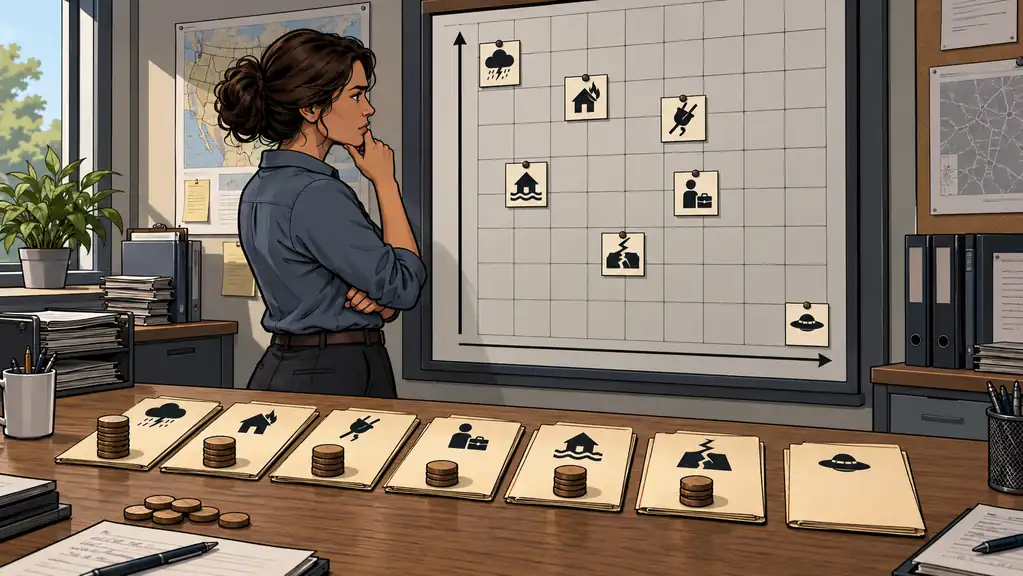
Yes, “alien invasion” is on our list of threats. And no, we haven’t lost our minds. It’s on the list for one reason: honesty. A real threat catalog should include the whole range of what could happen, from the boringly common to the wildly improbable — and then rank each one fairly. Alien invasion sits at the very bottom of that ranking, and it belongs there. Including it isn’t a prediction; it’s a way of showing you exactly how little the far-fetched scenarios deserve compared to the everyday ones.
Think of this article as the honest floor of the whole list. If we included it, we owe you a straight answer about how seriously to take it. The straight answer is: not very — and here’s why that’s actually a useful thing to understand.
Why it’s on the list — at the very bottom
Every threat gets two scores: how likely it is, and how bad it would be. Alien invasion scores the lowest possible likelihood (1 of 9) and, by definition, the highest possible impact (9 of 9) — because a real invasion by a hostile advanced civilization would be a civilization-ending event, if it ever happened.
But look closely at that likelihood score, because it’s the whole story: there is no evidence, no precedent, and no plausible mechanism for it on any timeframe you’d plan around. It’s not “rare like a big earthquake.” It’s “we have literally never seen anything like it, and have no reason to expect it.” That’s a different category entirely. It’s here for completeness — to mark the far edge of the map — not because it’s a real planning concern.
The honest history section
Here’s where a normal threat article would tell you about past events. And here’s the honest version: there aren’t any. There is no documented case of an alien invasion. There’s no track record to learn from, no warning signs to watch for, no lessons from last time. That absence isn’t a gap in our research; it is the finding. When a threat has zero precedent and no known way it could even occur, that tells you precisely where to file it: at the bottom, as perspective, not as a to-do item.
Now, some reading this will argue about the 1947 Roswell crash, the recent government disclosures, etc. I could see the argument that these events support that “something” is going on, and I touch on that subject in this article, but I’d argue that they make a case against this threat directly.
Let’s think about this logically for a minute. The nearest known planet to earth that scientists believe could support life is Proxima Centauri b and is located about 4.2 light years away. Our fastest manned spacecraft can travel at about 0.000037 of the speed of light, meaning the journey would take us about 113,500 years. I’m sure we could do better if we tried, but you get the point - it’s such a ridiculously large number that it’s effectively unachievable. If an entity came from there to here, they obviously have technological capabilities of a factor of many thousands of times that of humanity — that I believe we can all agree on.
So, we get to the application of logic. If they did come all that way to “invade” earth, why would they instead spend the following 70 years playing hide-and-seek with our military? Were they waiting for our technology to increase so it’s more of a fair fight?… When you think things through, “invasion” isn’t just off the table - it’s in a different house.
What “preparedness” looks like here — and it’s a trick question
You cannot meaningfully prepare for a specific alien-invasion scenario. Nobody knows what it would involve, so there’s no sensible gear to buy or plan to make for it specifically. But here’s the genuinely useful part: the only thing that would help in any extreme scenario is broad, general resilience — and that’s worth building for a hundred real reasons.
- Water, food, and the basics to get your household through a crisis.
- A way to communicate and stay informed when normal systems are down.
- Community — neighbors and relationships you can count on.
None of that is alien-specific. All of it helps with storms, outages, job loss, and every likely threat on the list. So if you’ve built solid, all-purpose preparedness, you’ve done the only rational thing that touches this scenario too — as a free byproduct, not a special project.
The real lesson
The point of putting alien invasion on the list is to teach you how to weight threats. Your time, money, and attention are limited. Every dollar and every hour you spend preparing for the vanishingly improbable is a dollar and an hour not spent on the things that are thousands of times more likely to actually reach you: a bad storm, a power outage, a lost job, a medical emergency.
So spend nothing specific here. Pour that energy into the everyday threats. And keep a sense of humor about the far edge of the list — a clear head and a good attitude are preparedness assets too.
Bottom Line
- It’s on the list for honesty, ranked dead last — the lowest possible likelihood, marking the far edge of the map.
- No evidence, no precedent, no plausible mechanism — that absence is the finding, not a gap.
- You can’t prepare for it specifically, and anyone saying differently is selling fear.
- Only broad resilience helps any extreme scenario — water, food, comms, community — and that’s worth building for real reasons.
- Spend nothing here; spend your energy on the threats thousands of times likelier — that’s the actual lesson.
Alien invasion earns a spot on the list the way the edge of a map earns a label — to show you where the real territory ends. Prepare for the everyday; keep the improbable in perspective; keep your sense of humor.
Rank this threat against all the rest using the Threat Planning tool or use the county Threat Report to identify your real, local risks — the ones worth your time.