


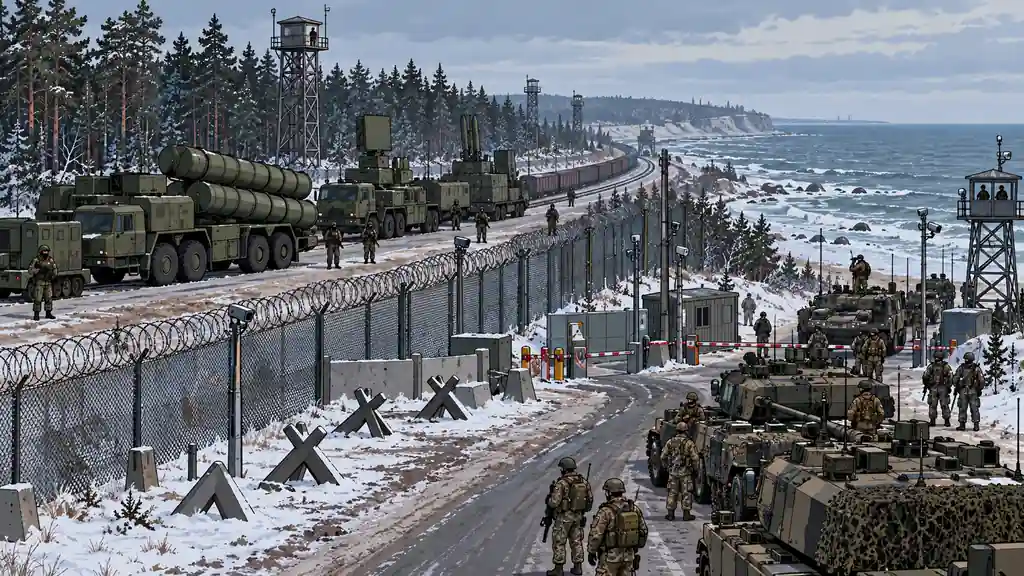
When people imagine a NATO–Russia war starting, they picture tanks pouring across a plain, or a missile out of nowhere. The more likely version is quieter and stranger: an argument over a 200-mile-wide patch of Baltic coast that most Americans have never heard of, escalating faster than anyone intended because both sides have boxed themselves in.
That patch is Kaliningrad — and at the end of September, Russia’s own embassy in London said the quiet part out loud.
What the embassy actually said
On September 29, 2026, the Russian Embassy in the United Kingdom posted a statement to its Telegram and X channels warning Britain and NATO off any move against Kaliningrad. The relevant lines, as reported by Newsweek and other outlets:
“Those advocating plans to blockade or strike Kaliningrad should have no illusions about the consequences.” Any British or NATO military action against Russian territory, it continued, “would be met with a response using all means at Russia’s disposal, including nuclear weapons.”
A day later, Russia’s embassy in Ireland issued a near-identical warning, framing it as defense of Russian territory. NATO confirmed it received a written message and, through a spokesperson, said it “strongly denounce[s] the threat of force, including any irresponsible nuclear rhetoric.”
Let me be precise about what this is, because precision is the whole job here. This is an official threat from one government, not a neutral forecast of what will happen. It is coercive signaling — a sentence engineered to make Western planners flinch. Russia has leaned on nuclear language repeatedly since 2022, and most of it has turned out to be pressure rather than prelude. So the correct posture is neither “they’re bluffing, ignore it” nor “the missiles are flying.” It’s: a nuclear-armed state just publicly attached its most extreme option to a specific piece of ground. That tells you where the fault line is. It does not tell you a war is coming.
Why this specific sliver of coast
Here’s the geography that makes Kaliningrad different from every other grievance on the map.
Kaliningrad is a Russian exclave — a chunk of Russia with no land connection to Russia (similar to Alaska or Hawaii for the United States). It sits on the Baltic, wedged between Poland to the south and Lithuania to the north and east, both NATO members. Everything Russia wants to move in or out of it by land has to cross alliance territory or pass through the sea and air space the alliance can contest.
Militarily, it is not a sleepy border town. It’s the headquarters of Russia’s Baltic Fleet and one of the most heavily militarized spots in Europe — the core of what analysts call an anti-access/area-denial (A2/AD) “bubble.” The widely reported pieces of that bubble include long-range S-400 air-defense systems, coastal anti-ship missiles, and nuclear-capable Iskander ballistic missiles, which Russia has deployed to the exclave repeatedly over the past decade. Stack those systems together and Russia can, on paper, threaten aircraft and ships across a large slice of the Baltic from inside one small territory.
Now the part that turns geography into a tripwire. The only land route connecting the three Baltic states — Lithuania, Latvia, Estonia — to the rest of NATO is a corridor roughly 65 kilometers wide between Kaliningrad and Belarus, called the Suwałki Gap. A former commander of U.S. Army Europe has described it as the alliance’s Achilles’ heel. Pinch that corridor shut from both sides and the Baltics are physically cut off from reinforcement by land. I walked through this choke point in more detail in Europe is preparing for war with Russia.
So you have a Russian fortress-exclave that can only be sustained across NATO’s doorstep, sitting right next to NATO’s single most fragile seam. Both sides have a plan that depends on controlling the same ground first. That’s the structure of a tripwire: a place where one side’s defensive move looks identical to the other side’s opening attack.
What prompted the “blockade or strike” talk
The embassy didn’t invent the words “blockade” and “strike.” They were reacting to Western discussion of exactly those options.
The immediate trigger, per the reporting, was a British television war-game — Sky News’ dramatized series The Wargame — depicting a hypothetical Russian attack and a British response that included operations against Kaliningrad, alongside broader media speculation about choking the exclave off. Moscow’s statements went further and claimed it had “information” that NATO was preparing an air and naval blockade of the exclave — but, as the Kyiv Independent reported, the embassy made that assertion “without providing evidence or identifying the source of the claim.”
That’s worth flagging twice. The nuclear threat is real in the sense that Russia really said it. The premise it was built on — an imminent NATO blockade — is an unsupported assertion by the party doing the threatening. Both things are true at once, and keeping them separate is how you avoid being played by either side’s messaging.
The preparedness read
I am not predicting a nuclear war, and nobody selling you a date knows one. What I’m doing is telling you where to point your attention, and what it would actually mean if the needle moved.
First, understand what makes Kaliningrad more dangerous than a louder-sounding crisis: it’s the combination of high stakes, tight geography, and a short fuse. There’s very little room and very little time for a misread to get walked back. That’s precisely the profile that rates high on Likelihood even when the base rate of nuclear use is, thankfully, very low.
Second — and this is the part that makes it concrete for an American household — you do not prepare for “Kaliningrad.” You prepare for its effects, which are the same ones every large-conflict scenario on this site funnels into: energy-price shocks, financial turbulence, strained supply chains, and, in the genuine tail case, the fallout and grid consequences of nuclear use somewhere in Europe. If you’ve built toward a grid-down plan, a supply buffer, and a financial runway, a flashpoint like this doesn’t hand you new work. It raises the Likelihood score on work you already justified.
Third, watch indicators, not adjectives. The Baltic states don’t monitor this threat by reading nuclear rhetoric — they watch rail hubs, troop movements, and logistics activity, the physical things that have to happen before anything real does. Do the same. A fresh embassy post is noise. Large, unannounced force movement around the Suwałki corridor, a genuine interdiction of Kaliningrad traffic, or a NATO alert-posture change — those are signal.
Bottom Line
- Treat the quote as what it is. An official Russian nuclear threat tied to a specific place — coercive signaling with a long track record of pressure-not-prelude, resting on a blockade claim Russia didn’t back up. Real words; unproven premise.
- Kaliningrad is the structural flashpoint. A militarized Russian exclave surrounded by NATO, sitting beside the alliance’s narrowest seam, where defense and attack look identical. That geometry is why it ranks, not the latest headline.
- Prepare for effects, not the event. Energy, supply chain, finances, and the grid. The same four you’d prep for a dozen likelier things — a Russia crisis just moves them up the queue.
- Watch logistics, not rhetoric. Rail, troops, posture, actual interference with Kaliningrad traffic. Those precede a war. Embassy Telegram posts do not.
Track this on the conflict with Russia threat page.