


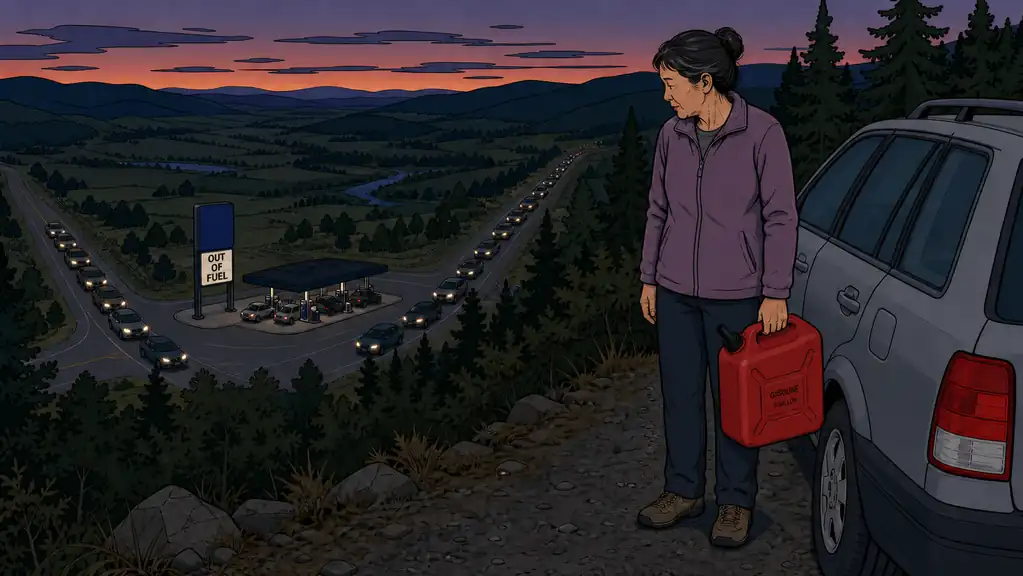
Almost every bug-out plan has the same silent assumption baked into it: that fuel will be available. Top off on the way out, hit a station when the gauge drops, refill the cans if things drag on. It’s the most reasonable assumption in the world right up until the emergency, at which point it’s usually the first thing to break.
Understand why the pump fails and you’ll stop counting on it. A gas station stores its fuel in underground tanks and lifts it out with electric pumps. No grid, no fuel — the gasoline is sitting right under the concrete and completely out of reach. Add the run on supply the moment a region gets nervous (anyone who’s evacuated ahead of a hurricane has watched stations drain in hours) and the math is grim: the pump is offline exactly when everyone wants it.
The resupply fantasies, one by one
The instinct is to find another way to get fuel in a pinch. Each option is thinner than it looks:
- Filling up on the way. First stations sell out, and the ones with fuel have lines measured in hours. You may burn a quarter tank to gain half of one.
- Stored fuel at home. The right answer — but most people have a can for the mower and a jug for the generator, a few gallons that won’t meaningfully extend a bug-out.
- Siphoning from other vehicles. A real skill with real obstacles: modern tanks have anti-siphon screens that defeat the hose-and-suck method. If you’ve never actually done it, don’t count on figuring it out in the moment.
Range you didn’t store is range you don’t have. In an emergency the fuel supply chain runs backward from the pump to the refinery, and the pump is the first link to break.
The real prep: a reserve you keep fresh
Since you can’t count on buying fuel, the only fuel you can count on is the fuel you already own. Storing it is easy; the discipline that makes it useful is rotation, because fuel goes stale.
- Gasoline degrades relatively fast. Untreated, it starts losing quality in a matter of months; a stabilizer additive extends that, but it’s not forever.
- Diesel stores longer. It’s one of diesel’s real advantages for preparedness — better range per tank and a reserve that keeps far longer than gasoline. (Propane, for what it’s worth, stores essentially indefinitely — worth knowing if any of your gear runs on it.)
- Rotation is the whole game. Stored fuel you never cycle becomes varnish that won’t run your vehicle when you need it. Burn the oldest can in your daily driver, refill with fresh, repeat on a schedule you’ll actually keep. Track it the same way you’d track food expiry.
Size the reserve against the range gap you actually have. If your bug-out location is 300 miles out and you might leave on half a tank, the stored fuel that closes that gap isn’t a luxury — it’s the difference between arriving and walking.
Know how fuel reaches you
There’s a layer above your own tank worth understanding: how fuel physically gets to your area. Does it arrive by pipeline part of the way, or entirely by truck? The longer the last leg runs by truck, and the farther your region sits from the refinery, the more fragile that supply is and the faster local stations run dry when anything disrupts it. A locally-owned station or fuel-delivery company can usually tell you exactly how it reaches your town. Knowing that tells you how much reserve is enough — an area at the end of a long, thin supply line needs more.
Knowing how fast your area stations will run out of fuel gives you some insight into the situation of the people around you during an emergency. Those that don’t have fuel stored will be panicked - plan for this too.
Bottom Line
- The pump fails first. Electric pumps go dark with the grid, and panic buying drains the rest — plan on no resupply.
- The resupply fantasies are thin. Filling up on the way, a couple of cans, or siphoning you’ve never practiced won’t save a long bug-out.
- Store a reserve and rotate it. The only fuel you can count on is what you own — and stale fuel is no fuel. Cycle the oldest into your daily driver on a schedule.
- Know your supply line. Understanding how fuel reaches your area tells you how much reserve is enough and the situation those around you will be in.
Check how fuel reaches your area — and what else your county leans on — with the Threat Report, then log your stored fuel and rotation in your energy inventory.