


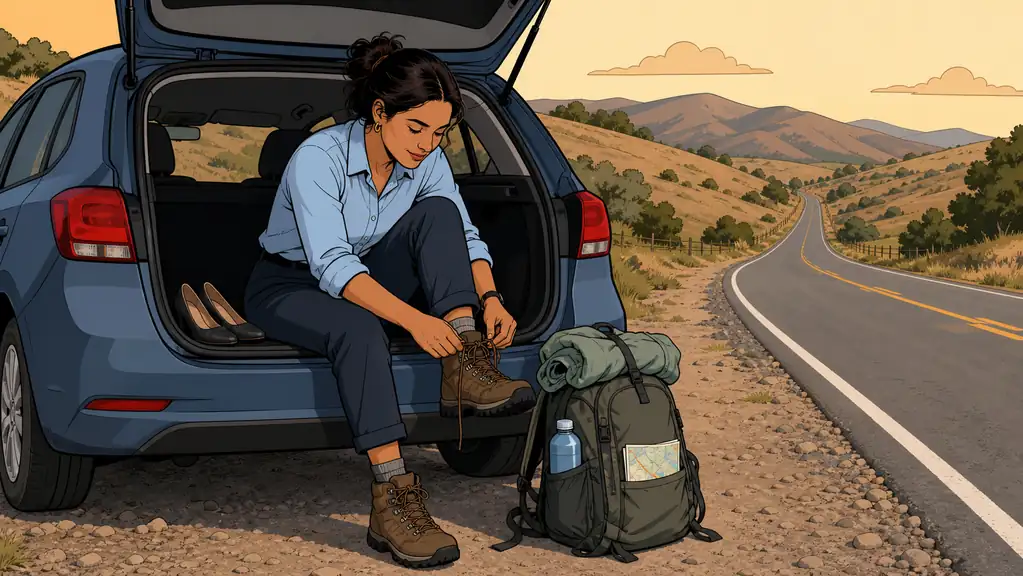
Ask a prepper how they get home when the roads fail and you’ll usually hear a route, a vehicle, and a full tank. That’s the easy half of the problem. The hard half starts the moment the car stops — because in a real regional emergency, most of them do, and they do it a long way from the driveway.
Here’s the number that should reframe the whole plan: the average vehicle gets about 225 miles in an emergency before it’s out of fuel — half a tank against a typical 450-mile range. Past that point, everyone is a pedestrian. So the question isn’t “how good is my vehicle.” It’s “how far am I willing to walk, and am I actually equipped to do it?”
What walking home actually costs
We have decent data on this, because backpackers have measured it for decades. An experienced backpacker, in reasonable terrain, covers 8–10 miles a day. A really strong one peaks around 15 miles. That’s someone fit, trained, carrying gear they’ve dialed in, moving through country they chose.
Now subtract everything that doesn’t describe an emergency. You’ll likely be in the wrong shoes, carrying more than you should, off-trail or dodging traffic, possibly with a child or an older parent setting the pace. Realistically, plan for less than that backpacker’s number — and understand that the person slowest in your group sets the speed for everyone.
A get-home plan measured in miles on a map is fiction. Measure it in days on foot — then ask whether you have the food, water, and feet to spend them.
Run your own commute against it. If work is 15 miles from home, that’s a hard but doable one-day walk for a healthy adult. If it’s 60, you’re looking at a multi-day journey with everything that implies: water along the way, somewhere to sleep, and the fitness to still be moving on day three.
The three things that actually decide it
The vehicle gets a lot of attention. These get almost none, and they matter more once you’re on foot:
- Your feet and your fitness. This is the real vehicle for the last leg. Broken-in boots in the car beat dress shoes every time, and the walk you can’t physically do is not a plan — it’s a wish.
- Water, not food. Over a one-to-three-day walk, water is the binding constraint, not calories. You can’t carry three days of it, which means your route has to pass water you can treat — plan the walk and the water together.
- A bag you’ll actually have. The best get-home bag is the one in your trunk right now, not the perfect one at home. Good boots, water and a way to treat it, a layer, light, a map. That’s most of the job.
Why “I’ll just drive around it” fails
The instinct is to treat a stopped car as a routing problem — take the back roads, go around. Sometimes that works. But the same event that stops you stops thousands of others on the same roads, and fuel is a fixed budget that only goes down. Every mile you burn hunting for an open route is a mile you don’t have for the walk you may still have to make.
Treat the drive as a bonus that shortens the walk, not as the plan. Whatever range the vehicle gives you is pure profit — but the plan underneath it has to survive the tank hitting empty.
Bottom Line
- Assume the car stops. In a regional emergency the average vehicle dies around 225 miles from home. Everything after that is on foot.
- Measure the walk in days, not miles. 8–10 miles a day is a trained pace with a reasonable load — plan for less, and let your slowest person set it.
- Feet, water, and a trunk bag decide it. Not the truck. Broken-in boots, water you can treat, and a bag already in the vehicle.
- Practice the walk once. A single long hike tells you your real daily mileage and where your gear fails — while failing is cheap.
Draw your route home — the drive and the walk — in Area Recon, and mark the water and shelter along it before you ever need to use it.