


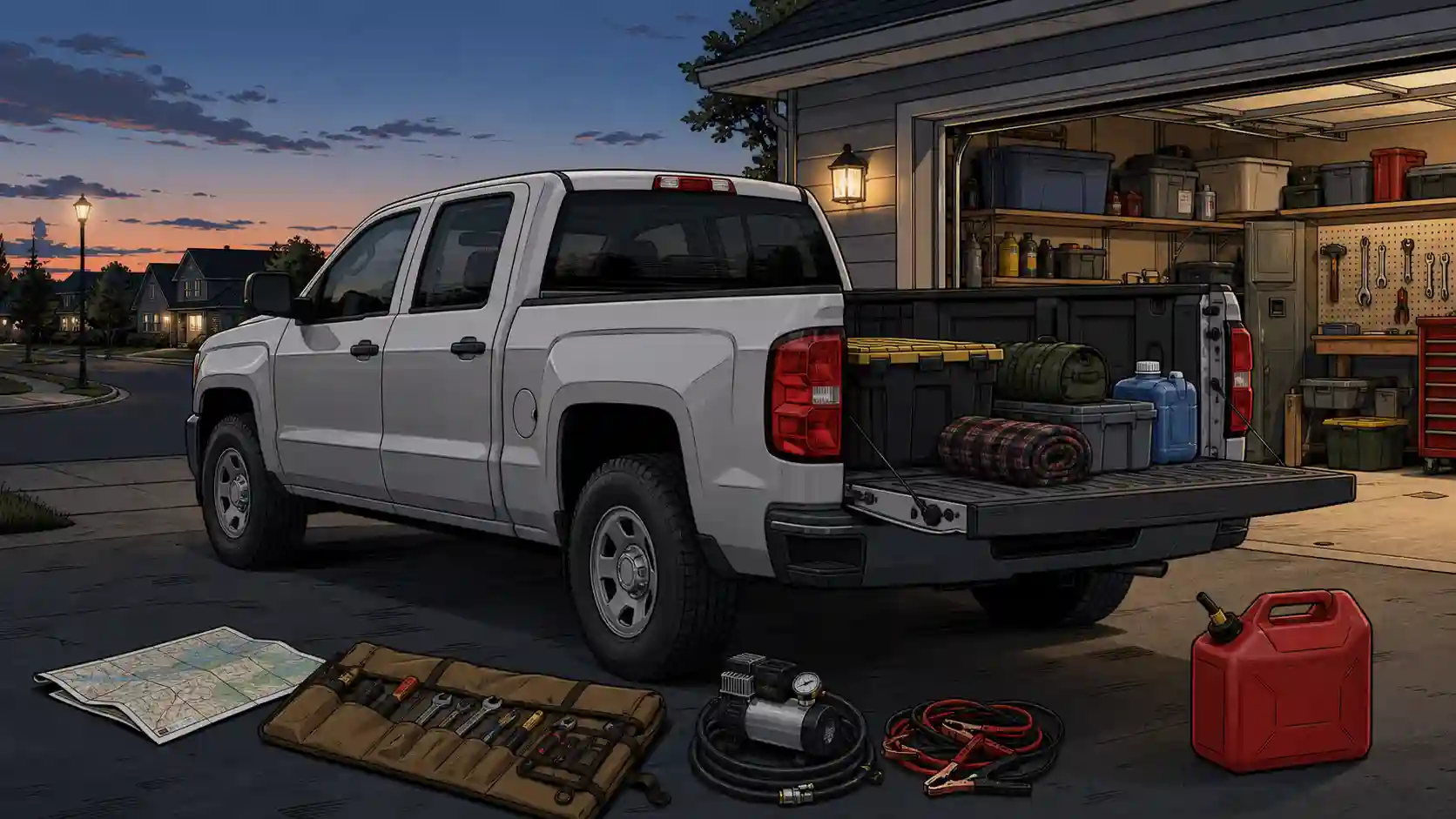
Bug-out vehicles (or BOV’s as the cool kids call them) have become a popular topic in some preparedness circles. As a result, I felt that it’s probably time that I weigh in on this topic as well. We’ll look at what they are and if they apply to all preppers, or just the “hard core” set.
What is a bug-out vehicle?
Typically, when this topic comes up most people have an image of a decked out 4x4 or ex-military vehicle come to mind. While this can be an option, it’s far from the only one. To understand what it is, we first need to establish some terminology to be clear: What is bugging-out?
Bug-Out: — When disaster strikes, leaving your home or primary location. This could be your initial plan (city-dwellers for instance), or because of forced evacuation due to circumstances.
For additional depth on determining when to bug-in vs bug-out, we’ve written a dedicated article with some things to keep in mind surrounding this topic.
A key thing to keep in consideration is that everyone needs to plan to bug-out. Even if you have the best retreat known to man, there are scenarios that exist that would require you to leave it. That means bugging-out. If you must bug-out, then the logical next step is that you must have the means to bug-out. This is where a bug-out vehicle comes into the conversation.
Prevailing opinions
I’ve seen many comments on this topic over the years, and I’ve noticed a couple reoccurring themes:
- Extreme 4x4 capabilities - Ability to “go anywhere”.
- Pre-Electronics - Older vehicles that were built before computers, etc.
Extreme Off-Road Capabilities
It seems that many have the idea that they’ll use their BOV to drive far out into the wilderness to get away from the collapse of society. They want big lifts and big tires to be able to traverse large rocks, fallen trees or deep mud. Heavy bumpers for pushing disabled cars out of the way. Winches for dragging things out of the way or if they do get stuck.
If your hobby is overlanding, then this plan may make sense. For anyone else it doesn’t. There is skill involved that must be developed. Additionally, many of the remote areas reachable by 4x4 are not that far away when traveling on foot. This means these areas aren’t as remote as you’d want/need to make that plan successful. Finally, there’s the supply problem. You can only carry so many supplies, and most of the overlanding vehicles I know of can’t carry more than about a week’s provisions. Starving in the middle of the wilderness is still starving (and no, you’re not going to forage your way through unless you’re training for that now).
Generally, extreme off-road capabilities aren’t required if driving from one house to another, which means this criteria isn’t as valuable as many may believe.
Pre-Electronics
Older vehicles that were built before computers, etc. were utilized are typically prized in the preparedness community. The main stated reason is because of electro-magnetic pulse (EMP) resilience. It is true that pre-electronics vehicles are generally more resilient to the effects of an EMP (for more information on EMPs, see this threat brief). While EMP is a very high-impact threat, thankfully it also carries an extremely low probability. As a result, EMP resilience shouldn’t be at the top of your priorities (and there are ways to mitigate it on newer vehicles that we’ll cover below).
Dedicated Bug-Out Vehicle or Daily Driver?
Extreme off-road capability and/or pre-electronics generally means it’s not a vehicle you’re driving to work or to get groceries. Extreme off-road generally means poor on-road manners (wandering, noise, rough ride, etc.) and economy. Pre-electronics generally means it’s missing all the creature comforts most spoiled Americans want. As a result, these vehicles essentially become a dedicated bug-out vehicle. Now, I do know guys driving these daily, but they’re the minority. Most vehicles that meet the above criteria that I know of are parked 99% of the time, and that’s a killer. Leaving a vehicle sit lowers the reliability considerably, that’s just a fact.
It’s for all these reasons that I argue against a hard-core, dedicated bug-out vehicle. I believe that you should drive your bug-out vehicle daily. If an emergency happens while away from home, the capabilities of a BOV will help you get home or to where your family is. If driving an economy car, you’re going to be much more limited on what you can do in the moment.
My Criteria
There are two key factors that I place above all others when considering this topic:
- Availability — Something you have today beats what you want to have in 10 years. Don’t wait for the “ideal” — plan to utilize what you have.
- Reliability — You want something that works when you need it, without fail.
That said, there are features that I believe are good to look for when selecting amongst your current options, or when purchasing something else:
- 4-Wheel or All-Wheel Drive - There is little negative and tons of benefit to having all four tires propelling you. This is especially important if you live where there’s snow or other inclement weather.
- Tires & Ground Clearance - It doesn’t need a 12 inch lift and 44” Super Swampers, but you need enough ground clearance and traction to handle crossing a highway median in the rain.
- Storage Capacity - When bugging-out, you’ll probably be taking a lot with you (people and gear). The more you can carry, the more options this gives you.
The above criteria causes me to deviate significantly from much of the prevailing wisdom on the subject. Many extoll the typical overlanding vehicles like Jeep JK’s, Land Cruisers or Tacomas. While these are all great for overlanding due to their offroad capabilities, I feel that this pro is offset by the negative of storage capacity. My recommendation is a full-sized truck or SUV. If going a truck, I even recommend a long (8’) bed for maximum cargo capacity. I gravitate toward the HD varieties as well due to the increased power and durability of the drivetrain.
For full-sized trucks, I recommend one of these based on personal experience:
- Chevy Silverado or GMC Sierra 2500/3500 — This is my first pick as I have direct experience. My truck is ~20 years old with 350k miles and still going strong with no major drivetrain repairs needed. I recommend the Duramax diesel, but be aware different years have different pros/cons so do your research.
- Ford F-250 or F-350 — I know of several people with these, and they love them - especially those with the 7.3L Powerstroke. It’s not the most powerful option, but it’s extremely reliable. The solid front axle is a plus over the Chevy/GMC. Like the Chevy/GMC, different engine generations have their “quirks” - do your homework.
- Dodge or Ram 2500 or 3500 — Probably the most reliable engine of the 3 makes (Cummins diesel) and these trucks are generally cheaper than the Chevy or Ford. If you’re dead set on “EMP-proof”, it’s hard to beat a 12-valve (6BT) for simplicity. These trucks are infamous for automatic transmission issues and the truck bodies don’t last as well as the Chevy or Ford, so pay attention while shopping.
If you prefer an SUV, my recommendations are:
- Chevy Suburban 2500, GMC Yukon XL 2500 or Chevy Avalanche 2500 — Many people don’t realize that GM built HD versions of their full-sized SUVs (and whatever the Avalanche was). They have the same body/interior as their normal half-ton variants, but have the drivetrain and suspension of the HD trucks. The easiest way to identify them is the 8-lug wheels. They were made from 1992 to 2013 and carry a premium due to their rarity/demand. Unfortunately, they only made a diesel version in the 1990’s, but many later models have been converted. To convert to the Duramax diesel and Allison transmission is a near plug-in-play install on the 2001 to 2013 years and the result is a like-factory execution. One of these with the Duramax conversion is on my wish list.
- Ford Excursion — The Ford Excursion was only made from 2000 to 2005. Like the HD Suburbans and Yukons, they carry a premium, especially the earlier years with the 7.3L Powerstroke diesel engine. The Excursion also has much better aftermarket support than the Chevy/GMC variants so there are more options for bumpers and other accessories.
What if you only have a small FWD car?
You’re doomed… Just kidding. As I said above, plan to use what you have. If you don’t have a truck/SUV and getting one isn’t in the cards today, then you need to think of ways to “maximize” what you do have. Even if you have a sub-compact car, there are things you can do to make it function better as a BOV. Here are a few ideas:
- Tires — The next time you get tires, get something that will help you on wet grass, etc. A mild all-terrain tire will be a monumental step up from a typical highway tire in snow or off-road conditions.
- Storage Capacity - Maximize the carrying capacity of your car. Think about roof racks, small trailers, etc.
For the over-achievers…
If you’re the type of person that wants the best bug-out vehicle possible, this part’s for you. This is my opinion of the “best” bug-out vehicle:
- Truck/SUV — Full-sized HD Truck/SUV. Diesel engine for best power/economy and longest fuel storage life. If going for a truck, I recommend a crew cab and long bed. I know it’s harder to park, but you can’t beat the carrying capacity… Every brand did a long bed in a single-rear-wheel, so no dualies are required (and I don’t recommend dual rear wheels - they get stuck in mud easier).
- Fuel — Larger fuel tank from Titan, SB Filters, or Transfer Flow. Having over 1,000-mile range on a tank of fuel is a great capability for a BOV.
- Tires — The biggest all-terrain tires that will fit without a lift (leveling is OK). The trick is maximizing capabilities without making it obnoxious to live with.
- Traction — Selectable lockers in the front and rear differentials. It’s amazing what a truck with lockers can do off-road and if selectable it has no on-road side effects - a true win-win.
- Bumpers — Bumpers with winches front and rear. You have to have something to scare the commuter car drivers with…
- EMP Protection — There are many options to choose from (EMP Shield, Faraday Defense or Bad Wolf). For full transparency, I have multiple EMP Shield products, but I don’t know what’s the best on the market as I have no way to test them (yet).
- Communications — 2m/70cm/MURS/FRS/GMRS radios installed with antennas. My current go-to is a BTech UV-50X2 and Comet CA-2X4SR antenna. It’s not the highest quality radio, but this radio & antenna both work on all those bands (legally doing this is another story). If you want to go whole-hog, add in HF radio capabilities (Yaesu FT-857D and ATAS-120A or other mobile antenna).
- Storage — Onboard storage with tools, fluids, parts, etc. For trucks, I’m a fan of across-the-bed toolboxes. I don’t like camper shells as I inevitably need to put something tall into the bed or load/unload with the tractor. For SUVs, plastic totes are my go-to.
Redundancy, even in this
Preppers commonly hear the military mantra of “two is one and one is none”, and apply it to a variety of things like can openers and guns. But this rule applies to everything your life depends upon, and your bug-out vehicle definitely falls into that category. As a result, you need to consider redundancy here as well. I don’t expect you to purchase two decked-out four-wheel drive trucks and set them up as dedicated bug-out vehicles. But you need to figure out what you would do if you need to bug out and the vehicle can’t fulfill that duty. Maybe it’s as simple as a flat tire, or as bad as being disabled by an EMP. Consider the threats you are preparing for and make plans that consider your primary bug-out vehicle not being functional.
Bottom Line
You must have a means of transportation in case you need to bug out quickly. What you use for this is really dependent upon your individual circumstance and can range from a roof rack on a compact car to an up-armored Humvee, complete with a 50-cal on top. Whatever it is, I recommend you use it as a daily driver so you have it whenever the need arises unexpectedly. And establish a backup plan, even if you have to resort to a bicycle with a trailer.