


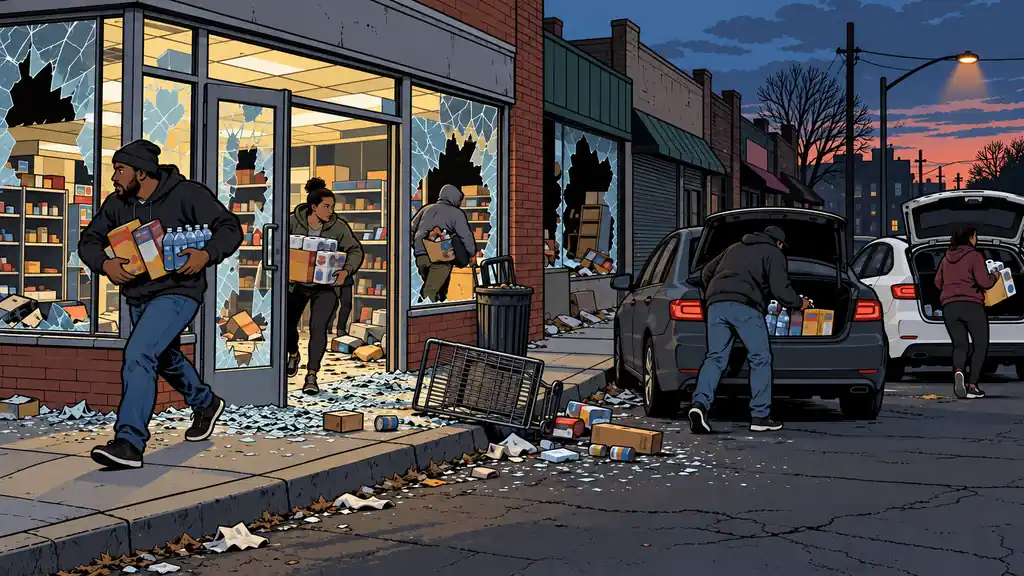
Crime isn’t steady background noise. It moves, and it tends to move up under stress: a bad economy, high unemployment, a politically charged news event. That’s the pattern behind a local crime wave, and it scores likelihood 5/9, impact 4/9 — an on-and-off risk that threatens your stuff and your peace of mind more than your life.
Here’s why it earns a spot in a prep plan even at 4/9 impact: it shows up at the exact same time as the other hard-times threats. The downturn that raises your odds of losing a job is the same downturn that raises the odds someone tries your car door at 2 a.m. They travel together. So when you plan for lean times, plan for a little more crime as part of that, not as a separate roll of the dice.
The one thing to understand: it’s opportunity, not obsession
Almost all property crime is opportunistic. The person doing it is making a fast, cold calculation — how much can I get, how much work is it, and how likely am I to get caught. They want easy in, a decent payoff, and low odds of being seen. They are not fixated on your house. They’re looking for an easy house, and they’ll take the path of least resistance.
That’s the most useful fact about this whole threat, because it means you don’t have to be impenetrable. You just have to be a worse target than the house next door. That’s not fortress-building; that’s making the thief’s math come out negative so he walks on to an easier target.
Picture it straight. Someone drifts down a dark street at night looking for a car to go through or a garage left open. He passes a house with a motion light that snaps on, trimmed bushes, a locked truck, and a camera by the door. Next to it sits a dark house, a car with a bag on the seat, and a side gate hanging open. He is not going to fight the first house. He’s going to take the second one. Every dollar you spend on hardening is really spent moving your house from the second category into the first.
Why a wave happens
A crime wave rises when two things climb at once: more people willing to steal (money’s tight, things are unsettled) and more easy chances to do it (people distracted, stretched, not watching). You can’t do much about the first one. You have a lot of control over the second one — and the second one is where all your leverage is.
The link between hard economic times and rising property crime is real but noisy. Property crime tracks the economy more reliably than violent crime does. An influential study by economists Raphael and Winter-Ebmer (Journal of Law and Economics, 2001) found unemployment has a real effect on property-crime rates and pinned about 40% of the 1990s property-crime drop on the falling unemployment of that decade. The broader research is genuinely mixed, so the honest read is: a real link, not a clean formula. Sharper local spikes tend to follow discrete shocks — a disaster, civil unrest, or the town’s biggest employer shutting down — where the normal watching-out-for-each-other breaks down for a while.
And the lesson that keeps repeating across those episodes: the homes that came through best weren’t the ones with the most expensive gear. They were the ones where neighbors knew each other and the basics were locked down. Community and simple deterrence beat gadgets every time it’s been tested.
What it actually costs you
- Your stuff — electronics, tools, bikes, catalytic converters, and firearms. That last one has a tail: a stolen gun goes on to enable more crime.
- Money and time — a broken window or door to fix, an insurance deductible, and the premium creeping up after a claim.
- Your sense of safety — usually the part that lasts longest. Getting hit at home is a violation. The feeling of being watched or targeted can hang around long after the TV’s replaced, wrecking sleep and turning your own house into a place that doesn’t feel like yours.
- The rare bad turn — the low-odds case where a property crime becomes a face-to-face confrontation because someone’s home. Good prevention is mostly about keeping every incident on the property-only side of that line.
Build it in layers
Think in rings around your home, each one adding cost and noise for anyone trying to get in. Measure your readiness in deterrence and warning time, not in dollars spent.
1. Light it, clear it, and make it look watched. This is the cheapest, highest-value ring. Motion-activated lights at the doors and the dark approaches strip away the cover a thief needs. Trim the bushes and trees back from windows and doors so there’s nowhere to hide and so the street and your neighbors can see the house. A well-kept, well-lit, obviously-watched place reads as high-risk. That’s the whole idea behind CPTED — crime prevention through environmental design — and the fancy name just means make the property visible and clearly cared for.
2. Harden the actual openings. Solid locks, actually used, on every door and window. The most common break-in is just an unlocked or flimsy door. Reinforce the door frame and the strike plate, because the frame usually gives way before the lock does. Secure sliding doors and the garage service door. Lock the car, every time, and never leave the garage remote in it — that remote is a key to your house. Each barrier buys time and noise, and time-and-noise is exactly what an opportunist won’t spend. A reinforced frame turns a quiet five-second shove into a minute of loud prying, and a minute of loud prying is a deal-breaker.
3. Add eyes and evidence. A visible camera and an alarm sign raise the feeling of getting caught, which deters; a real camera and alarm actually catch and record it. Even modest, visible measures move the thief’s math. And photograph your valuables and write down the serial numbers on the expensive stuff — that’s the difference between a police report that goes nowhere and one that can actually recover your property or pay a claim.
4. Know your neighbors — the strongest ring and the cheapest. A street where people recognize each other, notice a stranger, watch each other’s houses during a trip, and can text the group chat is drastically harder to work than a street of strangers. This costs nothing and multiplies everything. It’s the layer that held up best in real crime waves, and it’s the one the gear-first crowd skips. Trade phone numbers, cover each other’s mail and packages when someone’s away, and agree on what “normal” looks like on the block so “not normal” jumps out.
5. Don’t advertise. Keep valuables out of sight in the car and the yard. Break down the box from the new TV instead of setting it at the curb announcing what just moved in. Don’t broadcast the two-week vacation on social media while you’re on it. Lowering the signal of a payoff drops your ranking on the thief’s mental list.
Bottom Line
- A crime wave is an on-and-off, conditions-driven risk (5/9) that mostly costs you stuff and peace of mind (4/9) — and it rides in on the same hard times you’re already prepping for.
- Almost all of it is opportunistic — a fast cost-benefit call. You don’t need to be impenetrable, just a worse target than the alternatives.
- Layer it: light and sight lines, hardened openings, cameras and documentation, and — strongest of all — neighbors who watch out for each other.
- Community beats gadgets. It’s free, it multiplies everything else, and it’s what actually held up when waves hit.
- Lock up the firearms and the high-value, easy-to-grab items, and write down what you own so a theft is recoverable and claimable.
You have zero say in how many desperate people a bad year produces. You have almost total say in whether your house is the easy one. Fix the second thing, know your neighbors, and let the thief’s own math send him down the block.
Map your neighborhood — the approaches, the lighting, the sight lines — deliberately with the Area Recon tool. Thinking through your own ground before you need to is the core of the plan.