Look at what the preparedness community actually produces. How to prepare for threat X by buying this stuff. How to build a fire with nothing but chewing gum and a battery. How to store rice for thirty years.
Don’t get me wrong — those are important things. But they’re not the only thing. The “what” and the “why” matter more than the “how,” and they’re completely overlooked by most preppers.
Here’s the test. Ask a prepper what they’re preparing for and you’ll usually get one or two threats. Ask why those two, out of the thousands of scenarios available, and the conversation gets quiet.
I was that guy
I’m not throwing stones from outside. I was this way.
I began prepping when a book made me realize how fragile our economic systems are. Like a lot of people, I expanded into a few other threats over time. But I had very few I was truly preparing for — and that’s the problem. We as preppers rarely stop to consider what we should prepare for, or why we’d pick that out of everything that could happen.
I’ve been a formal prepper for more than 20 years, and some would say my family were preppers before that. We had cattle, chickens, a large garden. We didn’t consider ourselves preppers; we were just normal country people. My dad was a kid during the Great Depression, and he and my mom didn’t even have power until they were in high school. Both of them knew what self-sufficiency looked like and taught me the lessons they’d learned the hard way.
So I had a head start, and I still had the nagging feeling that I was missing threats — or putting attention in the wrong places. When I took a step back and analyzed my own approach, I found exactly the problem I described above. I knew a great deal about how. I had never done the work on what and why.
That’s why I set out to fix it, and that’s why this site (and the book it’s based upon) exists.
Where the framework came from
Early in the process I found something the military does called an Area Study.
An area study is often one of the first steps of military planning. A specific geographic area gets analyzed systematically to understand a handful of key things:
- Terrain
- Infrastructure
- Local populations
- Political landscape
- Potential threats
Through careful study, planners can determine where and how operations can be conducted in a given area. Notice what that is: it’s a rigorous, repeatable answer to what’s actually here and what does it mean — before anyone decides what to do about it. That’s the missing half of preparedness, and the military has been doing it for a long time.
It also isn’t a perfect fit. An area study is built for an army moving into ground it doesn’t own, for a defined operation, with a staff to run it and an entire supply and logistics group backing them up. You live in your area. You’re not conducting an operation; you’re raising a family. And you don’t have a staff.
I’ve been an engineer for over 25 years, and like most engineers I said, “I can improve that.”
Unlike most engineers, much of my career has been spent developing and improving processes — which happens to be exactly the skill this needed. Over a couple of years I took the methodologies I use at work and reshaped the area study until I had a system that works extremely well at making sure I’m as prepared as I can be.
I want to be honest about what that means. Nothing is perfect. I can’t guarantee I’ve identified every threat my family may face. What I can tell you is that I’m dramatically more prepared than I was before I had a system — not because I bought more, but because I finally knew what I was buying for.
What the book teaches
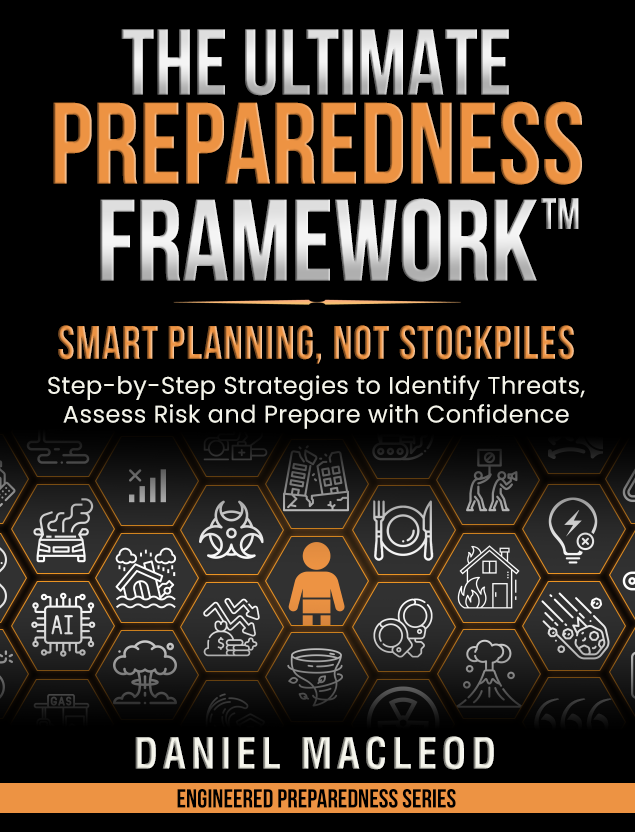
The Ultimate Preparedness Framework™ teaches a methodical way of planning for preparedness. You analyze your area, identify the threats you’re genuinely most likely to face, and — because you know the why — you have everything you need to address them properly.
Specifically, it improves your preparations in three ways:
- You’ll identify things you should be preparing for and haven’t been. This is the one that gets people. Almost everybody finds something in their own backyard they’d never listed.
- Your preparations become specific. They address the threats you actually identified, instead of the threats a YouTube channel identified.
- You’ll prioritize. Your time and money go to the top of the list instead of the most interesting item on it.
Simplification
Like most things in life, you get out what you put in. In this case, the better and more thorough analysis that you do about your area, the better the results you’ll see.
I learned first-hand how much work it is to do this system. The time it took me isn’t a fair comparison as I was developing a system in conjunction, so I won’t scare you with that number. But even with a step-by-step system, there’s a lot of work involved. In an effort to make this process as easy as possible, I created this website. In it, I’ve tried to incorporate any and everything that would help you to complete the framework — and most of all, become better prepared.
The six steps
Everything above is the argument. Here’s the shape of the work:
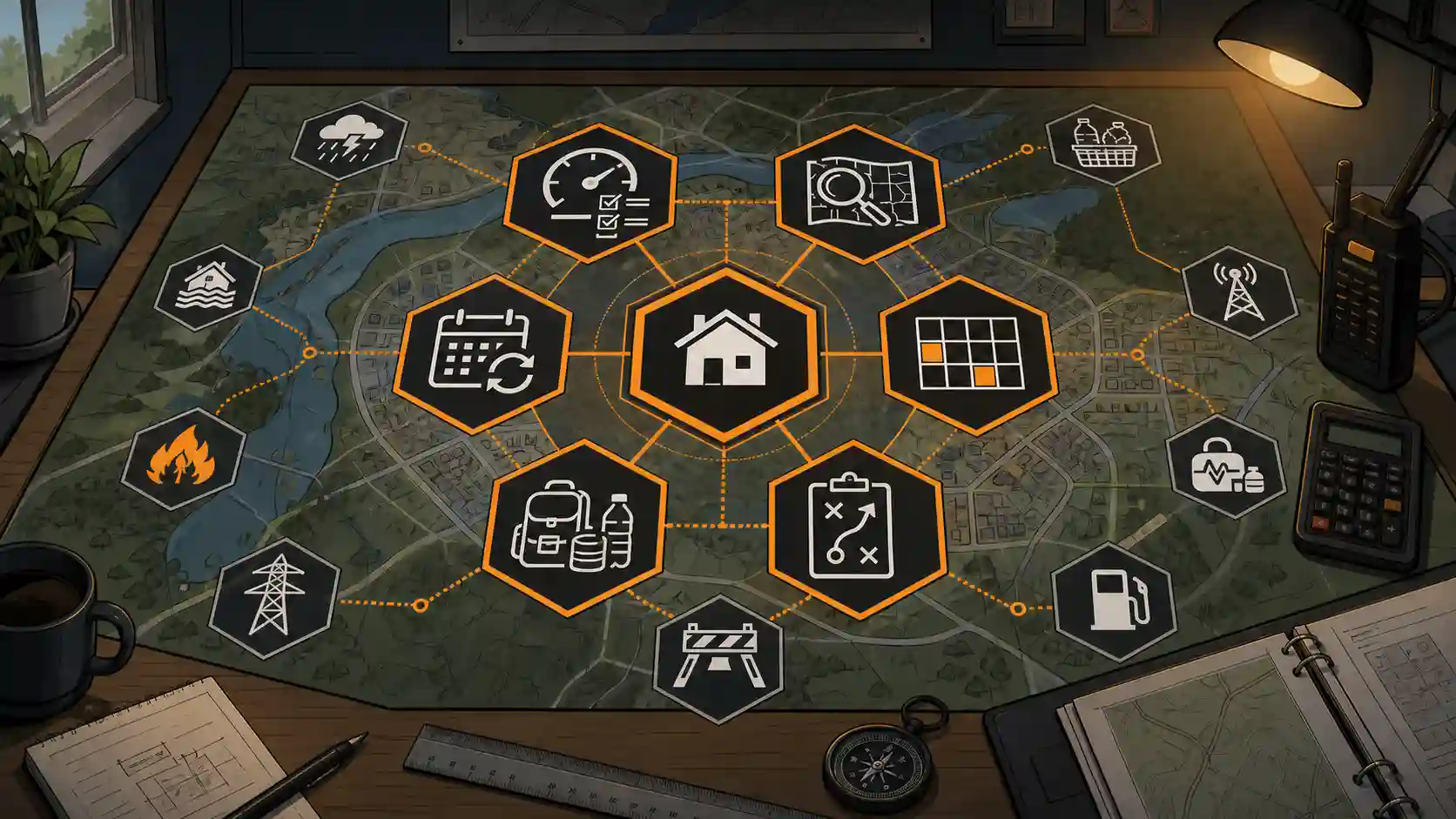
- Assess — Measure where you stand across every preparedness category, and set your scope. What are you preparing for, and what does “done” look like? Output: your Preparedness Index.
- Research — Learn everything you can about your area. Hazards, population, infrastructure, the things your life leans on. You can’t plan for threats you’ve never named. Output: your Threat Report and maps.
- Analyze — List every threat and score each one Impact × Vulnerability × Likelihood. Three honest ratings, multiplied, so any single factor can veto the others. This is where emotion leaves the equation. Output: a ranked threat list.
- Plan — Every ranked threat gets a plan with concrete goals: preparation, response, recovery. Above those sit category plans, where one effort closes several threats at once.
- Prepare — Actually do the plans. Learn the skills, buy the gear, store the supplies. One task at a time, on calm days.
- Maintain — Practice the plans, update them as life changes, run the drills and watch for developing threats that genuinely touch your area. This is the step most preparedness advice forgets, and it’s the one that separates a system from a weekend project.
Notice that buying things is step five of six. That is not an accident. It’s the whole point.
Bottom Line
The prepper community has produced a mountain of excellent answers to “how” and almost nothing on “what” and “why.” That’s backwards, because the “how” is worthless if you aimed it at the wrong threat.
You don’t need my framework to fix that. You need a framework — some repeatable way to answer, honestly, what’s around you, what it can do to you, and in what order it deserves your attention. This is mine, adapted from a process armies have used for a long time, refined by an engineer who got tired of guessing.
Start at Assess. Measure where you actually stand and write down what “finished” looks like for your household. The system will walk you through the rest of the steps so that you become better prepared for whatever comes.