


If you prep in a fire-prone place, you probably already have a go-bag. That’s the fire nobody forgets to plan for. The gap for most people is treating wildfire as an event — the day the fire comes — when for the majority it affects, it’s now a recurring season with two very different hazards on two very different clocks.
One is rare and fast: the flame front and the run for the exit. The other is common and slow: weeks of bad air. Here’s the part people get backwards. The scary one — flames at the door — is the one you’ll probably never face. The boring one — smoke — is the one you’ll almost certainly use your gear for, every year. So you build for both, and you’re honest about which is which: the smoke kit is seasonal equipment you’ll run for weeks at a stretch, and the evacuation plan is the thing that has to work flawlessly the one time you need it.
Two hazards, two clocks
- Fire front and evacuation — fast, local, hours. When a fire runs at a populated area, the whole problem becomes getting out ahead of it. Wind-driven fires move faster than people expect and throw embers a mile or more in front of the flames, lighting up houses well before the front arrives. The danger here is compressed time, jammed roads, and closed exits.
- Smoke — slow, regional, weeks. Wildfire smoke is a fine-particle hazard, and the dangerous fraction is PM2.5 — particles small enough to lodge deep in the lungs and cross into the bloodstream. A big fire can foul the air across an entire region for days to weeks, far past where anything is actually burning. The health effects run from scratchy eyes to serious heart and lung strain, and they hit kids, older adults, pregnant people, and anyone with asthma, COPD, or heart disease the hardest. This is the high-frequency face of the threat, and it reaches people who will never see a flame.
Your prep has to serve both, and the two toolkits barely overlap: filtration and sealing for the smoke, packed logistics and rehearsed routes for the run.
This is a step-change, not a bad year
The trend across the last couple of decades is a clear escalation — bigger fires, more intense fires, longer seasons, and smoke reaching cities that never see flame. National Interagency Fire Center data compiled by the Congressional Research Service shows average area burned has roughly doubled — from about 3.3 million acres a year in the 1990s to around 7 million acres a year since 2000 — even though the number of fires has held about flat. Read that again: same number of fires, twice the acreage. That means the individual fires are getting bigger, which is exactly the trend that produces region-wide smoke.
The recurring lessons from the bad seasons are consistent. Homes are most often lost to embers landing on fine fuels right around the house — not to a solid wall of flame rolling over them. Late evacuations get people killed on the road. And smoke’s reach means air-quality prep matters for millions who will never once be told to evacuate. The communities that hardened their homes and drilled their evacuations did measurably better than the ones that improvised.
The odds: middling on average, split by geography
On a 1-to-9 scale this lands mid-range — but that average hides a sharp split. In much of the fire-prone West and in a lot of forested and grassland country, some level of wildfire or serious smoke is now basically an annual expectation. Plan on running your smoke setup every year. In wetter or non-forested regions the direct fire risk is low, but downwind smoke can still find you. What sets your specific number:
- How close you live to fuel — forest, brush, or grassland near the house.
- Your regional fire climate — drought cycles, how much fuel has built up, and the dry downslope wind events that drive the worst fires.
- Where you sit downwind — even far from any fuel, the prevailing winds can route smoke to your door again and again.
The practical move: figure out which zone you’re in. If you’re in the annual-expectation zone, that smoke kit isn’t emergency gear you stash and forget. It’s seasonal equipment you run for weeks.
What it does — the cascade
The direct impact is serious: you could lose the house, and smoke exposure carries a real health cost. But the knock-on effects are what make this a regional problem instead of a personal one:
- Air-quality emergencies that shut down a whole region at once — outdoor work, school, and normal life on hold for everybody, not just you.
- Evacuation and displacement — sometimes tens of thousands of people, straining roads, shelters, and housing for weeks or months after.
- The power-shutoff overlap. Utilities increasingly cut power on purpose during high-fire-risk wind events — public safety power shutoffs — which turns your smoke problem into a smoke-plus-blackout problem at the exact moment you need filtration running. Your air purifier and your HVAC both run on electricity, and the worst air often shows up during a deliberate grid cutoff. That’s the cascade intermediate preppers miss most.
- Supplies and insurance strain — masks, filters, and purifiers sell out in the first days of a bad season, and insurance and rebuilding pressure follow the big fires.
Building it: breathe, leave, harden, watch
Breathe — treat indoor air as a system. The goal is one room you can hold clean for weeks.
- Upgrade your HVAC filter to a high-MERV rating (MERV 13 where your system can handle it) and run the fan on recirculate on smoke days.
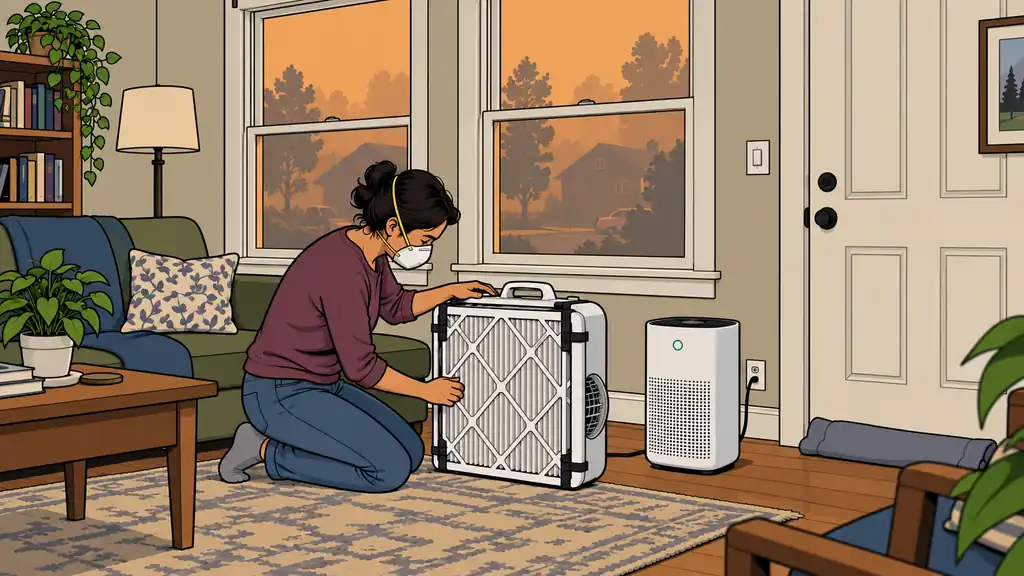
- Add a portable HEPA air purifier sized to at least one room — your designated clean-air room, ideally a bedroom. A DIY box-fan-plus-filter unit is a legitimate, cheap way to add capacity, not a compromise.
- Seal the room on smoke days: windows and doors shut, gaps addressed, HVAC on recirculate — not fresh-air intake.
- Stock NIOSH N95 respirators that seal to the face for the outdoor time you can’t avoid. A cloth or surgical mask does almost nothing against PM2.5; that’s not a mask, that’s a chin decoration. Size them for every person in the house, kids included where the fit works.
- Plan for the blackout overlap: a battery or generator that can at least keep the clean-air room’s purifier running through a power shutoff.
Leave — evacuation logistics.
- A packed go-bag per person, plus a household grab list of the irreplaceables — documents, meds, hard drives, keepsakes — stored so they load in minutes.
- Multiple pre-driven routes, because fire routinely closes the obvious one. Keep the tank above half all season.
- Set your triggers and a family comms plan in advance: what alert level makes you pre-stage, what level makes you go. And leave early — the evidence on this is not ambiguous. Late departure is the deadly mistake.
Harden — lower the ignition odds.
- Build defensible space: clear the fine and dead fuels in the first 0-to-5 feet around the structure — no bark mulch, no firewood, no dry brush against the walls — and thin and space the fuels farther out.
- Close the ember entry points: clean the gutters and roof, screen the vents, clear debris off decks and out from under eaves. Embers landing on fine fuel near the house is the dominant way homes ignite, so this is where the work pays.
Watch — pay attention in season.
- Sign up for county and regional emergency alerts, and know your local fire and air-quality sources.
- Track the local AQI and act on it early. Treat a rising PM2.5 number like a weather warning, because that’s what it is.
Bottom Line
- Wildfire is two hazards on two clocks: weeks of regional smoke (common) and a fast evacuation (rare) — build for both, and know which one you’ll actually use.
- Smoke’s danger is PM2.5. Hold one clean-air room with HEPA filtration, a high-MERV HVAC filter, sealing, and sealed N95s — not cloth masks.
- Plan for the blackout overlap — your filtration needs power exactly when the grid may be cut on purpose.
- Keep go-bags and a grab list ready, pre-drive multiple routes, keep the tank above half, and leave early — late evacuation is the fatal error.
- Harden the house against embers — defensible space, clean gutters, screened vents — because ember ignition, not a flame wall, is what usually takes homes.
In most fire seasons you’ll fight the air, not the flames. Win the clean-air room every year, and keep the bag and the route ready for the year you have to run.
Wildfire and smoke risk are sharply local — see where your county sits and what other threats pair with it in the Threat Report.