


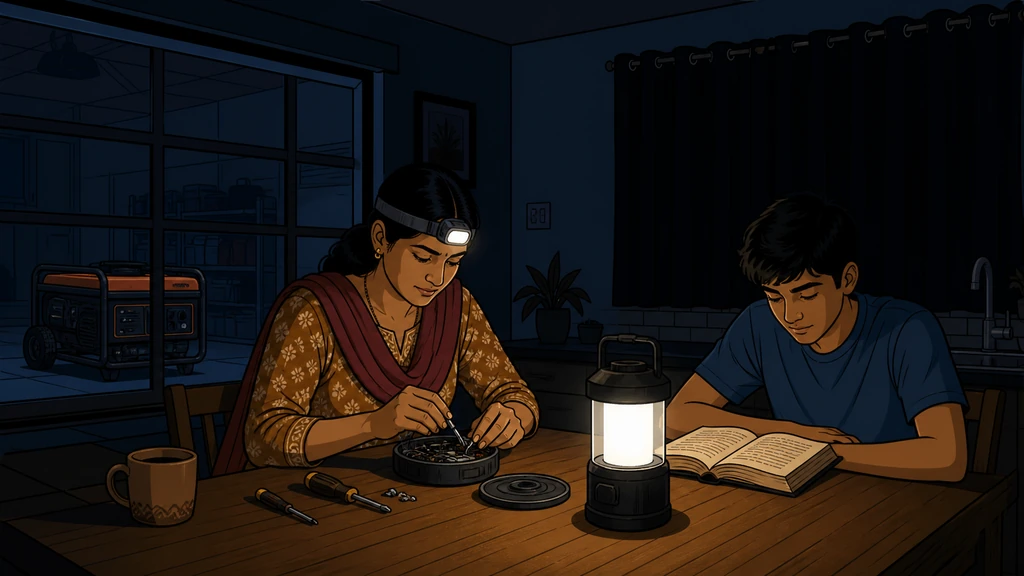
Preparedness spending chases the big, dramatic problems — the generator, the wood stove, the solar array. The humble flashlight gets treated as an afterthought, a junk-drawer item, something you’ll “grab if you need it.” That’s backwards. Of everything that goes wrong in a power outage, darkness is the only guaranteed one. The furnace might hold heat for hours; the fridge stays cold for most of a day. But the moment the sun sets, you are in the dark, every single time.
There’s a certainty here worth building on: it will get dark tonight, and every night after. It’s the most predictable emergency there is. So why treat the fix as an afterthought? The good news is that light is also the cheapest high-value prep you own — modern LEDs turn a handful of batteries into hours of usable light, and covering it well costs less than a tank of generator fuel.
Build light in tiers
One big lantern is not a lighting plan any more than one flashlight is. Think in layers, each doing a different job:
- On your body — always. A small flashlight in your pocket or a headlamp within reach handles the first thirty seconds of any outage: finding the breaker panel, the stairs, the other lights. A headlamp matters more than people expect — it puts light where you’re looking and leaves both hands free to actually do the work.
- Per room. A lantern or a standing light that fills a space so people aren’t fencing with flashlight beams. This is where the household gathers and functions after dark.
- Long-duration. For an outage measured in days, battery-powered light needs a fallback: fuel-based lamps — oil, kerosene, or white gas — or candles, which burn for many hours on stored fuel that never goes stale. The tradeoff is real: open flame is a fire and carbon-monoxide risk, so it’s the deep-reserve layer, used with ventilation and attention, not the everyday tool.
Standardize your batteries or drown in them
Nothing wrecks a light plan faster than five devices that each take a different cell. Pick a standard — settle on one or two battery sizes across your flashlights, headlamps, and lanterns — and stock deep in those. Add a rechargeable path: a set of rechargeable cells and a way to top them off (wall charger for now, a small solar charger or power station for a long outage) so your light isn’t a fixed number of hours ticking down to zero.
Rotate and check them. Alkaline cells leak and ruin the device they’re sitting in; a light you never test is a light that’s dead when you reach for it. This is the same rule that governs the generator and the stored fuel — untested gear is an assumption, not a prep.
Light is the one emergency you can see coming from the moment the sun goes down. It’s also the cheapest to solve completely. There’s no excuse for being caught in the dark.
Don’t burn your good power on light
Here’s why lighting sits at the cheap end even in a serious grid-down: an LED bulb sips a few watts, while a freezer full of meat or a well pump is where your real backup power has to go. When you size backup power from your loads, light barely registers on the budget — which is exactly why it should be covered by cheap batteries and stored fuel, freeing your generator or battery bank for the things that actually protect your water and food. Not relying on your generator for lighting allows you to cycle it periodically, making your stored fuel reserves go much longer as well.
One caution worth naming: after dark, light is a signal. A brightly lit house on an otherwise black street announces that you have power, supplies, and something worth having. In a genuinely bad stretch, blackout curtains and pointing light down and inward is a cheap piece of discretion.
Bottom Line
- Darkness is the guaranteed part of every day. Treat it as the certainty it is, not an afterthought — and it’s the cheapest problem on the whole list to fully solve.
- Layer it. A light on your body, a light per room, and a long-duration fuel-based fallback. Each does a job the others can’t.
- Standardize batteries and keep a recharge path. One or two cell sizes, stocked deep, with rechargeables so your light doesn’t just count down to zero.
- Spend cheap here, save your power for the freezer. LEDs cost almost nothing to run; protect water and food with your real backup power.
The generator is the hard, expensive decision. Light is the easy, cheap one — which is exactly why it’s inexcusable to get caught without it.
Account for every flashlight, headlamp, lantern, and the batteries and fuel that run them in your Supply Inventories — the whole tiered kit in one place, so nothing’s dead when the lights go out.