


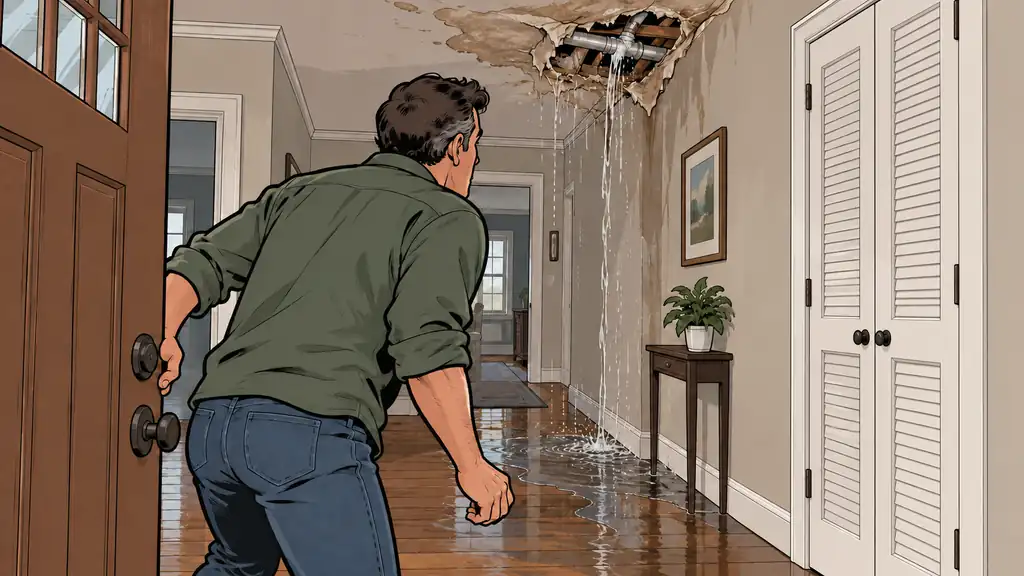
Water damage is the rare household threat that’s two things at once: nearly certain over the life of a home, and almost entirely preventable with a little knowledge and a few cheap devices. On our scale it’s likelihood 4, impact 4 — modest odds, low danger to people, but a real hit to your house and your wallet when it goes wrong. Repairs run into five figures. And the difference between a minor mess and a major one usually comes down to one thing: how many hours the water ran before somebody shut it off.
That’s the whole insight. A pipe that fails while you’re standing in the kitchen is a mop and a bad afternoon. The exact same pipe failing while you’re on vacation is new flooring, new drywall, and a mold job. Same failure — the only thing that changed is time.
Why it earns a spot
Preparedness is about the threats you’ll actually face, weighted by what they cost you. Water damage is one of the most likely things that will ever go wrong in your home, and while it won’t threaten your life, “low danger” still means a five-figure repair, weeks of disruption, maybe moving out during the fix, and the slow rot of mold. It’s a property-and-insurance problem — but a serious one, and one you control more completely than almost anything else on the list. The pipes are yours. Every failure point, every place you could put a sensor, every valve you could shut — all yours.
The one thing that sets the size of the loss
Nearly all serious water damage comes down to how fast the water flows times how long it runs before you stop it. You can’t always prevent a failure. But you can attack both halves of that equation: cut the odds of a failure happening at all (insulation, maintenance, replacing worn parts), and collapse the time between the failure and the shutoff (alarms that catch it, and knowing where the valve is). That’s the entire strategy, and it’s why this threat is so winnable.
Put a number on it. A crack as small as 1/8 of an inch can push out more than 250 gallons a day. Gone for a long weekend — call it 3 days — that’s 750-plus gallons through your ceiling before you walk in the door. An alarm that screams in the first hour turns those 750 gallons into maybe 10. Nothing else you do moves the number that hard.
Where it actually comes from
Three sources cause most household water damage. Knowing them tells you where to spend your effort:
- Frozen pipes. When water freezes it expands, and the pressure — not the ice — splits the pipe. The break often doesn’t show until the thaw, when water pours out of the crack. The vulnerable spots are exposed pipes in garages, crawlspaces, attics, and along outside walls. These are among the most expensive winter claims there are: State Farm alone paid over $181 million on nearly 9,000 frozen-pipe claims in 2022 — an average north of $20,000 each — because that tiny 1/8-inch crack just keeps running until someone kills the water.
- Water heaters. A tank corrodes from the inside over a service life of 8 to 12 years or so, then starts to leak or lets go entirely — dumping the full tank and refilling and leaking until it’s shut off. An aging heater with no drain pan and no alarm under it is a slow-motion flood on a timer.
- Slow leaks and failed connections. The supply lines to your washer, dishwasher, toilets, and sinks — often flexible hoses — get old and give out. The slow version rots cabinets and framing and grows mold behind the wall for weeks unseen. The sudden version — a washer hose that lets go — sprays at full house pressure until you stop it.
I had this recently myself. We came home after being gone for a weekend to find a bulge in the basement ceiling. Upon investigation, the supply line into the toilet in the bathroom above had started leaking. Thankfully, the damage was isolated and was something I could fix myself instead of needing an insurance claim, but it could have been much worse.
Where the risk runs highest
Real everywhere, but the mix shifts. Cold-climate homes carry more freeze risk. Older homes carry more from aging pipes and heaters. And homes left empty — vacations, second homes, snowbird properties — carry the worst severity risk, because that’s where a failure runs the longest before anyone finds it. The odds are modest but real over the years. Your job is to shrink the damage when the number finally comes up.
What it does after the water stops
The soaked drywall, flooring, and cabinets are the first bill. The second act is usually worse:
- Mold. Once porous materials stay wet, mold takes hold within a day or two. Cleaning it up is often more expensive and more disruptive than drying the original leak — it can mean tearing out drywall and flooring, and it carries health issues on top.
- Rot. Keep wood wet long enough and the framing and subfloor go, which can turn a plumbing problem into a structural one.
- Moving out. A serious event can make part or all of a house unlivable during the repair — weeks of drying, demolition, and rebuild.
- The insurance surprise. Not all water damage is covered. A sudden, accidental burst usually is. A gradual leak blamed on deferred maintenance often isn’t, and flood — water coming in from outside — is a separate policy entirely. Learning those lines after a loss is the worst possible time.
Building the defense
Four cheap subsystems, each tiny next to what it prevents. Measure your readiness here in response time and redundancy, not dollars spent.
1. Own your shutoffs — the single highest-value move. Find your main water shutoff and make sure everyone capable in the house can find and work it in the dark, under stress. Know the valve type: an old gate valve needs several turns and can seize solid with age; a ball valve is a quarter turn. Keep any wrench or key it needs staged right there. Then go one level down and map your secondary shutoffs — the little valves behind each toilet, sink, and appliance — so you can isolate one failure without killing water to the whole house. If your main is an old seized gate valve, replace it with a modern quarter-turn ball valve. A valve you can’t turn when it matters isn’t a valve; it’s decoration.
2. Beat the freeze. Sleeve exposed pipes with foam insulation — a few dollars a length and one of the best returns in all of home prep. Seal drafts near the vulnerable runs. In a hard freeze, let a faucet drip on the most exposed line (moving water resists freezing) and open the cabinet doors under sinks on outside walls so house heat reaches the pipes. Leaving for the winter? Either keep the heat on or drain the system.
3. Catch it early. Put leak detectors — cheap battery alarms — at every high-risk spot: under the water heater, behind the washer, under each sink, near the dishwasher, in the basement. They shrink detection time from weeks to minutes. The next tier up is a smart water monitor with automatic shutoff on the main line: it watches the flow, notices water running when it shouldn’t be, and shuts the house off by itself. That’s the strongest single upgrade for any home that sits empty regularly, because it attacks the time half of the equation even when nobody’s there.
4. Know your insurance before you need it. Read the policy for what water damage it actually covers and what your deductible is, and learn the sudden-versus-gradual and the flood distinctions cold. Photograph or video the house and your belongings so a claim goes smoothly. And put your water heater and appliance hoses on a replacement schedule instead of running them to failure — swapping a $15 hose on a calendar beats a $15,000 claim on a surprise.
Bottom Line
- Water damage is a real but occasional risk over the years (likelihood 4) but low danger to people (impact 4) — a property and insurance problem you have unusually strong control over.
- The size of the loss is flow rate times time undetected. Attack both: make failures less likely, and cut the minutes to detection and shutoff.
- Own your shutoffs — main and secondary — until anyone can kill the water fast, in the dark. Replace a seized main valve.
- Insulate pipes before winter and put leak detectors at every high-risk spot; add an auto-shutoff monitor if the home is ever left empty.
- Know your coverage, deductible, and the sudden-vs-gradual line before a loss, and keep hoses and heaters on a replacement schedule.
You can’t promise a pipe never fails. You can promise that when one does, it runs for three minutes instead of three days — and that’s the whole difference between a mop and a mortgage-sized repair.
See where hardening your plumbing ranks against the rest of your threats with the Threat Planning tool.