


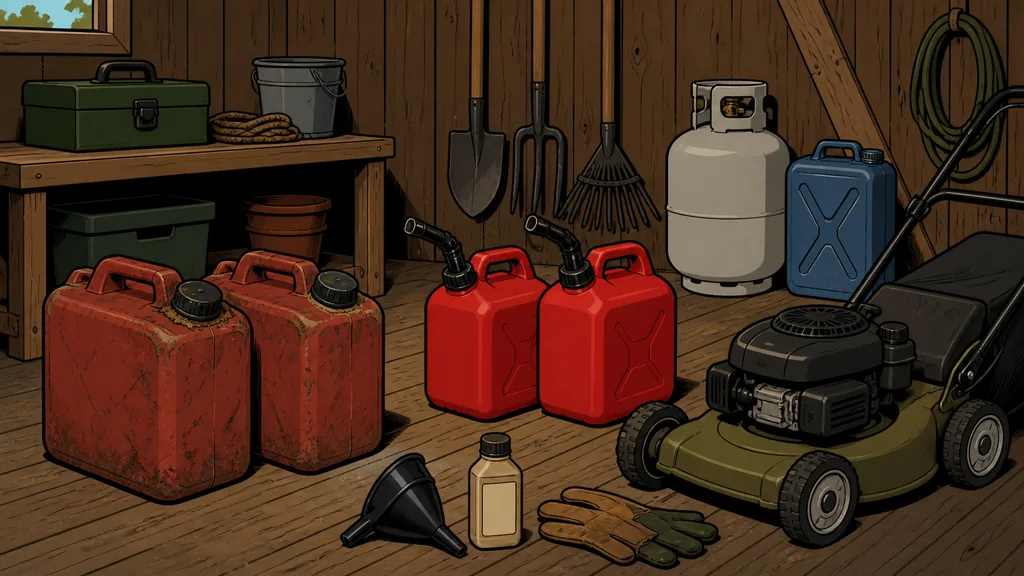
A row of full jerry cans in the garage feels like money in the bank. It’s the most tangible prep there is — you can lift it, smell it, count it. So it’s easy to buy fuel once, stack it, and mentally check the box. Then the power goes out eight months later, the generator coughs, sputters, and quits on gummed-up gas, and the “bank” turns out to have been quietly emptying itself the whole time.
Fuel is the one supply that degrades on your shelf whether you touch it or not. Food you can eat late; water you can filter. Stale gasoline just fails — at the exact moment the whole plan depended on it starting.
Every fuel is on a clock
The clocks run at wildly different speeds, and that difference should drive what you store:
- Gasoline is the sprinter — the shortest-lived and the most demanding. Untreated, it starts oxidizing and losing volatility in a matter of months; ethanol-blended pump gas is worse because the ethanol pulls water out of the air.
- Diesel keeps longer, but its enemy isn’t volatility — it’s water and microbial growth, the “diesel algae” that clogs filters. Store it dry and sealed and it lasts considerably longer than gas.
- Kerosene is one of the most storable liquid fuels — kept sealed, dry, and cool, it holds for years, which is part of why it earns a place in a heat and light plan.
- Propane is the outlier: the fuel itself doesn’t degrade. A 20-lb bottle stored for a decade holds the same energy it did on day one. The clock that matters for propane is the tank — valves, seals, and the recertification date — not the gas inside it.
Notice the pattern. The fuels that store the worst are the ones people stack the most of. That’s backwards.
Stored liquid fuel isn’t an asset sitting on a shelf. It’s a countdown, and the only way to stop it running out is to keep resetting it.
Rotation is the entire game
There’s exactly one way to beat the clock on gasoline and diesel, and it isn’t a better additive. It’s use. Fuel you cycle through your vehicles, your mower, your generator’s monthly test run — that fuel never gets old, because it never sits. The cans in the garage are a buffer you’re constantly draining and refilling, first-in-first-out, not a monument you pour once and admire.
Stabilizers buy you time inside that cycle; they don’t replace it. Think of a stabilizer as extending the rotation window, not as a way to store fuel forever and forget it.
This is where a real inventory earns its keep. “I have some gas out there” is not a plan. “Six cans of stabilized non-ethanol gas, filled in March, rotated every spring” is. Write down the type, the quantity, and the fill date, and the rotation schedule enforces itself.
This is what I do. I currently have two 55 gallon barrels of gasoline and two of diesel fuel. All get stabilizer when I buy it, and I’m always using out of two drums with two as backup. When one gets emptied, it gets refilled and placed as the backup and the old backup gets put into use. This way, I’m always using good fuel for my farm equipment and lawn mower, and always have enough fuel on hand to run my generator for as long as I would need. Lately, I’ve been using it a bit faster, so I may soon add a 3rd barrel of each - I can do this because I test.
Even if my farm usage wasn’t enough, there’s always another option that I touched on earlier - run it through your car/truck if the shelf life starts to get too old. Doing this, you can probably store nearly as much fuel as you would want to…
Store to a number, then store it safely
The same discipline that runs the backup heat plan runs fuel storage: start from a number. How many hours does your generator need to run per day, at what fuel burn, for how many days? That gives you gallons — a target you can measure against — instead of a vague pile.
Then respect what you’re storing. Gasoline vapor is the bigger hazard, and quantity, container type, and distance from the house are governed by fire code for good reason. Use approved containers, keep fuel cool and ventilated and away from ignition sources and living space, and know your local limits before you scale up.
Back to my example, I store my fuel in the barn, far away from the house. It’s kept out of the sun to minimize expansion/contraction (the contraction likes to pull in air containing water). Most importantly, I have no ignition sources near it.
Bottom Line
- Match what you stack to how it stores. Propane and kerosene keep for years; gasoline is a sprinter. Don’t build your reserve out of the fuel that dies fastest.
- Rotate or lose it. First-in-first-out through your vehicles and equipment is the only thing that actually beats the clock. Stabilizer extends the window; it doesn’t stop time.
- Store to a calculated number. Days of runtime × burn rate = gallons. A measured target beats a random pile.
- The vapor is the danger. Approved containers, cool and ventilated, away from the house and ignition, within code.
Fuel feels like the most solid prep you own. It’s actually the one with a countdown running on it — treat it that way.
Log every fuel, its quantity, and its fill date in your Fuel Inventories so rotation runs on a schedule instead of on luck.