


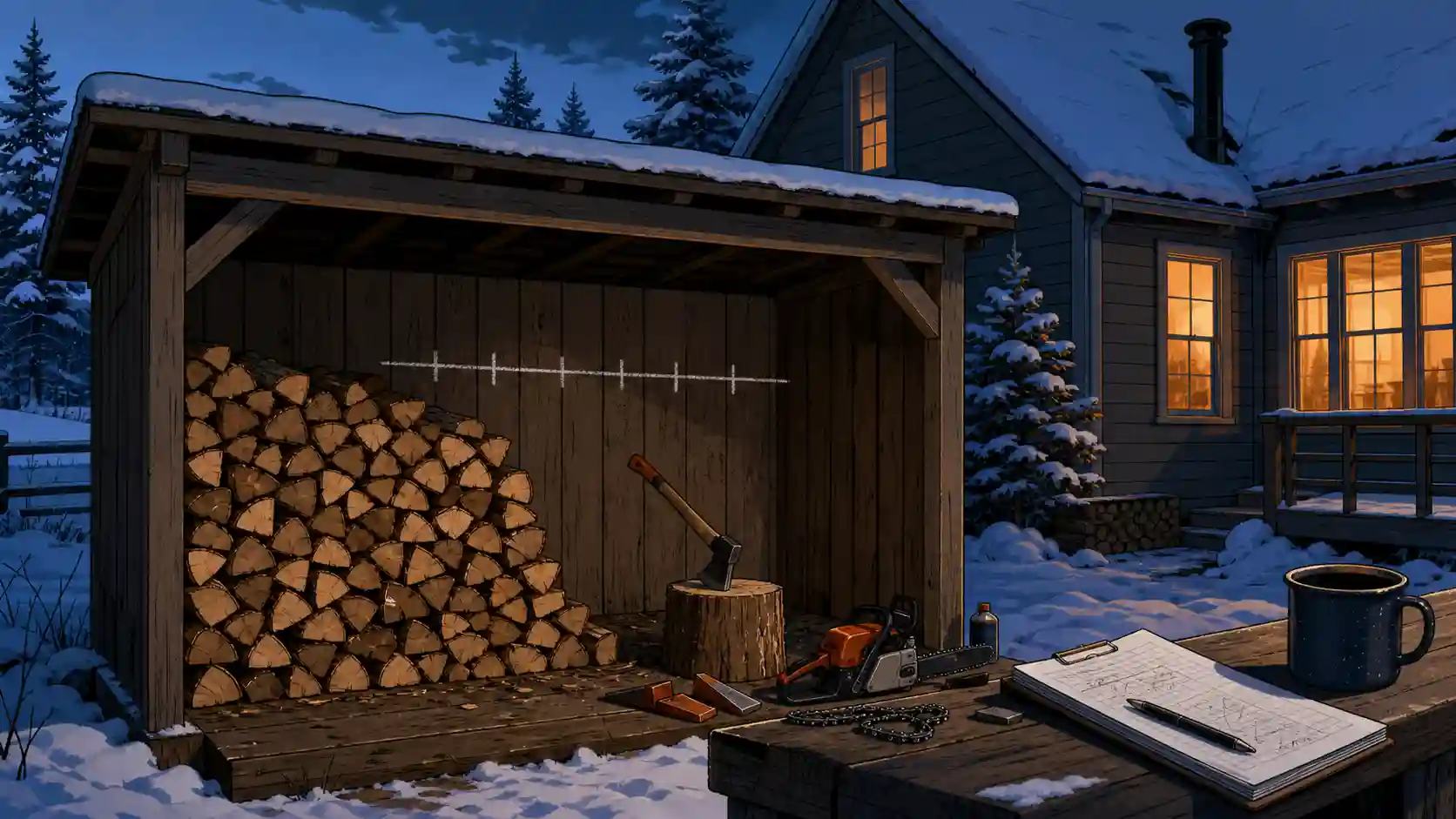
Backup heat is where preparedness spending goes to feel productive. A wood stove gets installed, a few ricks get stacked out back, and the box gets checked. Then the power goes out in January and the honest question finally shows up: is that enough wood, or not?
Nobody can answer it, because the plan started at the stove. It should have started at a number.
Get the number first
Your house needs a specific amount of energy to stay warm through a winter. That amount doesn’t care what you burn. Work it out once and every other decision — fuel, storage, how much land you need, whether you buy a splitter — falls out of it.
For my house, the number is about 15.4 million BTUs for the whole winter, on average. I plan against that figure even though we could drop the thermostat and burn less. If the estimate is going to be wrong, I want it wrong in the direction that leaves us warm.
That single number is what makes the fuel comparison possible. Without it, you’re comparing stoves. With it, you’re comparing answers.
Run the fuels against it
Here’s the comparison for my house, using the same 15.4 million BTUs:
Wood. A cord of dry hardwood averages 21.3 million BTUs. After stove efficiency, heating the house takes roughly 2 cords a year. January — the worst of it — runs about 4.3 million BTUs, which works out to about 40 lbs of wood per day.
Propane. Heating the house on propane alone would take 716 lbs per year. It’s neither practical nor cost-effective to store that much, and it doesn’t sustain past one winter. Propane runs out and can’t be replaced without a supply chain.
Wood wins here on energy density, cost, and availability — but notice why it wins. It wins because of a number I calculated before I shopped. Run the same math on your house, in your climate, and you might land somewhere else entirely. That’s the point. The method travels; my answer doesn’t.
So: wood is the primary, with some propane heat capability for limited redundancy or enhanced comfort. That’s a plan. “I have a wood stove” is not.
The number sets the target, and the target finds the gaps
Two cords a year means the target is at least 3 cords on hand — one of which can be green, seasoning for next year. That’s what “prepared” means here, stated as a quantity I can walk outside and verify.
Right now I have 2.2 cords. That gap is the to-do list, and it only exists because there’s a number to measure against. A vague sense of “I should probably get more wood” doesn’t survive a busy autumn. “I’m 0.8 cords short” does.
The number also drags a second set of requirements into view — the ones people miss until it’s too late to fix them. If wood is the plan, then long-term the plan is really harvesting wood, not storing it. That means chainsaws, axes, splitting wedges, mauls, bar oil, spare chains and sharpening files. It may well mean a hydraulic splitter. Two cords a year is a real, recurring amount of work, and the tools to do it are part of the heat plan whether you wrote them down or not.
This is what the framework calls a category plan — the place where a general need like “stay warm during a power outage” becomes a measured quantity and a route to get there. Threat plans point at it. It’s the one place the actual number lives.
Bottom Line
Fuel is an engineering problem with an arithmetic answer. Do the arithmetic.
- Calculate your winter BTU load. Your house, your climate, your tolerance for a cold living room. Everything downstream depends on this.
- Convert it to fuel. Cords, pounds, or gallons depending on the fuel type. Now the options are actually comparable.
- Set a stored target and check it against reality. The difference between target and actual is your plan.
- Add the means to make more. Stored fuel buys you a season. The ability to harvest it is what carries you past one.
The stove is the last decision, not the first. Get the number and the rest of it stops being a matter of opinion.