


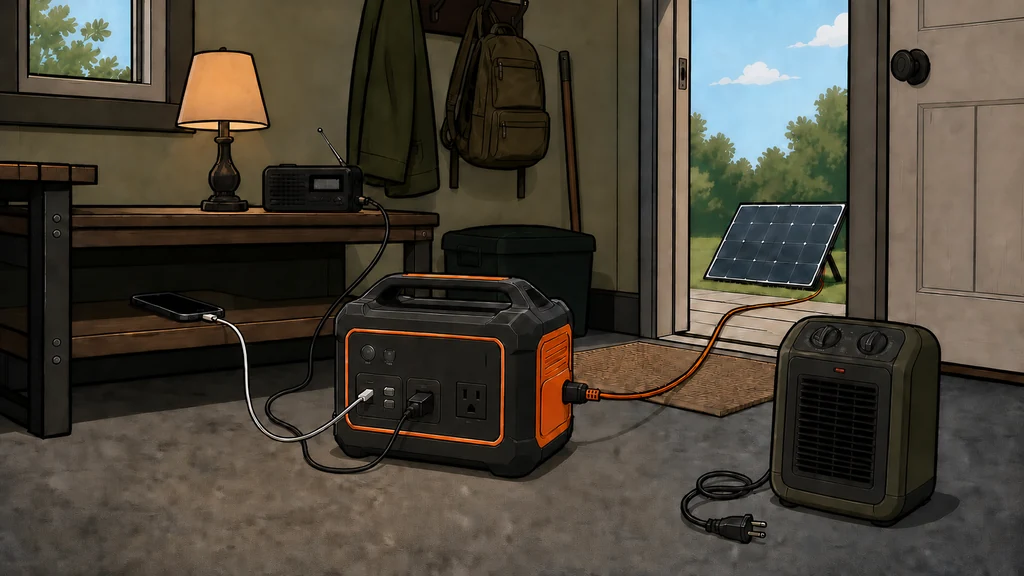
The marketing writes itself: a sleek box with a handle, a bank of outlets, and the words “whole-home backup” across the top. Wheel it out, plug in, and ride out the storm. It’s clean, it’s quiet, it’s idiot-proof — and it has quietly reframed a hard engineering problem as a shopping decision. So people buy the biggest one they can afford and consider power handled.
Here’s the reframe that matters: a portable power station is a battery, not a generator. A generator makes power for as long as you feed it fuel. A power station holds a fixed pile of watt-hours that only goes down — and the entire question of whether it saves you or strands you comes down to how you put those watt-hours back.
Know the two numbers, not the big one on the box
The number in the product name is the rated capacity — say, a “1,000 Wh” unit. That’s not what you get. Real usable energy is lower: the inverter loses some converting the battery’s DC to household AC, and you can’t safely run most packs to a hard zero. Plan on delivering meaningfully less than the label. You’ll need to read the spec sheet and see what true capabilities you’ll get before you buy as they’re not all created equal - some manufacturers are more “honest” with their advertising than others.
Then do the only arithmetic that matters:
usable watt-hours ÷ device watts = hours of runtime.
That single division deflates most fantasies. A modest fridge or chest freezer drawing a couple hundred watts, cycling on and off, can lean on a mid-size station for a day or so — useful, real, and finite. The same station running a space heater pulling 1,500 watts is empty in well under an hour. High-heat loads — space heaters, kettles, hair dryers, most cooking — will drain any portable battery almost immediately. Know which of your devices are sippers and which are firehoses before the outage, not after.
A power station doesn’t run your house. It runs a short list of chosen loads for a chosen number of hours — and then it’s a heavy box until you refill it.
The refill is the whole plan
A battery with no way to recharge is a one-shot. That’s the part the box doesn’t advertise. Your options in an actual outage:
- Wall outlet — fastest, and gone, because the grid is down. That’s the whole reason you’re using the thing. In a local outage, you may be able to take it to work or to a friend or relative’s house to charge, but you can’t always count on this option.
- Vehicle — slow, but it works: idle the car and trickle the station back up. Real, but it costs fuel and hours.
- Solar panels — silent and open-ended, but slow and weather-dependent. A panel that refills the pack over a sunny day is what turns a station from a bridge into something you can actually live on — and in a winter outage, the season you most need it, the sun is lowest and the days shortest.
Without a recharge source matched to the station, you don’t have backup power. You have one tank of it.
Where it actually fits
A power station isn’t a bad tool — it’s a specific tool, and it beats a generator in the places a generator can’t go. It’s silent, emission-free, and safe to run indoors, which makes it the right answer for an apartment, for keeping a CPAP and phones and a radio alive overnight, for medical devices, for the quiet critical loads. A generator wins on sustained, heavy output — a well pump, a real fridge-and-freezer combination, days of runtime — as long as you have fuel. A solar array wins on open-ended, hands-off supply.
The mistake is buying the battery expecting the generator’s job. Match the box to the loads it will actually carry, the same way you’d size any backup power system from the loads first — and pair it with a way to refill it — and it earns its place. Skip that, and you’ve bought a very expensive, very quiet paperweight.
Bottom Line
- It’s a battery. A fixed number of watt-hours that only goes down. Think in “hours of this device,” never in “backup for the house.”
- Use the two real numbers. Usable capacity is below the label; divide it by your load’s watts to get honest runtime. Heat loads empty it fast.
- The recharge source is the plan. Wall power is gone in an outage — solar or vehicle is what makes it more than one shot, and winter sun is the weak link.
- Buy it for what it’s good at. Silent, indoor-safe power for critical small loads. For heavy sustained draw or days of runtime, that’s a generator’s or an array’s job.
Quiet, clean, and simple are worth a lot. Just don’t let the handle and the marketing convince you a battery is a generator.
Turn your device list into a watt-hour number with the Solar Calculator — the same figure a power station has to cover, so you buy capacity that matches the loads instead of the label.