Threats  /  Tornado

Tornado

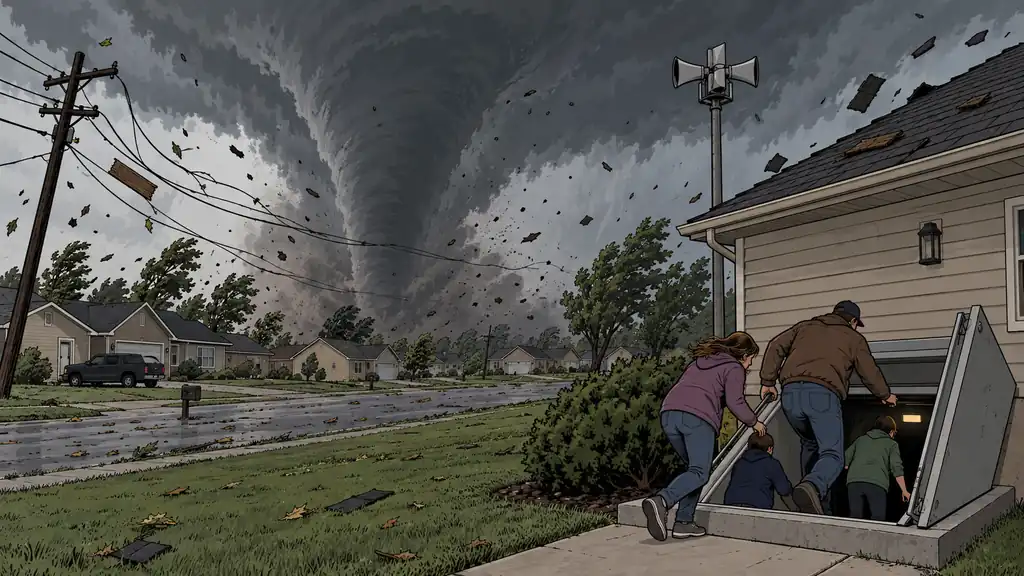
The room, the kit, the trigger — three decisions made on a calm day so nobody decides during the warning.
ScopeLocalCauseNaturalDriven byLocationImpactMajorLikelihoodPossible
Tornado
Why it matters

What Tornado would mean for you

Three numbers decide how important Tornado is to your preparedness planning. Impact and Likelihood are general baselines. Vulnerability depends on how prepared you are for this threat.

ImpactMajor8/9
NegligibleCatastrophic

A direct hit on an unprepared home is deadly - winds level structures in seconds with little warning, so the Impact for those in the path is severe.

LikelihoodPossible6/9
RareFrequent

In tornado-prone regions they arrive most years, making the Likelihood high there; far lower elsewhere, so it varies sharply by geography.

VulnerabilityNot rated
NegligibleCatastrophic

This number is yours. It measures how hard Tornado would actually hit your household given what you already have in place. Rate it in Threat Planning — then all three multiply into your personal threat rating.

Rate it in Threat Planning →

General baselines — How we rate threats →

What drives it

Potential causes

  • Supercell thunderstorms and strong frontal systems, where warm, moist air collides with cold, dry air.
  • Peak season in spring and early summer, most often in the late afternoon and evening.
  • Hurricanes and tropical systems, which can spin up tornadoes well inland.
Early warning

Signs & warnings

  • A National Weather Service tornado WATCH (conditions are favorable) or WARNING (one is imminent - act now).
  • A dark, often greenish sky, a lowering wall cloud, or large hail.
  • A loud, continuous roar like a freight train that doesn't fade.
  • A sudden calm or wind shift, or a visible debris cloud near the ground.
Be ready

Preparing for Tornado

Concrete moves that lower your Vulnerability. Add any of them and we'll track it as an action on your threat list.

Add to my threat list
Before

Prepare beforehand

Moves to make on a calm day, before it ever happens.

Identify your safe room - the lowest floor, most interior room, away from windows.
Get a NOAA weather radio with battery backup and turn on Wireless Emergency Alerts.
Decide your shelter trigger in advance and drill the route with everyone.
Stage shoes, head protection, a whistle, and a flashlight in the shelter spot.
During

When it happens

What to do in the moment.

Go to your safe room the instant a warning is issued - don't wait to confirm it.
Cover your head and neck; get under sturdy furniture or a mattress.
Stay away from windows and exterior walls.
In a vehicle or mobile home, get to a sturdy building immediately - don't try to outrun it.
After

Recover

Getting your household back to normal afterward.

Wait for the all-clear; treat every downed line as live and watch for gas leaks.
Check on family and neighbors, especially the elderly and anyone alone.
Photograph all damage before you clean up - your insurer will need it.
Wear sturdy shoes and gloves; assume damaged structures and debris are unstable.
Learn more

Articles on Tornado

Keep close

Resources for Tornado

See it on the map

Tornado where you live.

Where tornadoes actually touch down — every recorded track since 1950.

Loading the map…
Lower
Higher

A national view — this is one of 410+ layers in Area Recon. Open it to zoom to your address, then add the hazards, infrastructure, terrain and resources around you, and read the real numbers for your county.

Explore in Area Recon →
Act on it

Tools for Tornado

Make Tornado part of your plan

Add it to your personal threat list, score it for your own household, or pull the real hazard data for your county.