


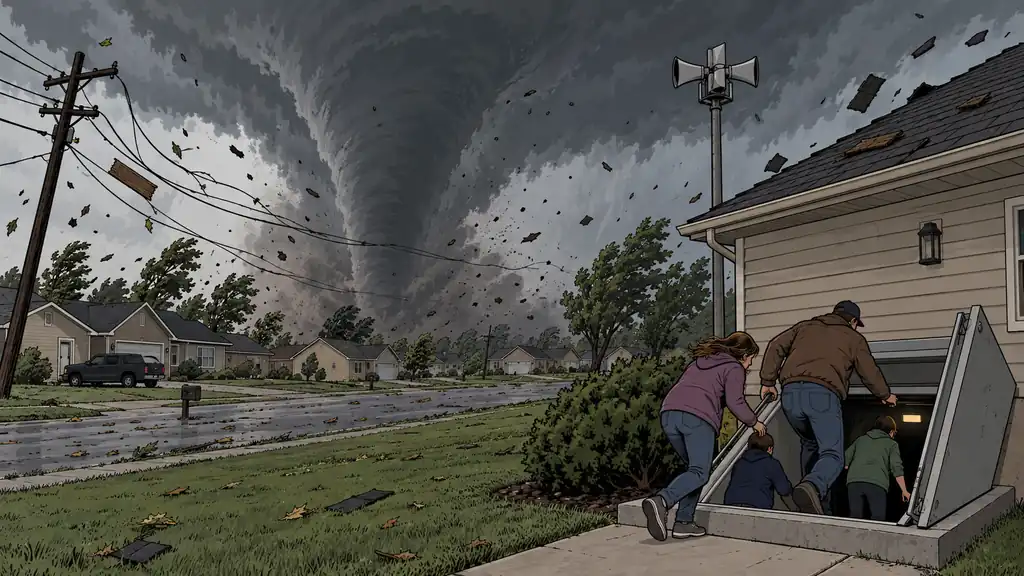
Most people respect a tornado’s power. That’s not the dangerous mistake. The dangerous mistake is assuming you’ll have time to figure out what to do when one is coming. You won’t. A tornado warning can beat the storm to your door by only a handful of minutes, and those minutes get spent moving, not deciding.
Every good tornado outcome traces back to decisions made when the sky was clear: the room, the kit, and the trigger. Fix those three and you’ve done the part that actually saves lives. Everything else is detail.
Where a tornado sits as a threat
A tornado is a local hazard from a natural cause. On our scale it rates impact 8, likelihood 6 — but that likelihood is a regional average hiding a sharp geographic gradient. The impact is not in dispute. A direct hit on an unprepared house is about as deadly as weather gets, because it stacks three things at once: the building coming apart, high-speed debris, and almost no time to react.
The likelihood is high where they cluster and low everywhere else. So the first real step isn’t buying anything. It’s knowing your geography.
What actually makes a tornado
Tornadoes drop out of the rotating updrafts inside supercell thunderstorms — usually when warm, moist air runs into cool, dry air under strong wind shear. That’s the setup that owns the central and southern U.S. in spring and early summer. Two regional patterns change how you plan:
- The Plains (“Tornado Alley”). Classic spring-afternoon supercells. Often better visibility and somewhat more lead time.
- The Southeast (“Dixie Alley”). The more dangerous profile in practice: more tornadoes at night, more rain-wrapped ones you never see coming, more mobile homes, and often faster-moving storms.
That second one deserves numbers, because the danger isn’t the wind speed — it’s the clock. Research in the journal Weather and Forecasting found nighttime tornadoes are about 2.5 times more likely to be deadly than daytime ones, and the Southeast gets hit after dark far more often than the Plains. Manufactured (mobile) homes, common across the region, account for roughly half of all U.S. tornado deaths while housing a small share of the population. Same EF rating, deadlier outcome — because the time you have to get to shelter is effectively shorter.
Intensity runs the Enhanced Fujita (EF) scale, EF0 to EF5, rated by damage. The line that matters to you is EF2 and up. At those wind speeds a normal wood-frame home starts failing at its connection points, and “get low, get interior” is doing real work instead of just making you feel better.
Watch versus warning — know this cold
- Tornado Watch: conditions are right for one. Be alert, know your plan, watch the sky and the radio. Don’t shelter yet.
- Tornado Warning: one has been spotted or shown on radar in your area. Shelter now. This is your trigger.
Mixing these two up is the common, costly mistake. Either you ignore a warning because you’re numb to watches, or you burn yourself out reacting to every watch. The rule is simple: a warning for your location means move.
How likely is it, honestly
The U.S. averages roughly 1,200 tornadoes a year (NOAA), more than any country on earth — but they’re bunched up in space and time. For your region, if you’re in the central plains or the Southeast, watches and warnings are a most-years event. For your specific house, a direct hit in any given year stays low: tornado paths are narrow.
Both things are true at once, and both matter. The regional frequency is why you build the plan. The low per-home odds are why you build it calmly instead of fearfully. Outside the high-risk corridors the threat is real but rare enough to run a lighter plan — though a weather radio is cheap enough to own anywhere.
They follow similar paths
One thing I’ve noticed being in an area with our share of tornadoes and other severe weather is that it typically follows the same paths. My house for instance hasn’t had a tornado within 4 miles over the last 50 years. To see how your site compares, use Area Recon — it contains every tornado path in the US since 1950.
Work the clock
Here’s the math that makes this concrete, in the only unit that counts — time.
A warning might hand you 10 minutes. Sometimes 5. Now count what it takes to get everyone into the safe spot. A household that has drilled it — shoes and gear already in the room, one agreed rule, no debate — is sheltered in about 2 minutes. A household starting cold at 2 a.m. burns those minutes waking up, arguing about whether it’s real, hunting for shoes and the dog, and deciding where to go. That family can eat 8 or 10 minutes before anyone is actually safe.
The tornado doesn’t care how much gear you own. It cares whether you were in the right spot when it arrived. Every prep below is aimed at shrinking that number from 10 minutes to 2.
The three decisions, expanded
1. The room. Lowest floor, most interior, no windows, as many walls between you and the outside as you can get. Priority order: a purpose-built storm shelter or basement, then a small interior ground-floor room (bathroom, closet, under the stairs), then an interior hallway. If you live in a mobile home, your plan is to leave it. Manufactured housing gives essentially no protection in a real tornado, so the single most important decision you can make is picking a sturdy shelter nearby — a neighbor’s basement, a community shelter — and knowing it now, not at warning time.
2. The kit — kept in the room. Sturdy closed-toe shoes, because you may be walking out through a debris field. Helmets or bike helmets for everyone, because head trauma from flying debris is a top injury. A whistle each, so a trapped person can signal long after their voice gives out. A flashlight and a phone charger. Add a little water and a small first-aid kit if you like. The whole point of keeping it in the shelter is that you will not have time to gather it.
3. The trigger and the drill. Agree the rule out loud, once, on a calm day: “Warning for us means safe room, no debate.” Then walk it as a family until it’s automatic. The piece that makes the trigger reliable at night is a NOAA Weather Radio with battery backup and SAME (county-specific) alerting — it wakes you when your phone is silenced or dead. Pair it with Wireless Emergency Alerts on your phone as a backstop. For the Southeast’s after-dark problem especially, the weather radio isn’t optional. It’s the thing that gets you out of bed at 3 a.m.
Don’t stop at the funnel
The storm is over in a minute; the mess isn’t. A strong tornado can knock out power, water, and roads across a wide area for days, and a fresh debris field is full of downed lines, gas leaks, and sharp metal. So a few days of household self-sufficiency — water, food, light, a way to check on people — belongs in tornado prep even though the tornado itself lasts seconds.
Bottom Line
- Geography sets your risk. Plains and Southeast are high-frequency; the Southeast’s nighttime, rain-wrapped storms are the deadlier profile.
- Learn watch versus warning cold. A warning for your location is the trigger to move, right now.
- Fix the room in advance — lowest, interior, windowless. If you’re in a mobile home, your plan is to leave for something sturdier.
- Keep shoes and gear in the shelter. Debris causes the injuries, and you won’t have time to grab it.
- Own a NOAA radio with battery backup. It’s what wakes you for the 3 a.m. warning nothing else will.
The warning doesn’t give you time to plan. It gives you time to run a plan you already made — that’s the entire game.
See how your tornado risk compares to other counties on the Tornado Risk Map, and build your household shelter checklist in the Digital Binder.