


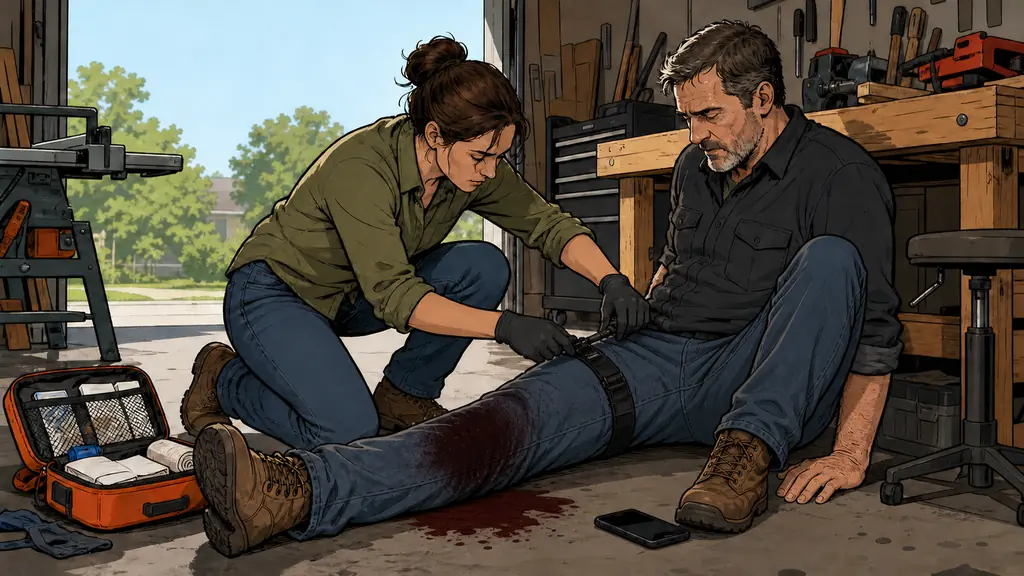
Most medical emergencies give you time. You can drive to urgent care, wait in an ER, call a nurse line. A major bleed doesn’t. A serious arterial wound can empty enough blood to kill before help arrives — and that’s true on a normal day with a working 911, let alone in an emergency when the ambulance isn’t coming at all.
That combination — fatal in minutes, and you’re the only one there — is what makes bleeding control different from every other item in this category. For most of medical prep, the honest answer is “stabilize and get to a professional.” For a hemorrhage, you are the professional for the first several minutes, and those are the minutes that decide it.
Uncontrolled bleeding is the most survivable cause of preventable death — but only if the person standing there knows what to do in the first minute.
Why this one, and not the whole trauma textbook
You can’t learn field surgery from an article, and you shouldn’t try. But bleeding control is different: the interventions are few, they’re physical, and a motivated person can become genuinely competent in an afternoon. The payoff-to-effort ratio isn’t close to anything else in the kit.
The core moves are simple to name and worth learning in order:
- Direct pressure. Hard, focused pressure directly on the wound, and keep it there. Or said another way, “Put your thumb in it.” This alone stops most bleeding. The common mistake is letting up to look if the bleeding has stopped.
- Wound packing. For a deep wound in a spot you can’t tourniquet, packing gauze firmly into the wound and holding pressure. This is a taught skill — the technique matters.
- The tourniquet. For a life-threatening limb bleed that pressure won’t hold. A real commercial tourniquet, applied high and tight, is the tool that turns an arterial bleed into a survivable one. Buy quality — cheap knockoffs fail under load.
Notice what’s not on the list: nothing you improvise, nothing you guess at. This is a short, learnable set — which is exactly why it’s the place to start.
Reading it is not knowing it
Here’s the trap. You buy the tourniquet, you watch the video, you feel prepared. Then the real moment arrives — blood, adrenaline, a person you love — and you discover that watching a tourniquet get applied and applying one are not the same skill. Fine-motor tasks under stress degrade to whatever you’ve actually practiced.
So the prep isn’t the purchase. It’s the reps:
- Take a hands-on course. Stop the Bleed is a real, widely available bleeding-control class built for exactly this — laypeople, one session, hands on real trainers. First-aid/CPR courses stack on top of it.
- Practice on the gear you actually own. A tourniquet you’ve applied to your own leg twenty times is a tool. One still in the wrapper is a hope.
- Keep it fresh. Skills decay. Put a bleeding-control drill on a recurring schedule so it doesn’t quietly rot between the day you learned it and the day you need it.
A trauma kit with an untrained owner is a bag of expensive props. A trained owner with a roll of gauze is a first responder. The gap between those two is a class and some practice — not more shopping.
Where the kit lives matters too
The best bleeding-control kit is the one within reach when it happens — and it rarely happens at the medicine cabinet. One on each vehicle, one where you run power tools, one where the family spends time. A tourniquet three rooms away during a two-minute emergency might as well be at the store.
Bottom Line
- A major bleed is the one that can’t wait for help. Fatal in minutes, and you’re the person on scene — that’s why this skill comes first.
- The core moves are few and learnable. Direct pressure, wound packing, tourniquet — in that order, on real training, not from memory.
- Reps, not purchases. Take a hands-on class and practice on your own gear until it’s muscle memory, then keep it fresh.
- Stage the kit where bleeds happen. Vehicles, workshop, common areas — not just the bathroom cabinet.
Put a bleeding-control drill on a recurring cadence with Reminders so the skill stays sharp — and log the gear itself in the Medical & Hygiene inventory.