


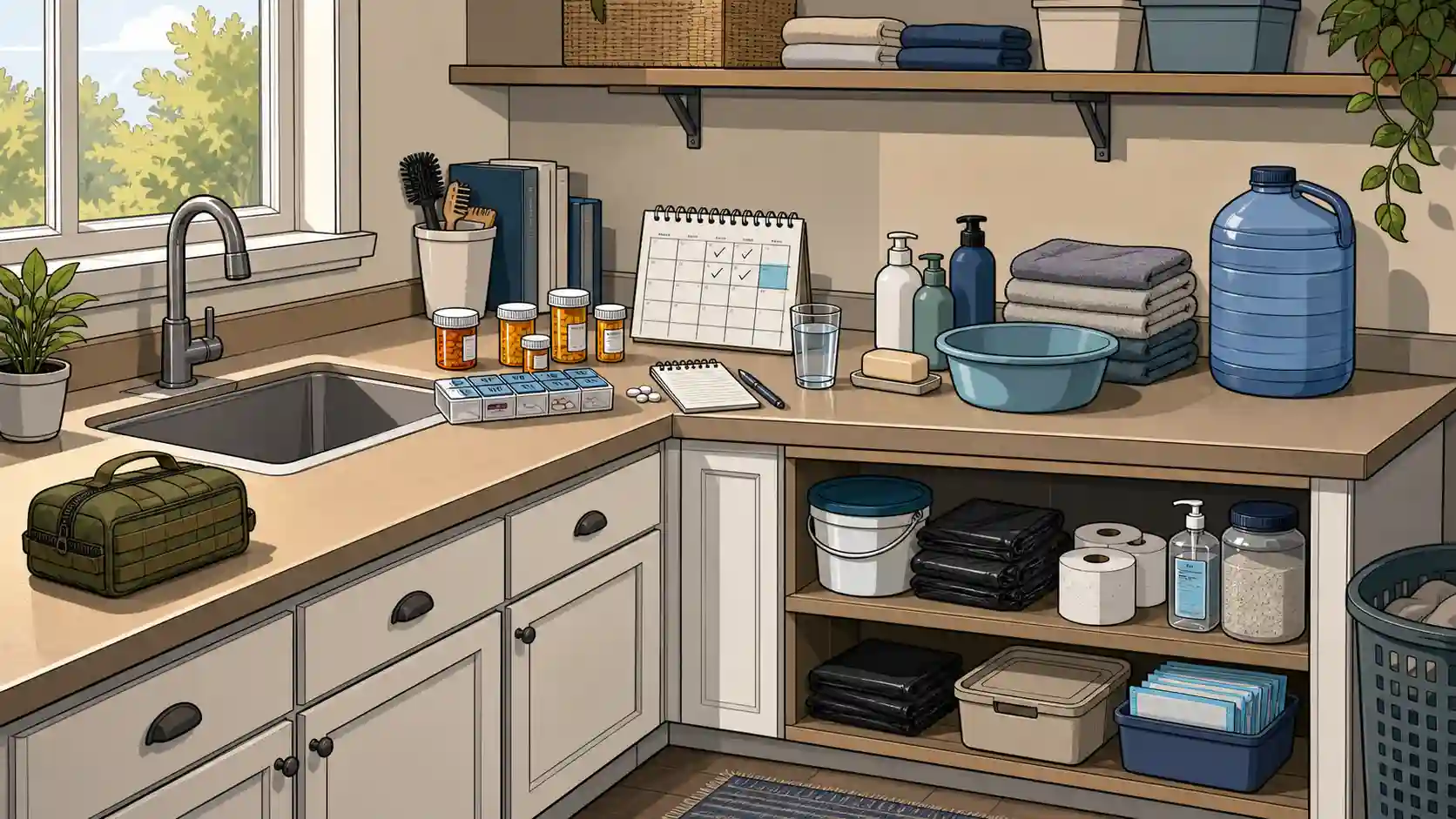
Medical preparedness has a shopping problem. There’s a well-stocked trauma kit on the shelf, a tourniquet in the truck, maybe a chest seal that came in a bundle. It photographs beautifully. And it addresses roughly a quarter of what this category actually requires.
The framework asks four things of Medical and Hygiene. Only one of them is a kit:
- Stored stockpile of critical medications.
- Ability to treat medical emergencies.
- Ability to wash people, clothes, and dishes.
- Ability to handle human waste properly.
Read that list again and notice where the trauma kit sits. It’s the second bullet. The other three are the ones nobody posts photos of, and they’re the ones that decide how week three goes.
The prescription problem is a big one
For most households, the highest-consequence medical issue isn’t a wound. It’s the little orange bottle that runs out.
Think about what’s actually in your house right now: blood pressure medication, insulin, a thyroid prescription, an inhaler, an anti-seizure drug, something for the heart. These are not conveniences. For the person taking them, a supply gap isn’t discomfort — it’s the emergency itself, and no amount of gauze helps.
This is uncomfortable to prepare for, because you can’t solve it by ordering a case of something. The supply is metered out by a system that assumes the pharmacy will still be there. So the work here isn’t shopping — it’s conversation and paperwork:
- Talk to your doctor. Explain that you want a buffer. Many will work with you on a 90-day fill, an extra script, or a mail-order supply that runs ahead of your consumption. Some won’t, and controlled substances have hard limits. You won’t know until you ask. If you get a “no” from your primary doc, you always have the option of going to another doc to see if they’ll help.
- Know your real burn rate. Doses per day, per person. This is the same math as food and water — a rate, times days, equals a target.
- Know what happens if it stops. Some medications taper. Some can’t be stopped abruptly without serious risk. That’s a question for the person who prescribed it, and it’s worth asking before you need the answer.
- Watch the expiration dates and rotate. A stockpile you don’t rotate is a stockpile that quietly expires.
Talk to your doctor about your prescriptions — I’m an engineer, not a physician, and this is one of the few places in preparedness where “figure it out yourself” is genuinely bad advice.
Over-the-counter is the easy half of the same problem, and there’s no reason not to be deep on it. Pain relievers, antihistamines, anti-diarrheals, fever reducers, rehydration salts. Cheap, shelf-stable, and the stuff you’ll actually reach for constantly. Remember to treat these as first-in, first-out to ensure they’re fresh.
If you want supplies of antibiotics, ivermectin or other general medications that normally require a prescription, you can talk to your provider about those too. Or, you can utilize services like Jase Medical (I haven’t used them personally - I have a great primary doc - but have heard good things).
Sanitation is medical
This is the part that gets filed under “gross” and skipped, and it’s the part with the longest reach.
Ability to wash people, clothes, etc. and ability to handle human waste properly are on the framework’s list for a reason. When the water stops, the toilet stops. What happens next is a decision you either made in advance or you’re making at 2 a.m. with a shovel and a bad attitude. A grid-down event that lasts a week turns hygiene from a comfort into the thing standing between your household and everyone getting sick at once — in the exact circumstances where a hospital is hardest to reach.
Nobody wants to plan for waste. Plan for it anyway. It’s soap, it’s water you’ve already accounted for in your water math, it’s a way to wash clothes without a machine, and it’s a defined method of dealing with human waste that doesn’t contaminate the water you’re drinking.
Two years of hygiene supplies is a category goal worth setting. It’s not glamorous. It’s soap, and it works. Most of it lasts forever with proper storage, so there’s no recurring cost - pay once and be done forever - the best kind of prep there is.
Rate the boring emergencies honestly
Run the personal medical threats through the same threat-rating math as everything else. Allergic reaction. Chainsaw injury. Choking. Heart attack. Venomous snake bite. Score them like you’d score a hurricane, and something clarifying happens: the everyday ones rank higher than the dramatic ones, because Likelihood is doing real work in that equation.
Then add the ones only you know about. Think honestly about what you actually do — if you run a chainsaw most weekends, that’s not a hypothetical, that’s a Saturday.
And don’t dismiss the small stuff because the Impact score is low. Small threats compound. A minor injury on a normal day is an inconvenience; the same injury while you’re evacuating ahead of a wildfire is a different event entirely. The severity of a problem depends on what else is happening at the time, and emergencies have a way of arriving together.
Bottom Line
The kit is the part you can buy. The plan is the part you have to think about.
- Start with prescriptions. Know the burn rate, build what buffer your doctor will support, and rotate it.
- Go deep on OTC. It’s cheap, it stores, and it’s what you’ll use.
- Solve sanitation before you need it. Washing and waste are medical preparations, not housekeeping.
- Then build the kit — and the knowledge to use it. Supplies without training are a bag of expensive props.
Get the three boring quarters right and the fourth one gets to do its job. Get them wrong and the best trauma kit in the county won’t matter.
The Medical & Hygiene inventory tracks supplies with expiration dates so the rotation doesn’t depend on your memory, and Category Planning is where the actual quantities get written down.