


Pull out your phone and list everything that has to be working for a text to reach your spouse.
- The battery.
- A cell tower with power and a live backhaul link.
- Your carrier’s network.
- Their carrier’s network.
Somewhere in that chain, a billing system deciding your account is in good standing. You don’t own a single link in it. You rent access to all of them, and any one can fail, fill up, or be switched off without asking you.
That’s true of nearly every way we communicate now — cell, internet, even the “landline” from the cable company that dies the instant your internet does. They’re conveniences built on infrastructure someone else controls. Which is fine, right up until the day it isn’t.
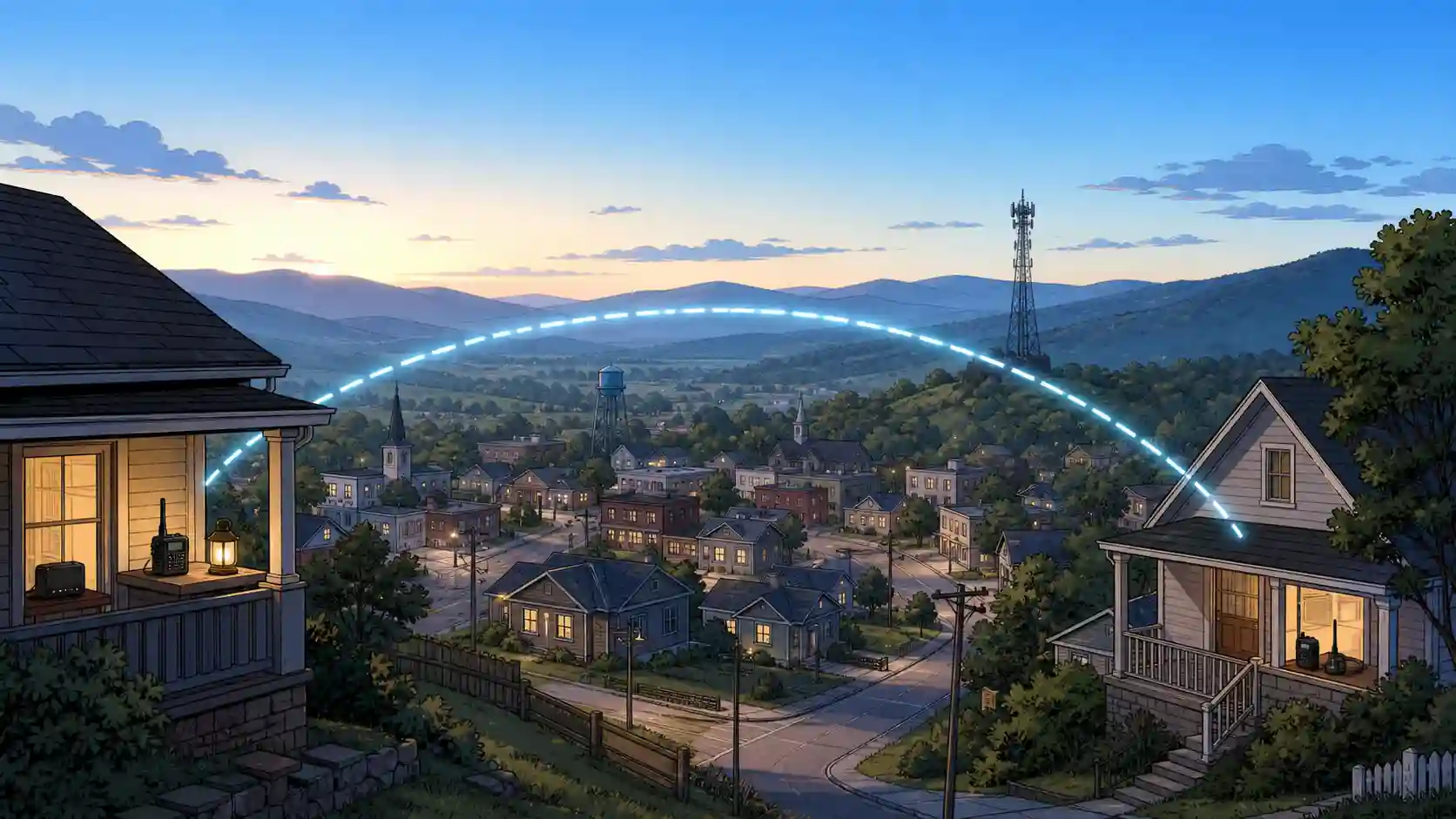
There is exactly one method where, if you and the other person have the gear, nobody stands between you in normal circumstances. That’s radio operating in simplex — two radios talking directly, no tower, no network, no account. The case for it isn’t nostalgia or hobbyism. It’s an engineering argument about who holds the off switch.
Three properties nothing else has
Radio operated simplex has three characteristics that matter enormously in an emergency, and no infrastructure-based method has all three:
- You control it. In simplex there’s no infrastructure between you and the other person, so there’s no one who can censor, throttle, or shut it down. The transmission happens because you keyed the mic, and for no other reason.
- It’s decentralized. No infrastructure means no single point of failure. There is no “system” to go down. If you both have the right radios and antennas and a way to power them, you can talk. Full stop.
- It scales by distance. The same fundamental technology reaches across a room, across a county, across the country, or around the world — you just change the band and the technique.
Put those together and you get something rare: a way to pass information that keeps working precisely when the convenient methods have failed. When the grid is down and the towers are dark, the person with a radio and a plan is still in contact. Everyone else is waiting for someone else’s infrastructure to come back.
The honest catch
I won’t pretend it’s as easy as a phone. It isn’t, and anyone who tells you otherwise is selling something.
You can’t just dial a number. Different frequencies behave in completely different ways — one band is line-of-sight only, another bounces off the ionosphere to the far side of the planet but skips over everything in between. You have to match the method to the job, and that takes some learning. That learning curve is the price of the independence. This whole section of the site exists to flatten it, but the curve is real, and the payoff comes after a little work, not before.
The good news: the first rung is cheap and the payoff is immediate. A pair of inexpensive handhelds gets a family talking across a neighborhood today, with almost nothing to learn.
The three tiers: public, private, secret
Here’s a way to think about radio that most beginner guides skip, and it clarifies everything. For preparedness, radio really does three different jobs, and each calls for a different approach:
- Public — talking to, and listening to, everyone. FRS/GMRS for coordinating with family and neighbors. CB radio and HF ham for gathering information from far away. This is where most people start and where most of the day-to-day value lives.
- Private — reaching your own core group without broadcasting to the whole town. Non-standard frequencies, NVIS techniques for filling in the regional gap, licensed business-band radios. Not secret — just not on the channels everyone monitors.
- Secret — the tactical case, where transmitting at all carries risk and the content is sensitive. Encrypted digital like Meshtastic lives here. (Encrypting voice on ham frequencies also lives here, and it’s illegal in the US — know that line and don’t cross it casually.)
Most people only ever think about the first tier, and for most situations that’s the right place to spend your energy. But knowing all three exist keeps you from using the wrong tool — broadcasting on a public calling channel something you meant to keep inside your family.
Bottom Line
The question was never “is radio the best way to communicate?” On a normal Tuesday it obviously isn’t — your phone wins in every way. The question is narrower and more important:
When the thing you depend on belongs to someone else, what happens to your plan the day they can’t, or won’t, keep it running?
For every method but one, the honest answer is: your plan stops. Radio in simplex is the only answer where the honest answer is nothing happens — I can still reach my people.
- Start public and cheap. A pair of GMRS handhelds gets a family talking today. These require a license that covers your entire family. Go here for more information about GMRS.
- Learn one band at a time. You don’t need all of it — just the piece that covers the distance you actually have to reach.
- Remember receiving is half the job — and it needs no license and no permission at all. A radio that only listens still tells you what’s happening when nothing else can.
This is the parent piece for everything else here — from how far a radio actually reaches to the license you don’t strictly need. When you’re ready to turn it into your household’s plan, the PACE builder and the Field Reference deck are waiting.