


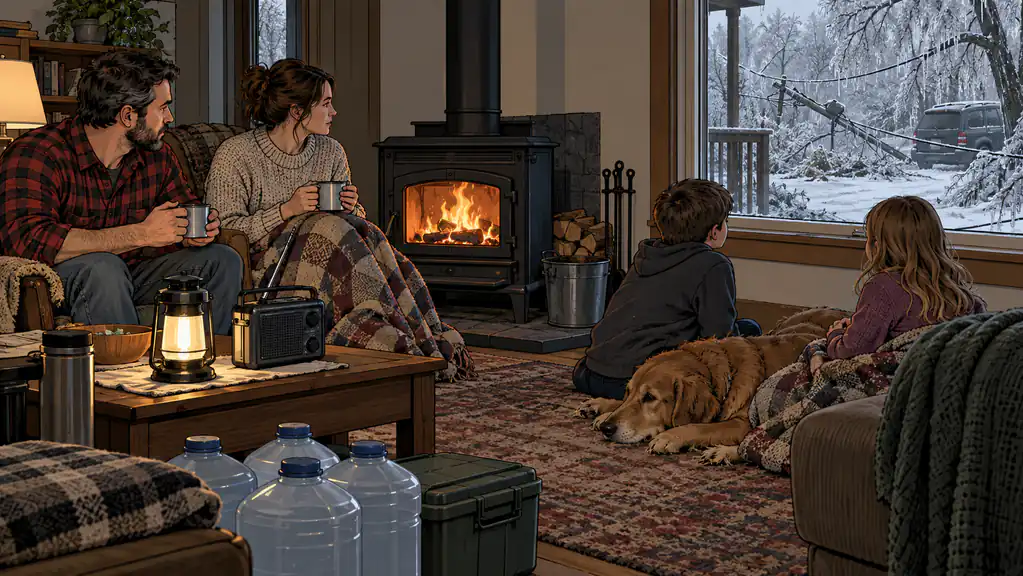
Most winter prep is really snow prep — traction, shoveling, staying off the road until the plow comes through. An ice storm is a different animal, and it’s more dangerous to your household precisely because it doesn’t just slow you down. Freezing rain loads every power line and tree branch with weight until they break across a whole region at once. When that happens you don’t have one problem. You have three at the same time: the power’s out, the house is getting cold, and the roads are sheets of ice — and they all last for days.
That’s the whole reframe. This isn’t a storm you wait out for an afternoon; it’s a multi-day loss of heat, water, and travel. So the prep isn’t one thing. It’s a backup for each of the three things ice takes away.
Why it lands in the middle of the scale and still hurts
Rate an ice storm impact 6, likelihood 5 — serious, and it comes around every few years where winters bite. The impact is high because of the combination. Any one of these alone is manageable: a power outage, a cold snap, an icy road. Ice hands you all three together and holds them there, because the same ice that dropped the lines also greatly slows the repair crews. The likelihood is mid-scale because freezing rain needs a specific setup — a thin layer of below-freezing air at the ground with warmer air above it — that shows up every so often, not constantly. The corridor from northwest Texas up through Michigan to New England is the country’s “glaze belt”: more than six freezing-rain days a year on average, and a damaging quarter- to half-inch event roughly once every three years.
Why ice breaks things and snow doesn’t
Snow blows off. It sheds. Ice does the opposite — it falls as rain and freezes on contact, building a solid glaze that sticks and grows with every hour the rain keeps falling. And it’s heavy. The National Weather Service marks the thresholds plainly:
- A quarter-inch glazes the roads and snaps the first limbs.
- A half-inch is where the widespread failures start — that much ice adds about 500 pounds to a single span of power line.
- An inch or more turns catastrophic, with grid damage that takes days to weeks to fix.
Here’s the part that makes it a preparedness event instead of an inconvenience: the damage isn’t in one place. It’s spread across thousands of broken points — every span, every overhanging branch — and the crews have to fix all of them while working in the same ice, on the same glazed roads. That’s not bad luck. That’s why the lights stay off for days.
I can remember when Springfield, MO got hit in 2007. A friend was living there and I got to see the aftermath. Springfield was blanketed with between 1.5 and 2 inches of ice. The city alone had to replace over 330 utility poles that were snapped off due to the weight. It was 3 weeks before some areas got power back. Thankfully, I’ve never been hit that hard, but I can’t count how many ice storms I’ve seen, and many bring power outages that last multiple days.
Where households actually get hurt
Walk the chain of what fails, because that’s where people get caught:
- Heat is the killer. When the grid goes, so does nearly every central heating system — including gas and oil furnaces, because the blower, the igniter, and the controls all run on electricity. “I have gas heat” is not “I have heat in an outage” unless you set that up on purpose. A house with no heat in the teens cools toward the outside temperature over hours. That threatens the people inside, and a little slower, it freezes the pipes — which burst and flood the house when things finally thaw. One disaster becomes two.
- Water fails two ways. City water can go down, and if you’re on a well, the pump dies the instant the grid does. No pump, no tap.
- Cooking and phones go with it. The electric range is dead. Phones and the router run down with nothing to charge them.
- The roads are out. “Just drive to a hotel or a warming center” is often off the table — the roads are exactly the most dangerous place to be.
- Carbon monoxide spikes. This is the one that kills. People improvise heat with a grill, a camp stove, or a generator running somewhere it shouldn’t, and poison themselves. The CPSC ties an average of about 100 deaths a year to portable-generator CO alone, most of them in the November-to-February outage months. A generator running in an enclosed space can build a lethal amount of CO in under 15 minutes.
What preparedness looks like — a backup for all three
Heat comes first. Set up a way to stay warm that doesn’t need the grid, and do it before winter, not during the storm:
- Your options: a wood or pellet stove if you have the setup and the fuel; an indoor-rated propane heater with enough ventilation and stored bottles; or a properly sized generator to run your existing furnace. Each has a catch — a stove needs a chimney and a woodpile, propane heaters need cartridges and airflow, generators need fuel and enough capacity to handle the furnace’s startup jolt.
- Do the fuel math for days, not one night. This is where people run short. Say your generator burns half a gallon an hour and you run it twelve hours a day — that’s six gallons a day, 42 for a week. Most people don’t store anywhere near that. Count your gallons against a multi-day event and stage them, with stabilizer, before the ice.
- Safety isn’t optional. Any burning device makes carbon monoxide. Never run a generator, grill, or unvented burner in the house or an attached garage — the CPSC says generators go outdoors only, at least 20 feet from the house and away from doors, windows, and vents. Put a battery CO alarm on every level. This one step prevents the most common way an ice storm kills people.
- Have a no-fuel fallback. Know how to pull the family into one small room, seal it up, and hold heat with sleeping bags rated for the cold and layered clothing. Measure your readiness in how many hours you can keep a room survivable with no power at all.
Water is second. Store the baseline — a gallon per person per day — and size it for the outage, not a night. Four people for a week is 28 gallons before you replenish a drop; stretch toward that or past it if you’re on a well or somewhere slow to fix. Fill extra containers the moment ice is in the forecast. And learn to protect your pipes: know where the main shutoff is, keep a trickle running, and open the cabinet doors under sinks on exterior walls so warm air reaches the plumbing stored water can’t replace.
Traction is third, and mostly it’s “don’t.” Keep ice melt or sand so you can safely reach your generator, your fuel, and your vehicle — a fall on glaze during an outage is its own emergency when the ambulances are already buried. Beyond that, the mobility plan is to not travel. Stage everything so you don’t have to.
Use the warning. Ice storms give you lead time — spend it. When freezing rain is in the forecast, run a checklist while you still have power: charge every phone and battery bank, fill water containers, stage lanterns and headlamps (skip open-flame candles — fire risk with tired people crowded in one room), fuel and test the heater or generator, and bring firewood or propane right up to where you’ll use it. Autonomy you can’t set up before the ice arrives is autonomy you might not get to. I failed to do this one year, and almost couldn’t get into the shed containing my generator because the ice was so thick…
Bottom Line
- An ice storm is three failures at once — heat, water, and roads go down together and stay down for days. Have a backup for each.
- Heat comes first, and most furnaces die with the grid. Arrange grid-independent warmth before winter, not the night of.
- Carbon monoxide is the leading avoidable death. Generators outdoors only, 20 feet out, and a battery CO alarm on every level.
- Store a week of water (a gallon per person per day), more on a well, and keep your pipes from freezing.
- Do the fuel math for a multi-day event and stage everything during the forecast window — including ice melt to move safely once it hits.
Snow is a travel problem. Ice is a survival problem — it takes your heat, your water, and your roads at once, and keeps them for days. The whole game is having a second answer to all three, ready before the first drop freezes.
Size your backup heat and fuel with the Heating Fuel Calculator, spec a generator with the Generator calculator, and set your stored water in the Food & Water Storage tool.