


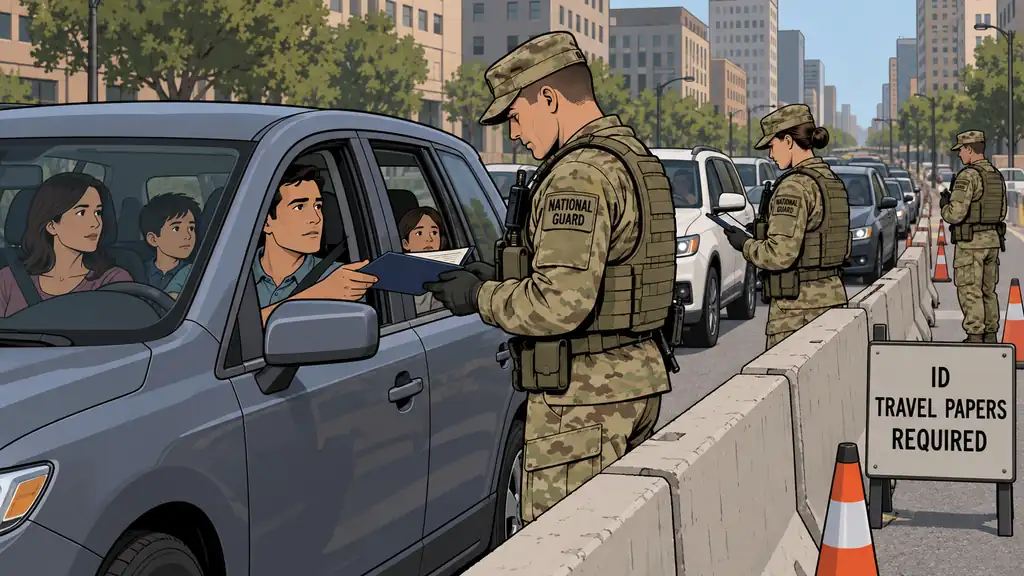
Say “martial law” and most people picture a last stand. That picture is the problem. It sends people toward a fight that almost certainly won’t happen, and that a household couldn’t out-gear if it did. Meanwhile the version you’re actually likely to meet gets no prep at all.
The realistic version is dull: a curfew after a disaster. A movement or gathering restriction during unrest. A stretch where services are disrupted and the normal rules are suspended or bypassed. The harm lands on your movement, your ability to prove who you are, and your ability to reach your people — not, for most households, on your survival. That’s why it sits mid-scale for impact and low for likelihood in a stable society. So prepare for the curfew, not the coup.
Why the framing decides everything
Get the framing wrong and you prepare wrong. Model this as a shootout and you’ll pour money into confrontation and neglect the things that actually cut your risk during a real disruption: your paperwork, a second way to communicate, knowing the rules, and enough supplies to stay home.
Model it as what it usually is — a period of imposed restriction and bad information — and the right prep is obvious. The threat is to your ability to function normally, so that’s what you harden. That’s not caving; that’s aiming at the target that’s actually there.
What actually happens in one
The harm is friction, not gunfire:
- Movement. Curfews, checkpoints, closed roads, and stay-put orders limit when and where you can go. That hits work, resupply, and getting the family back together.
- Communication. Networks get strained, degraded, or restricted. Suddenly you can’t coordinate, and you can’t tell what’s real from rumor. Being cut off makes every other problem worse.
- Identity and access. Rules change fast. Proving who you are, getting into your accounts, showing you’re allowed to do an ordinary thing — all of it gets harder.
- Normal protections thin out. In the more serious cases, the procedures people count on get suspended or skipped, which raises the stakes on being organized and calm.
Real hardship, rarely lethal. That’s the whole reason the impact is mid-scale and not a 9.
The precedent — real, and bounded
This isn’t hypothetical. Curfews and movement limits are a routine tool during disasters and unrest, usually mild and short. After Hurricane Katrina in 2005, New Orleans authorities went further and confiscated firearms from lawful owners — a seizure a federal court later enjoined and the city eventually settled. History also holds the graver cases: under Executive Order 9066 in 1942, roughly 120,000 people of Japanese ancestry — more than two-thirds of them US citizens — were forcibly interned, per the National Archives. That’s why civil-liberties readiness stays on a serious list.
But hold the proportion. In a stable society the sweeping, long version is rare. The common form is the short, local restriction, and that’s what most households will ever touch. We’re not going to invent predictions to scare you into prep. The durable lesson from precedent is small and enough: the organized, informed, self-sufficient household moves through a disruption with less risk and less panic than the one that’s none of those things.
A worked example: the stay-put math
The cleanest response to a movement restriction is not needing to move. So price it in time, not gear.
Say a stay-home order runs 10 days. Four people is 40 person-days. At two gallons of water a day, that’s 80 gallons you either have on hand or you don’t — no store run, because the store is off-limits or empty. Same with food, medications, and pet supplies: 40 person-days of each. If you’ve got that, a curfew is a boring week indoors. If you don’t, day three forces you out into exactly the checkpoints and friction you wanted to avoid.
That’s the trade in one number: a modest reserve buys you the right to stay off the street. It’s also the least confrontational move there is — the household that doesn’t need to be out isn’t exposed to whatever’s out there.
The mistakes people make
- Prepping for the firefight. The single biggest miss. Effort goes to a scenario that’s both unlikely and unwinnable at household scale, while the documents-comms-supplies that actually help sit undone.
- One network for everything. If your whole plan is a cell phone, a strained or restricted network isolates the family instantly. Isolation is where most of this threat’s real harm lives.
- Documents in one place, one form. Originals only, or unencrypted files on one phone, or everything at a house you might not be able to reach. Any single point of failure is the failure.
- Living on one rumor. In a restriction period, reliable information gets scarce and rumor gets loud. One source, believed hard, drives confidently wrong decisions.
What preparedness actually looks like
Four calm moves, in order of leverage:
- Organize and secure your documents. IDs, birth and marriage certificates, insurance, deeds and titles, financial and medical records. Keep them ordered, with redundant backups — physical originals secured and encrypted digital copies — so a lost phone or an unreachable house doesn’t cut you off from your own paperwork. This is the highest-value step because it pays off in fires, floods, moves, and estates, not just this. When rules tighten, being able to instantly prove identity and ownership removes an enormous amount of friction.
- Build a backup way to talk. Don’t hang everything on one network. Set a family plan: a primary method, a backup that doesn’t need the cell network (a simple radio within legal limits, a physical meeting point), pre-agreed check-in times, and an out-of-area contact everyone calls to relay. The goal is simple — stay coordinated when the normal channel is down.
- Learn the rules cold. Understand, in plain terms, your basic rights and how things actually work where you live. This is the opposite of looking for a fight. Calm, informed people de-escalate and make better calls; scared, guessing people do the reverse. Knowing what’s routine versus genuinely abnormal keeps you from over- or under-reacting to a rumor.
- Keep enough supplies to stay put. Run the stay-put math above and hold that reserve — food, water, medications, essentials. It turns a curfew from a crisis into a wait.
Notice what’s missing: anything dramatic. That’s not timidity. That’s accuracy. The tools that cut your risk in the real version of this threat are paperwork, communication, knowledge, and the ability to wait it out at home.
Bottom Line
- Drop the fantasy. The real threat is curfews, restrictions, and disrupted normalcy — not a firefight. Prepare for that.
- Likelihood is low in stable times, but the mild, temporary form is common and is your real planning target.
- The harm is friction and isolation — movement, communication, identity, and thinned protections — far more than physical danger.
- The prep is boring and reusable: organized and encrypted documents, a backup way to talk, knowing the rules, and enough supplies to stay put.
- Self-sufficiency is the least-confrontational move there is — the household that doesn’t need to leave isn’t exposed to what’s outside.
Prepared for this doesn’t look like a standoff. It looks like a person who can prove who they are, reach their family when the network’s down, knows the rules cold, and doesn’t need to leave the house to wait it out.
Organize and encrypt your identity and key documents in the Digital Binder, and build a layered, network-independent communication plan with the PACE Plan builder.