


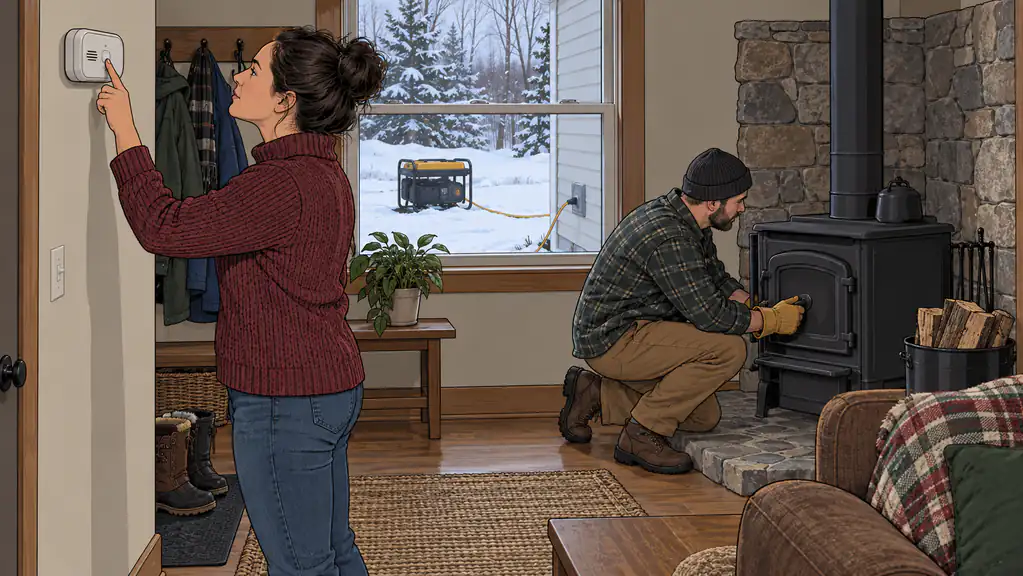
If you prep, you almost certainly own a way to make heat when the power dies — a generator, a propane heater, a kerosene unit, a camp stove for cooking. Good instinct. But here’s the trap most people never see: the exact event that makes you reach for backup heat is the event that makes carbon monoxide deadly. A cold snap with the power out isn’t a rare backdrop for CO poisoning. It’s the single most common one. If your winter plan has a fuel-burning appliance in it but no plan for where the exhaust goes, your plan has a hole in it big enough to lose your family through.
That’s the whole reframe. CO isn’t a freak accident that happens to other people. It’s a predictable side effect of the very thing you did to stay warm. Prepare the heat and skip the exhaust, and you didn’t build a safety net — you built the conditions for the accident.
CO rates a likelihood of 3 out of 9 and an impact of 9 out of 9. The low likelihood is honest — for a normal, well-maintained home running normally, this almost never happens. But that number isn’t fixed. It climbs the moment you drag improvised combustion into a sealed, cold house, which is exactly what preppers do. You don’t inherit a base rate. You set your own.
Why it kills so easily
Carbon monoxide is what you get when a fuel burns without enough oxygen or without a clear path for its exhaust. Burn natural gas, propane, gasoline, wood, or charcoal with plenty of air and a good vent, and you mostly get carbon dioxide, which leaves harmlessly. Choke that same flame — starve it of air, or block where the exhaust is supposed to go — and it makes carbon monoxide instead. So a generator running out in the open is fine, and the same generator in the garage is a coffin. That’s not a machine problem; that’s a ventilation problem.
Once you breathe it in, CO wins a rigged contest inside your blood. Hemoglobin — the protein in your red blood cells that normally carries oxygen — grabs carbon monoxide 200 to 250 times more tightly than it grabs oxygen (the Haldane ratio from the toxicology literature). So even a trace of CO in the air loads up your blood way out of proportion. Your blood fills with a molecule that can’t carry oxygen. It’s full and useless at the same time. The organs that burn the most oxygen fail first — your brain and your heart — which is where the confusion and the collapse come from.
Concentration and time both matter, and that’s the part that catches sleeping households. A low level over many hours can be just as lethal as a high level over minutes, because the poison keeps adding up in your blood the whole time. Hours of quiet exposure with nobody awake to notice the headache building — that’s the classic way a whole family is lost in one night.
Getting out is only the start of the clock
Here’s a number worth carrying: once you’re poisoned, breathing normal air, it takes roughly 4 to 5 hours for half the carbon monoxide to clear your blood. Put a victim on high-flow oxygen and that drops to about 60 to 90 minutes. That’s why “get to fresh air” is the first move but not the finish line — fresh air starts the clock running the right way, and oxygen runs it faster. If you keep oxygen in a serious medical kit, this is one of the reasons it earns its space.
The mistake repeats because it feels reasonable
After nearly every major winter storm or hurricane that knocks out power, the news carries a wave of CO deaths in the days that follow — people running generators in basements and attached garages, or bringing a charcoal grill inside to cook and heat. The CDC ties roughly 430 deaths a year to accidental, non-fire CO poisoning, and the CPSC estimates portable generators alone kill about 80 people a year — a toll that spikes in the outages after big storms. The deaths cluster in the aftermath, not the storm. The storm was survivable. The improvised heating is what killed.
It repeats because the mistake is intuitive. Cold, dark, scared people make a decision that feels obvious — bring the heat closer — and it happens to be fatal. Knowing that pattern before you’re in it is most of the defense.
What pushes your number up
The 3-out-of-9 is fair for a home in normal operation with modern, serviced appliances. Sealed-combustion furnaces, proper venting, and factory cutoffs make routine poisoning genuinely uncommon. Two things move you off that baseline:
- Old or neglected equipment. A cracked heat exchanger in an aging furnace, a corroded water-heater vent, a bird’s nest or ice plugging a flue — any of these turns a safe appliance into a source, silently.
- Improvised combustion during outages. This is the big one for us. Every generator, propane “buddy” heater, kerosene heater, and camp stove you own is a potential source if you use it wrong. The more backup-heat capability you stack up, the tighter your ventilation rules have to be. More gear is more discipline, not less.
What preparedness looks like
Measure your readiness here not in dollars but in layers of defense and habits you’ve actually rehearsed.
1. Detection — the non-negotiable layer. Put CO alarms on every level and within earshot of every sleeping area — the alarm has to be able to wake a sleeping person. Work it out for your own house: a two-story home with bedrooms upstairs needs at least three — one per floor, plus one in the bedroom hallway. Test them monthly. Better, buy 10-year sealed-battery units so a dead battery can’t be the failure that kills you. And know that CO alarms expire — the sensor wears out. Most are rated 5 to 7 years. Check the date printed on the unit and replace the whole thing on time. For serious cold-weather preppers, a low-level monitor with a numeric readout is worth it — standard alarms are built to ignore low chronic levels that can still hurt you over a long night.
2. Source control — the rule that prevents it. Generators run outdoors only, at least 20 feet from the house (the CPSC guideline), exhaust pointed away from every window, door, and vent. Never in a garage, even with the door open. Indoors, only ever burn heaters explicitly rated for indoor use, with their oxygen-depletion sensors intact, and crack a window for makeup air. Charcoal, gas grills, and camp stoves never come inside — not once, not “just to take the chill off.”
3. Maintenance — the layer that catches the invisible failures. Get a professional to service the furnace, water heater, and every gas appliance once a year. Ask specifically about the heat exchanger and the venting. Keep flues and exhaust vents clear of nests, debris, and — in winter — snow and ice, since the storm that kills your power can also bury your sidewall vent.
4. Response — because detection buys you seconds, not minutes. If an alarm sounds, or the symptoms show up together — headache, dizziness, nausea, confusion, several people or pets sick at once — get everyone into fresh air first, then call for help. Don’t investigate. Don’t finish the task. Bodies out the door, questions later.
Bottom Line
- Your risk isn’t the base rate — it’s the base rate plus your backup-heat habits. Prep the whole system, not half of it.
- Detectors on every level and by every bedroom, tested monthly, replaced when the unit expires at 5 to 7 years, not just when the battery dies.
- Combustion never comes indoors. Generators 20-plus feet out with exhaust aimed away; grills and camp stoves outside, always, no exceptions.
- Service gas appliances yearly and keep vents clear — most silent failures are a cracked exchanger or a blocked flue.
- Treat symptoms as an alarm. Headache plus dizziness plus nausea indoors means out the door now.
Backup heat that vents carbon monoxide into a sleeping house isn’t a preparedness win — it’s a self-inflicted disaster. Build the exhaust plan with the same seriousness you built the heat.
If your cold-weather plan leans on a generator or a fuel heater, size and stage it deliberately with the Heating Fuel Calculator and Generator calculator — and put the CO detector on the same checklist as the fuel.