


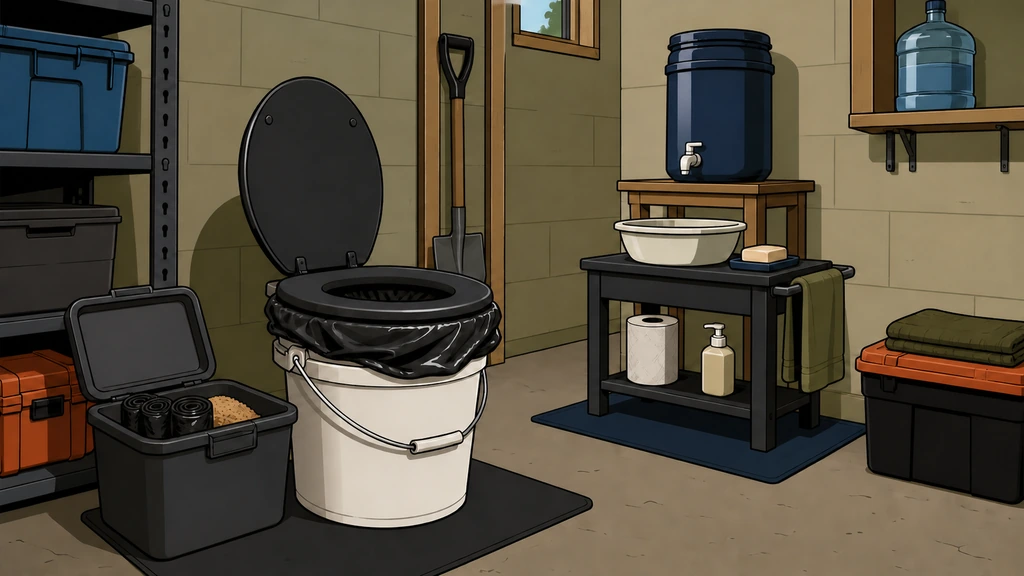
Ask someone what “medical preparedness” means and they’ll show you a trauma kit. Tourniquet, chest seal, gauze. It’s the dramatic quarter of the category — and in a long emergency, it’s not the quarter that puts the most people down. The thing that fills the cots isn’t a wound. It’s a failed toilet, a dirty pair of hands, and water that got mixed up with waste.
This is the least glamorous topic in preparedness and one of the most consequential. When the water stops, the toilet stops — and what happens in the days after that decision is either something you planned or something you improvise at 2 a.m. with a shovel.
I’ve covered the personal aspect in a separate article, Everybody poops, but here we’ll focus on the larger issues that surround a failure of sanitation systems.
Sanitation is the reason cities exist at all
Large population centers weren’t possible until we could deliver water and remove human waste at scale. Before that, packing people together simply created disease — it was self-regulating. The industrial revolution broke that limit, and today roughly 83% of the U.S. population — about 288 million people — live in urban areas.
Now consider a scenario: what happens if large-scale sanitation fails in a city? The answer is blunt. The city is no longer livable. Not “uncomfortable.” Not livable. The same infrastructure that lets millions live shoulder-to-shoulder is the infrastructure that, when it stops, turns density into a disease vector.
The thing that made the modern city possible is the same thing that ends it when it fails. Sanitation isn’t a comfort — it’s the load-bearing wall.
You don’t need a city-scale collapse for this to reach you. A weeklong water outage does it on your own street.
The chain that actually gets people sick
The mechanism is simple and it’s the same one every time: waste gets into water or onto hands, and then into a mouth. Fix any link in that chain and you break it. The classic grid-down illnesses — the diarrheal diseases that historically killed more people in disasters and wars than the disasters and wars themselves — spread this way.
The dangerous part is the multiplier. A wound is one person. A sanitation failure is the whole household at once — and it happens in exactly the circumstances where the hospital is hardest to reach, the pharmacy is closed, and a bad case of dehydration has no one to hang an IV. That’s not a first-aid problem; that’s a system problem, and you solve it before it starts.
What “solving it” actually looks like
Three jobs, none of them expensive:
- Contain the waste. Decide your method now — a lined bucket toilet with a real lid and waste bags, a designated cathole trench well away from any water, a chemical camp toilet. The failure mode is having no plan and defaulting to the yard next to the well. Again, I cover this in detail in Everybody poops.
- Wash the hands. Soap and a small amount of water beats hand sanitizer for actual dirt, and it’s cheap and it stores forever. This one habit does more than anything else in your kit. Budget the water for it — it’s part of your water math, not an afterthought.
- Keep clean and dirty apart. Separate water for drinking and for washing. Waste stays downhill and downstream of everything you drink. Clothes and dishes get washed. This is boring and it is the whole game.
Set a category goal you can measure: a two-year supply of soap and hygiene consumables is a target worth writing down. It’s not glamorous. It’s soap, and it works.
Rate it honestly
Run “sanitation failure during a multi-day outage” through the same threat-rating math you’d use for a hurricane. Score its Likelihood honestly — a multi-day water or grid outage is not exotic — and its Impact across a whole household, and it climbs the list fast. It ranks high precisely because Likelihood is doing real work: this is a Tuesday problem, not a doomsday one.
Bottom Line
- The disease comes after the disaster. In a long event, sanitation failure puts more people down at once than trauma does.
- Break the chain in one place. Waste-to-water-to-hands-to-mouth — contain waste, wash hands, keep clean and dirty apart.
- Decide the method before the water stops. A lined bucket, a trench, a camp toilet — planned, not improvised at 2 a.m.
- Stock soap like it’s ammo. A two-year hygiene supply is cheap, shelf-stable, and the highest-leverage thing in the medical category.
Log your hygiene and waste supplies in the Medical & Hygiene inventory, and map the water and drainage around your home in Area Recon so clean and dirty stay separate before you need them to.