


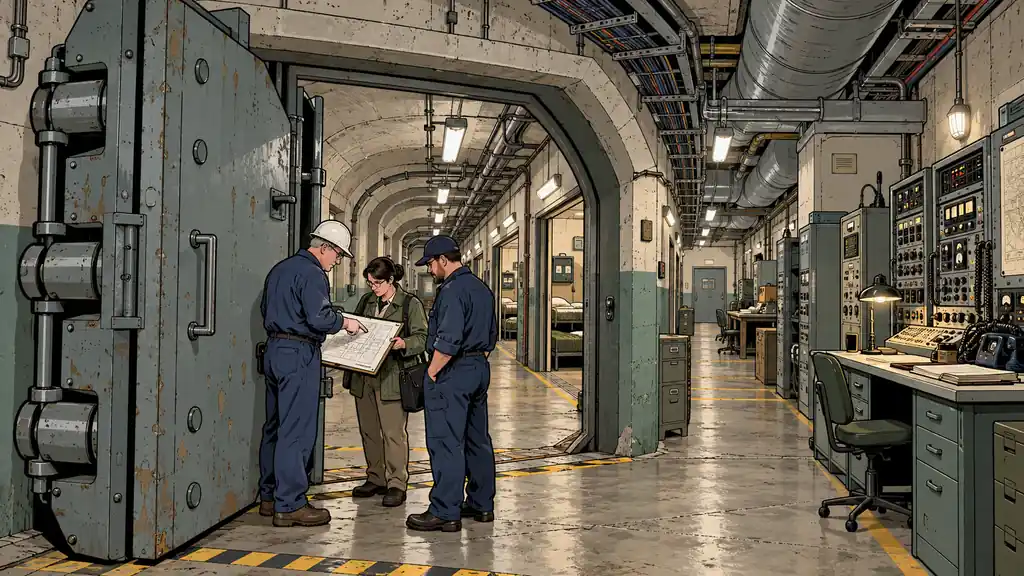
Here’s a claim that pings around the internet every couple of years and just got another lap: the United States secretly spent $21 trillion building a hidden network of roughly 170 underground bases — some under the ocean, linked by a secret transit system — so the elite can ride out a near-extinction event while the rest of us don’t. It’s a great story. Blast doors, subterranean cities, a departure gate for the chosen few.
I love a good bunker story, so let me do the thing that’s more fun than believing it or sneering at it: take it apart and keep the parts that are true. Because two things are simultaneously the case here, and few of the claims hold both at once. The government really did build doomsday bunkers. And the $21 trillion elite-city claim is a misunderstanding of a bookkeeping report. The real version is the better one.
Where the claim comes from
The “former official” in the headlines is Catherine Austin Fitts, who served as an Assistant Secretary at HUD under George H.W. Bush around 1989–1990. Speaking on Tucker Carlson’s podcast back in April 2025, she laid out the full version: the government can’t account for $21 trillion, that money built roughly 170 underground and undersea bunkers to shelter elites through a catastrophe, the facilities are linked by a hidden transit system, and the whole thing is powered by “a secret energy system known only to the military” — the same technology, she suggested, behind a “secret space program” and the fast-moving unidentified aerial phenomena in the news.
The tell is in her own account of how she got there. By her own telling in the press, later recounted by the New York Post, Fitts spent two years combing records on already-documented underground military bases, then compared that against the “missing” money and extrapolated a “guess” — her word — at how many more there must be. The 170, she says, counts only U.S. soil and coastline, with others worldwide. And on the mystery power source: “I’m convinced that this energy exists. If you look at a lot of the really fast ships, flying around the planet, they’re not using classical electricity.”
That’s worth noting, because it’s the whole claim’s foundation showing through. The number isn’t a leak or a document — it’s a guess, offered as a guess, stacked on top of a secret energy system she infers from UFO videos. No official source has corroborated the network, and there’s no public evidence it exists.
So the “170 bases” is air. But the $21 trillion is a real number — it’s just not the number people think it is.
What the $21 trillion actually is
This part is worth getting right, because there’s a legitimate story buried in it that’s more interesting than the fantasy.
In 2017, Michigan State economist Mark Skidmore, working with Fitts, went looking after she mentioned a multi-trillion-dollar Army figure. He assumed she’d confused billion with trillion, found the government reports himself, and confirmed the eye-watering version: official documents showed about $21 trillion in “unsupported journal voucher adjustments” at the Department of Defense and HUD between 1998 and 2015, the bulk of it at the Pentagon.
Here’s what that phrase means, because everything hinges on it. Government accounting systems often don’t talk to each other. When the balances between two systems don’t reconcile, an accountant makes a summary-level adjustment to force the books to match. When that adjustment lacks full backup documentation, it’s “unsupported.” The Pentagon’s own comptroller described exactly this mechanism and said flatly that calling it lost or missing money is inaccurate. FactCheck.org and others reached the same conclusion: the $21 trillion is not one big pot of cash sitting in a vault (or a mountain). It’s the gross sum of many multi-year, often double-counted reconciliation entries — a measure of how badly the books are kept, not of money spent.
The $21 trillion isn’t missing money. It’s the size of the accounting mess — the running total of entries the government itself says it can’t fully document. That’s a real scandal. It’s an audit scandal, not a bunker receipt.
While it’s impossible to prove a negative — no one can prove what the government didn’t do — we can look at what they did do during the time that Fitts claims. During the years of 1998 through 2015, the United States government spent a total of $53.5 trillion. This was every cent paid — salaries, interest on the debt, Social Security, Medicare, the military — everything. For Fitts’ claim to be true, it would mean that during this period almost 40% of every dollar spent went to build these underground bunkers. A basic sniff test tells me that this is extremely unlikely. Earlier, I mentioned double-counting. This is a critical aspect as it’s the only logical explanation. During this same period, total military expenditures were $9.77 trillion. It means they could only logically spend that much money, they didn’t even have access to $21 trillion.
Looking at this logically points to an unfortunate truth that is worth noting: the accounting is worse than many realize. When the “error” is more than twice the total they could even spend means something is fundamentally broken, and it’s known. The Department of Defense has famously struggled to pass a clean audit at all. That’s a real accountability problem, and poking at it is legitimate. What the accounting gap is not is evidence that the money was quietly poured into concrete a mile underground. A verification failure in a ledger and a secret construction project are different things, and only one of them is in the documents.
The bunkers that are actually real
Now the fun part, and the irony: you don’t need a conspiracy, because the real continuity-of-government facilities are declassified, documented, and in some cases open to tourists.
- Cheyenne Mountain Complex (Colorado). NORAD’s hardened command center, dug into a granite mountain behind 25-ton blast doors, built to keep working through a nuclear strike. Fully acknowledged.
- Raven Rock Mountain Complex — “Site R” (Pennsylvania). The “underground Pentagon”: an alternate national military command center meant to shelter top Defense leadership in a catastrophe. It’s so thoroughly documented that journalist Garrett Graff wrote a 500-page history of the whole program, Raven Rock, built from declassified records. If you want to understand how the government responds to perceived threats, I definitely encourage you to read it too.
- Mount Weather (Virginia). FEMA’s continuity hub and emergency operations center — the civilian side of keeping the government running after a decapitating attack.
- The Greenbrier (West Virginia). A bunker built under a luxury resort between 1958 and 1962 to relocate Congress, kept secret for three decades — its payroll and operations run through a front company — until a 1992 Washington Post exposé blew it, after which it was decommissioned. You can take a guided tour of it today.
These are the real “Continuity of Government” program: a sober, Cold War–rooted effort, documented down to the blast doors, to make sure the United States still has a functioning command structure after a worst-case event.
The middle ground
While there are bases we do know about, and there likely aren’t 170 secret bases powered by alien technology, there is a middle ground that needs to be mentioned. I’m sure there are secret bases that the public doesn’t know about. If we have four bases that were built in secret, basic logic would dictate that there are probably more that have never been made public.
What the conspiracy gets half-right
There’s another part worth being honest about, because it’s where the viral story borrows its emotional charge. The real continuity program was never built to save you. By design, it was built to save the government — the presidency, the command authority, the continuity of constitutional order — so that something could be reconstituted afterward. Graff’s history lays this out plainly, and the book’s own subtitle says the quiet part out loud: the U.S. government’s secret plan “to save itself — while the rest of us die.” While officials wired billions of dollars into hardened bunkers for the leadership, the plan for ordinary citizens was, more or less, Bert the Turtle teaching schoolkids to “duck and cover.”
So the feeling underneath the $21-trillion myth — they have a plan to save themselves, and not us — isn’t pure paranoia. In a narrow, documented, sense, it is true. What’s false is the embroidery: the secret transit network, the undersea cities, the 170 bases, the trillions. The conspiracy takes a real and slightly chilling fact and inflates it into a cartoon — and in doing so makes it easier to dismiss the genuinely useful lesson sitting right there.
A case in point: the Crofton “mystery tunnels”
Here’s a smaller story that makes the whole pattern visible. In July 1973, construction crews in Crofton, Maryland, broke into a network of narrow tunnels, and the find has circulated ever since as evidence of ancient or artificial tunnels that were quietly paved over before anyone could properly investigate them.
That “paved over before they could study it” detail is the tell — it’s the move every cover-up story makes, because it explains away the absence of evidence. And the real account is on the record and easy to find. The tunnels were about 20 inches wide, no artifacts or remains were ever recovered, and at an August 1973 conference at the Smithsonian, officials identified them as the work of beavers — a conclusion a later peer-reviewed study confirmed, cataloging the site as a Holocene beaver (Castor canadensis) tunnel complex. A real discovery, real tunnels, and a mundane, honestly kind of wonderful answer. The version that travels is the one where someone covered it up.
If you find yourself wanting the ancient-tunnel version to be true, that instinct is worth noticing — it’s the same pull that turns an accounting error into an underground city. The fix is the same every time: find the primary account, and follow it to the beavers.
The part that’s actually useful to you
Strip away the mythology and there’s a real preparedness lesson sitting underneath, and it’s the opposite of the despair the viral version sells (“they have mountains, you have nothing”).
The government hardens facilities and plans for continuity because resilience is real, and it’s worth investing in before the bad day. But take the honest kernel seriously: the government built continuity for the government. No one is provisioning a bunker for your household — which means your continuity is your job, and the good news is that the principle scales down. You can’t buy your way into Cheyenne Mountain, and you don’t need to. Your version of continuity is a stocked, defensible home, redundant power and water, documents you can grab, and a plan your household has actually rehearsed. Same logic as Raven Rock, ten thousand times smaller and entirely within reach.
And there’s the media-literacy lesson that runs through every story like this one: a real, boring problem (the Pentagon can’t reconcile its books) got dressed up into a thrilling, false one (a secret underground city). The skill worth building is pulling the verifiable kernel out of the viral claim and throwing the rest away — because the loudest version of a story is almost never the accurate one, and accuracy is what your plan has to run on.
Bottom Line
- The “$21 trillion elite bunker network” is not real. The 170-base figure is, by its own author’s admission, “totally a guess,” uncorroborated by any official source.
- The $21 trillion is a bookkeeping number, not a construction bill. It’s the gross total of “unsupported” accounting adjustments at DoD and HUD over 1998–2015 — undocumented reconciliation entries, which the Pentagon and fact-checkers agree is not the same as money that was spent or lost.
- The real bunkers are cooler than the fake city — and the kernel is real. Cheyenne Mountain, Raven Rock, Mount Weather, and the now-tourable Greenbrier are documented continuity sites. As Garrett Graff’s Raven Rock lays out, the program really was built to save the government “while the rest of us die” — the public got duck-and-cover. The myth just inflates that true, chilling fact into a trillion-dollar cartoon.
- Steal the principle, skip the panic. Hardening and continuity planning are real and scale down to a household. Build proportionate resilience, and practice pulling the true kernel out of a viral claim before it drives your decisions.
Rate real threats on evidence, not virality — start with the threat framework.