


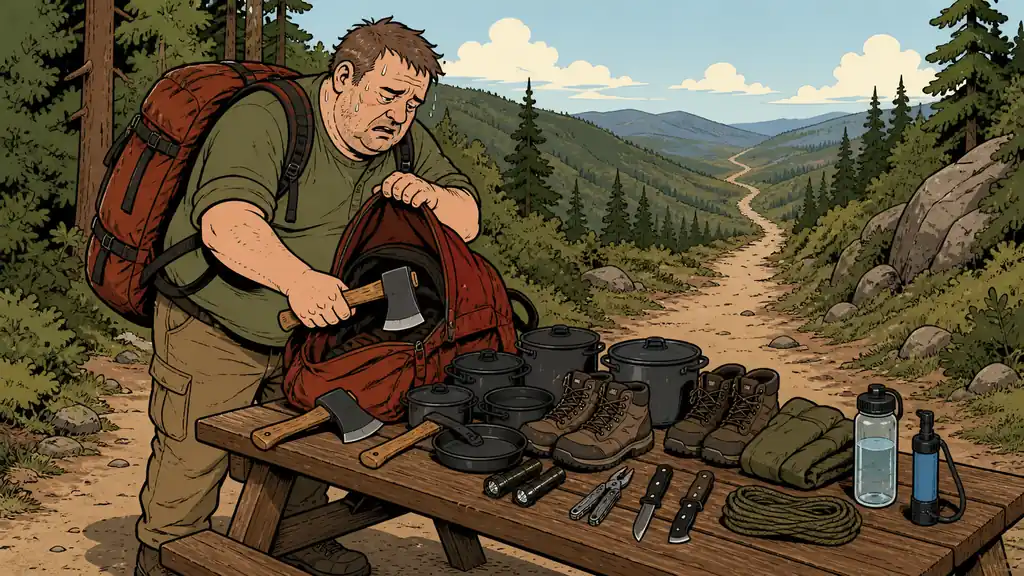
Watch how a bug-out bag gets built online and you’ll notice it only ever grows. Someone posts a list, the comments add to it — a second knife, a bigger stove, a solar panel, a hatchet, a week of food “just in case.” Every addition sounds reasonable on its own. The finished bag weighs fifty pounds and has never once been carried a mile. That’s the flaw: a kit is assembled by adding, but it’s used by walking, and those two forces pull in opposite directions.
The reason you need the bag at all is that the easy way home failed — the car stopped, the road closed, the grid dropped. Which means the bag’s entire job is to move on your back, at walking speed, possibly for a long way. Weight isn’t a detail of that job. Weight is the job.
The math the gear lists skip
Here’s the number that should govern every packing decision. An experienced backpacker in reasonable terrain covers 8–10 miles a day with a 40-pound pack. A genuinely fit, practiced one peaks around 15. That’s someone in shape, with a proper pack, who does this for fun regularly. Now, that said, I know of no serious backpacker that carries a 40-pound pack. They shave every ounce they can, and that’s the point of this article.
Now be honest about who’s actually walking home. Out of shape, wrong shoes, a bag that was packed by adding, quite possibly a kid or an older parent setting the pace. For that person the realistic average is closer to 6 miles a day, maybe 12 on a good one. Every pound over what you need doesn’t just make the walk unpleasant — it pulls that daily number down, turning a one-day walk into a two-day one and a two-day one into a failure.
A backpack has no engine. Everything in it is paid for twice — once at the store, and again with every step you take carrying it.
That’s why the trail and the internet build bags in opposite directions. Thru-hikers obsess over shaving ounces because they’ve felt what an extra five pounds does over twenty miles. The gear-list culture never feels it, because the bag lives in a closet. Your get-home bag has to survive contact with the trail’s reality, not the closet’s.
In my younger years, I did a lot of backpacking, and I learned this lesson quickly. I still remember my first backpacking trip. I packed what I thought I needed. After about 2 hours, I realized I had made a horrible mistake. But I was way past the point of no return, so I had to suck it up and continue. Others on the trip ended up taking some of my gear so that we could increase our pace - it was that bad.
After that trip, unless I had to have an item, I didn’t bring it - period. I went from the heaviest pack to the lightest almost overnight, and actually had a much higher degree of comfort because my body wasn’t screaming with every step I took.
Weigh the whole thing, then cut
You can’t manage what you haven’t measured. Load the bag exactly as it lives — water, boots hanging off it, everything — and put it on a bathroom scale. Then walk your real distance with it, once, before you ever need to. Most people discover their “grab bag” is a bag they can barely lift, let alone carry for two hours.
A useful discipline once you know the weight:
- Water is the pig, and it’s non-negotiable. Water runs about 8 pounds per gallon, and it’s the one thing you can’t cut. That’s the argument for carrying less stored water and more ability to make it safe — a filter weighs ounces and refills for free from every creek you pass.
- Every item earns its weight or leaves. Not “could this be useful?” — almost anything could. The test is “is this worth carrying twenty miles?” That question kills the third knife instantly.
- Multi-use beats single-use. One tool that does three jobs weighs less than three tools. This is where weight discipline and smart packing become the same skill.
- Dress for the walk, don’t pack for it. Clothing worn is weight your body carries efficiently; clothing stuffed in the bag is dead cargo. Wear the layers, or leave the ones you won’t.
Light enough to actually make it
The goal isn’t a minimalist bag for its own sake. It’s a bag matched to the trip. A five-mile urban walk home can carry a little more comfort; a forty-mile rural one has to be ruthless, because at 6 miles a day that’s a week on foot and the weight compounds every one of those days. Size the contents to the distance you’d really cover — which means you have to know that distance before you pack. The Area Recon map exists partly for this: measure the walk from where you spend your days back to your door, and let the real number set the weight budget.
Bottom Line
- Bags are built by adding and used by walking. Those forces oppose each other — respect the walking one.
- Know the pace: ~6 miles a day for a real person, not the 15 a fit backpacker manages. Every extra pound pulls that number down.
- Weigh the loaded bag and walk it once, now. The scale and the trial run will cut more weight than any list.
- Cut everything that won’t earn six miles of carrying — and carry the ability to make water instead of hauling all of it.
Open Area Recon and measure your real walk home — the distance decides the weight, and the weight decides whether you make it.