


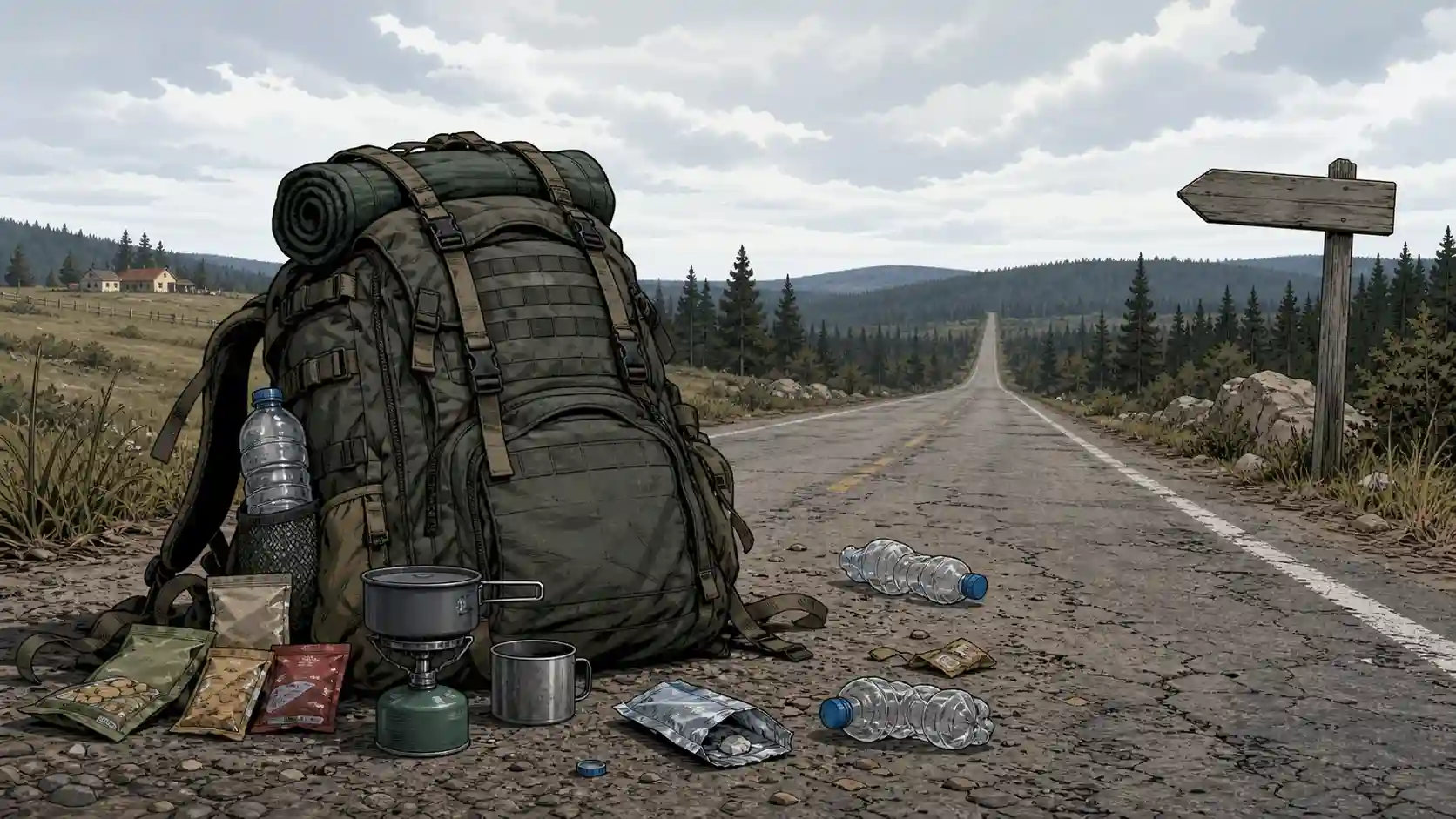
The INCH bag — “I’m Never Coming Home” — is the ultimate prepper fantasy in backpack form. The idea is that when the world truly ends, you grab this one bag, walk out the door, and never return: you’ll live off the land indefinitely, carrying everything you need to survive forever on your back. It sounds like the pinnacle of self-reliance.
It’s actually one of the most dangerous ideas in preparedness, and the reason is just arithmetic.
You cannot carry “forever”
Survival isn’t a one-time purchase you can shoulder and walk away with. It’s a rate — food, water, and energy consumed every single day — and a backpack holds a fixed amount. Do the math on how long that fixed amount lasts and the fantasy collapses.
I worked this out in detail in the Golden Horde chapter, modeling people forced to flee a city on foot. The numbers are brutal. An average family can carry maybe a week of food, if that. After roughly 42 miles of walking over seven days, they’re out of food. Stretch it three more days on water alone and they reach about 50 miles from home — and then they simply can’t go any further. That isn’t a pessimistic estimate. That’s the generous one, assuming they could carry and prepare that much at all.
The INCH bag asks you to believe you’ll do indefinitely what the math says ends in about ten days. “Living off the land” doesn’t rescue the plan, either — foraging, hunting, and trapping enough calories to feed a family, while on the move, in terrain you don’t control, alongside everyone else who had the same idea, is not a thing untrained people pull off. It’s a thing they die attempting.
This isn’t random math - I’ve lived it
I have experience in long term wilderness trips. Our longest one was about 10 days. We were canoeing lakes in Canada which requires portaging (carrying everything over a trail between the lakes). We successfully carried enough food to last the 10 days and we ate pretty well given what we were doing.
But those portage trails - it was all we could do to carry those packs across. Some packs weighed nearly as much as the people carrying them - no exaggeration (I was one of them). Carrying those only a couple miles was all we could do - and that was only enough food for 10 days and the absolute minimum of clothing and other gear. We did this in summer. I can’t imagine attempting something similar in winter.
I’ve also backpacked all over North America and I can’t imagine trying to backpack more than just a few days. I think my record is 5 days and that was a lot of food. I’ve heard of people going 7 days without resupply, but I would expect that to be about the limits of what’s generally possible.
Living off the land
I’m guessing you’re not Bear Grylls or Les Stroud. Unless you’ve spent a lot of time honing wilderness skills like they have, you’re just not going to live off the land. Again, I’ve done it. I’ve only tried it a couple times they were for short periods of time (couple days each) and they were both miserable. Unless you’ve actually done it, I don’t think you realize how much work it takes to forage and hunt for food. And again, in winter this becomes 1000% harder.
It’s the “planning to be a refugee” plan in disguise
Strip away the tactical backpack and the INCH bag is essentially a plan to become a refugee. Refugees are among the most vulnerable people in any disaster — no shelter, no resupply, no home base, entirely at the mercy of whatever they encounter. Dressing that up as rugged independence doesn’t change what it is. It just makes it feel like a decision instead of a default.
The INCH bag is seductive precisely because it feels like maximum preparedness — the biggest, most serious bag for the biggest, most serious scenario. But feeling prepared and being prepared are different things, and this is a case where they point in opposite directions.
What to do instead
If your honest assessment is that some threats will force you out of your home — and for a few threats, they will — the answer isn’t a heavier backpack. It’s the same real bug-out plan every serious evacuation needs:
- A secure, sustainable location to actually go to.
- Supplies already positioned there, so you’re resupplying, not rationing the contents of a backpack.
- A reliable way to get there quickly, with a backup route.
That’s the difference between relocating to prepared ground and wandering off of it. One is a plan. The other is a bag full of hope.
Bottom Line
The INCH bag solves the wrong problem in the worst possible way.
- You can’t carry indefinite survival. The carry math caps an average family around ten days and 50 miles — then it ends.
- It’s the refugee plan wearing tactical gear. Feeling prepared isn’t the same as being prepared.
- If you must leave, leave to somewhere. A stocked bug-out location beats the best backpack ever packed.
Build the get-home bag for the likely day, and a real bug-out plan for the rare one. Skip the bag that’s really just a well-organized way to die on your feet.