


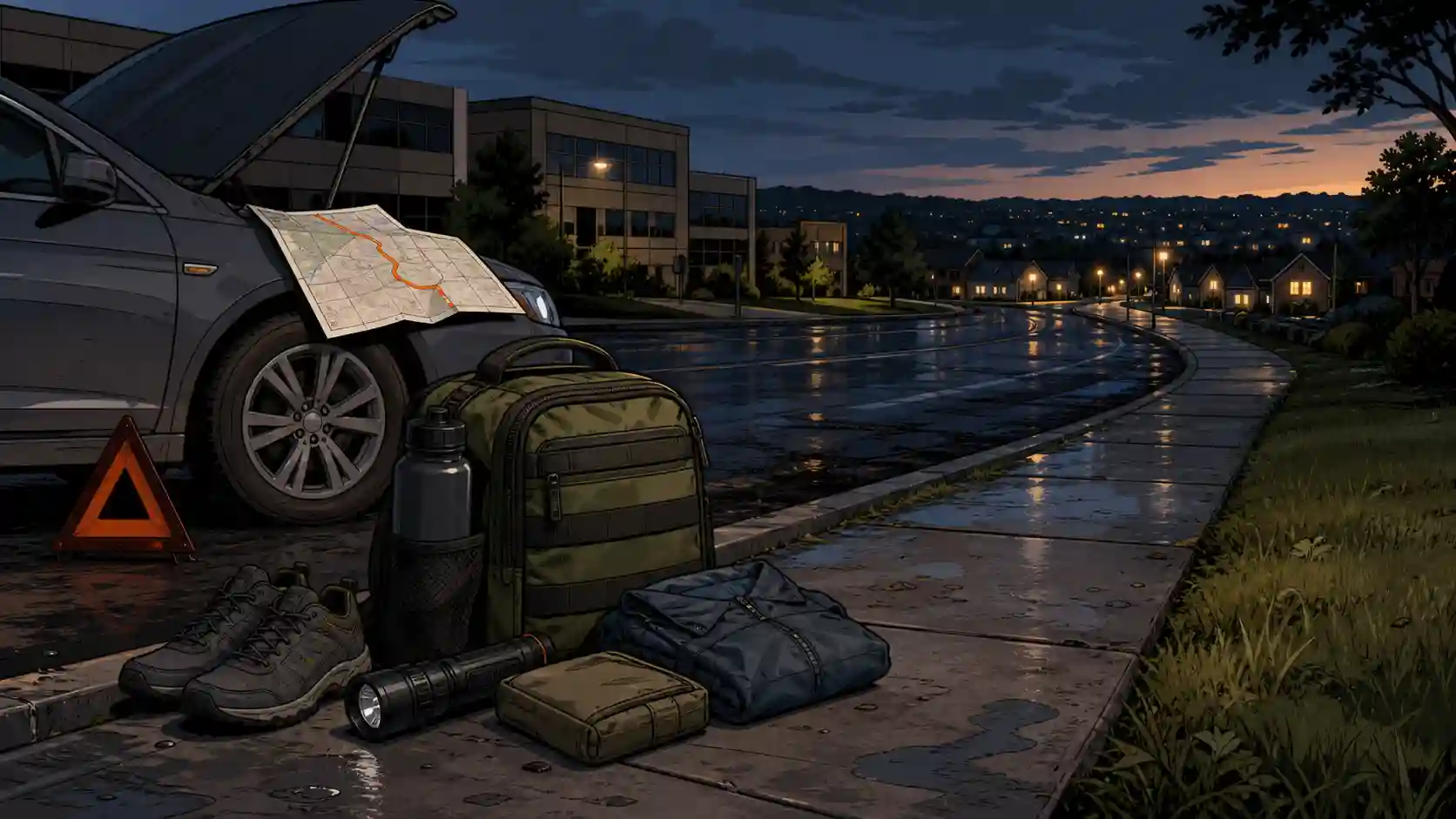
Ask a prepper about bags and you’ll usually hear about the bug-out bag, maybe the INCH bag — the ones built around dramatic scenarios where you flee your home and don’t come back. What you’ll rarely hear about is the bag that covers the emergency you’re actually most likely to face: you’re away from home when something goes wrong, and you need to get back.
That’s the get-home bag, and I’d argue it’s the most important bag you could build.
It answers the likeliest question
Think about where you are during your waking hours. At work. Running errands. Across town, twenty or forty miles from your house, when the weather turns, the grid drops, a road closes, or the car dies. In that moment your problem isn’t “how do I survive in the wilderness forever.” It’s small and specific: how do I get home — to my family, my supplies, my shelter, and my actual plan?
Home is where everything you’ve prepared already is. For almost every scenario, the correct first move isn’t to flee into the unknown; it’s to close the distance back to the resources you’ve spent all this effort building. The get-home bag exists to make that trip survivable on foot if it has to be.
That’s why it beats the flashier bags on importance. The bug-out and INCH bags are built for the rare case where home is gone or unreachable. The get-home bag is built for the common case where home is fine and you simply aren’t there yet.
What that makes it
Because its job is narrow, the get-home bag is easy to get right. It’s roughly the same three-day scope as a classic 72-hour kit, but with the contents shifted toward sustainment for a journey rather than sitting still waiting for help — the small upgrade that turns a generic kit into a get-home bag, with almost no downside. Build it around the trip you’d actually be making:
- Your real distance and terrain. A five-mile urban walk and a forty-mile rural one are different bags. Size it to your commute.
- On-foot, not in-cart. Everything in it has to move on your back at walking speed, because the reason you need it is that the easy way home failed.
- Season-aware. The walk home in January is a different problem than the one in July. If it lives in your car, it has to be ready for the current season.
Its neighbors in the system do the rest of the work: your EDC is what’s on you when you can’t reach the bag at all, and your home supplies are what you’re walking toward. The get-home bag just bridges the gap between them.
Recommendations
I’m not going to give you a list like most sites. Honestly, I can’t - I don’t know your terrain, situation or other needs. I can give you recommendations for things you may want to consider:
- Footwear — ensure you have footwear available that is suited to the terrain and weather.
- Wet weather gear — walking with a pack in the rain sucks. It sucks a lot more if you don’t have proper rain gear.
- Prioritize speed over comfort — minimize what you carry so you can move quickly and easily. You don’t need to eat well, you just need to get home as quickly and safely as you can.
- Be discreet — don’t make yourself a target of law enforcement or bad guys. This means nothing “tacticool”.
So what about bug-out and INCH?
The mistake isn’t wanting to prepare for having to leave. It’s trying to make one over-stuffed backpack do a job it can’t. Bugging out isn’t a bag — it’s a plan with a destination: somewhere real to go, supplies already positioned there, and a route to reach it. And the INCH bag — the one you supposedly live out of forever — is a fantasy that will get people killed. Both of those are addressed elsewhere, properly, and neither is a reason to skip the bag you’ll actually reach for.
Bottom Line
Build the bag for the emergency you’re most likely to have, not the one that makes the best story.
- Get-home bag first. It covers the common case — you, away from home, needing to return.
- Size it to your real trip. Distance, terrain, and season, on foot.
- Handle bug-out and INCH the right way — a planned retreat and pre-positioned supplies, not a heavier backpack.
The bug-out and INCH bags are answers to “what if I can never go home?” The get-home bag answers “how do I get home today?” — and today is the far more likely day.