


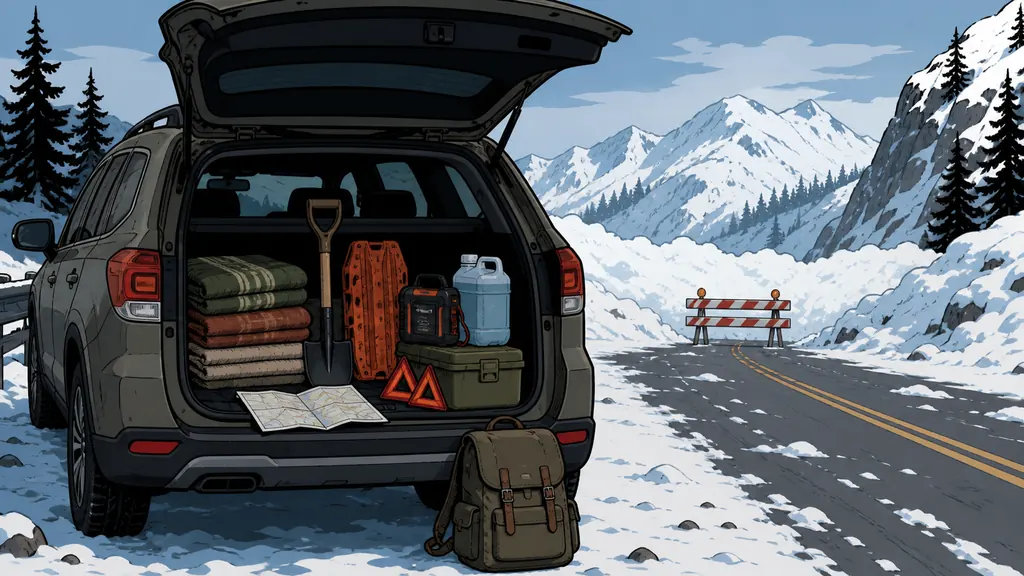
Preparedness culture is obsessed with the bag on your back and almost silent about the machine you spend the most time inside. That’s backwards. You commute in it, run errands in it, take the kids to practice in it — hours a week in a two-ton box, often miles from home, sometimes on a rural road with no cell signal. And unlike your back, that box can carry as much as you want to put in it. The vehicle kit is the tier that sits between your get-home bag and your home supplies, and most people never build it.
The reason to take it seriously isn’t just capacity. It’s exposure. For a lot of us, the single most likely place to be caught by a real emergency isn’t the home we’ve stocked or the office — it’s the road in between.
The emergency that finds you on the road
Think about how a routine drive goes wrong. A winter storm closes the highway. A breakdown strands you an hour from anywhere. A crash backs up traffic for miles in weather you didn’t dress for. None of these is exotic — they’re the ordinary failures of getting from A to B, and they land on you where you have the least around you.
When I first worked through my own threat assessment, getting stranded while traveling in winter came out as one of my single biggest risks — I’m in Missouri, where a routine drive can turn into ice, a closed road, and a long cold wait faster than people expect. The dramatic threats get the attention, but the boring one is the one the calendar says you’re most exposed to.
Your bug-out bag prepares for the day that probably won’t come. Your vehicle kit prepares for the Tuesday that probably will.
Stay with the car — it’s shelter, signal, and cargo
The instinct when a car strands you is to walk for help. Usually that’s the wrong move, and understanding why shapes the whole kit. The car is a windproof shelter, it’s visible to rescuers, and it’s carrying everything you loaded into it. Walking away trades all of that for a set of odds that got a lot of people killed on roads they thought they knew.
So the vehicle kit is built first to let you stay put safely, and only second to let you leave on foot if you truly must:
- Warmth, because the engine won’t run forever. Blankets or a sleeping bag rated for your worst month, a hat and gloves, hand warmers. In a stranded-in-winter scenario, staying warm is the survival task.
- Water and dense calories that tolerate a hot trunk in summer and a frozen one in winter — this rules out a lot of “bar” foods that turn to rock or mush.
- Getting unstuck. Traction aids, a small shovel, jumper cables or a jump pack, a tire plug kit. Most “stranded” situations are really “stuck” situations that gear resolves in ten minutes (if you have it).
- Being seen. A bright light, reflective markers or flares, something to signal with. Rescue can’t help a car it drives past.
- The paper and the plan. Registration, insurance, a paper map for when the phone dies or has no signal.
Because this kit rides instead of being carried, the weight rules invert: in a backpack every pound is a mile you won’t walk, but in a trunk, weight is nearly free. This is the one place you can afford to be generous.
And when you do have to walk
The vehicle kit’s last job is to hand off cleanly to the one on your back. If the car is truly done — out of fuel, blocked in, unsafe to stay with — you leave to somewhere, on foot, with your get-home bag. That’s why the get-home bag lives in the car in the first place: the vehicle kit keeps you alive at the car, and the get-home bag keeps you alive away from it. Knowing the routes matters as much as the gear — the Area Recon map is where you learn the roads you drive and the ways home before a closure picks one for you.
Bottom Line
- The road is where your most likely emergency finds you — and the vehicle is the tier of the system most preppers skip.
- Build it to keep you safe with the car first. Warmth, water, calories, and getting unstuck beat walking for help in almost every case.
- Weight is nearly free in a trunk. Everything a backpack can’t afford to carry belongs here instead.
- It hands off to your get-home bag. Stay at the car until staying is the worse option — then leave to somewhere, on foot, with the bag.
Map the roads you actually drive with Area Recon — the distances, the closures, and the ways home — so a stranded night is a plan, not a surprise.