


This is reference information, not medical advice. The exceptions later in this piece are the ones that can hurt you — when a medication matters, ask a pharmacist rather than a table.
Everyone has done it: you’re cleaning out a cabinet, you find a bottle of ibuprofen that “expired” eight months ago, and you throw it out. It feels responsible. It’s usually a waste of money — and if that reflex ever kicks in during a real shortage, it could cost you more than money.
The date stamped on a medication is not the day it turns dangerous. It’s a conservative date the manufacturer is willing to guarantee — typically the length of the stability testing they chose to run, often just two or three years, because testing longer costs money and there’s no incentive to prove your product lasts a decade. It’s a floor, not a cliff. The question every prepper actually cares about is: how far past that floor can I count on this? It turns out someone has spent almost forty years and a lot of taxpayer money answering exactly that.
The military had a very expensive problem
The U.S. military stockpiles staggering quantities of medicine — for bases, for wars, for disasters. And all of it carries an expiration date. Taken literally, that date meant the Department of Defense would have to incinerate and replace billions of dollars of perfectly good drugs every few years, on a schedule set by a printed number nobody had actually tested against reality.
So in 1986 the DoD and the FDA set up the Shelf Life Extension Program (SLEP). The idea is simple: instead of trusting the label, actually test the stockpiled drugs. Pull samples, run them through the same potency and stability assays the FDA uses for approval, and if a specific lot still meets spec, extend its usable date — lot by lot, retested periodically. It’s not a guess or a rule of thumb. It’s the real chemistry, repeated over time.
The economics vindicated it immediately. In 2016 alone the DoD spent about $3.1 million running SLEP and avoided roughly $2.1 billion in replacement costs — better than a 600-to-1 return. And it isn’t academic: during the 2009 H1N1 flu pandemic, the FDA authorized the use of expired Tamiflu specifically because SLEP data showed it was still good.
What the testing actually found
The landmark published analysis looked at 122 different drug products across more than 3,000 lots. The results were lopsided:
- 88% of the lots stayed within specification for at least a year past their printed expiration date.
- The average extension was 66 months — about five and a half years — though the paper is careful to say the extra life was highly variable from one drug to the next.
A separate group of researchers took it to the extreme, testing prescription drugs that had been sealed in a controlled environment and were 28 to 40 years past their expiration dates. Twelve of the fourteen active ingredients were still present at 90% or more of their labeled strength — the recognized bar for “full potency.” Decades expired, and most were essentially unchanged.
The reassuring part — and the important nuance
Here’s the distinction that makes all of this safe to think about clearly. When a solid medication ages out, what almost always happens is that it slowly loses potency — a 200 mg tablet quietly becomes a 180 mg tablet. It does not, as a rule, transform into something toxic. In fact there is essentially no record in the medical literature of anyone being harmed by a drug that degraded into a poison — with a single, decades-old exception involving old formulations of tetracycline, long since reformulated.
That reframes the whole risk. A weaker painkiller is an annoyance. A weaker emergency drug is a different animal — because for the medications you take when something is actively going wrong, an under-strength dose can be the same as no dose at all. That’s the line that separates “don’t bother throwing it out” from “never gamble on this one.”
The exceptions that genuinely matter
The “lasts for years” story applies to sealed tablets and capsules kept cool and dry. It does not extend to everything, and the exceptions aren’t arbitrary — each one has a physical reason:
- Liquids, suspensions, and anything reconstituted are chemically less stable, and once mixed they can grow bacteria. Reconstituted antibiotics are measured in days, not years.
- Eye drops rely on a preservative that wears out — an expired bottle is a contamination risk.
- Insulin and other refrigerated biologics degrade with both time and temperature.
- EpiPens and epinephrine break down in solution; a weak dose can fail during anaphylaxis.
- Nitroglycerin loses potency quickly, especially once the bottle has been opened — exactly when you can’t afford it to.
- Inhalers like albuterol lose potency over time.
And one caveat sits on top of all of it: storage is doing the heavy lifting. SLEP tested drugs in ideal, sealed, climate-controlled conditions. A bottle that has lived in a steamy bathroom or a hot glovebox degrades far faster and far less predictably. Your real-world shelf life is shorter than the military’s numbers, and anything crumbling, discolored, or smelling off is finished regardless of the date.
What to do with this
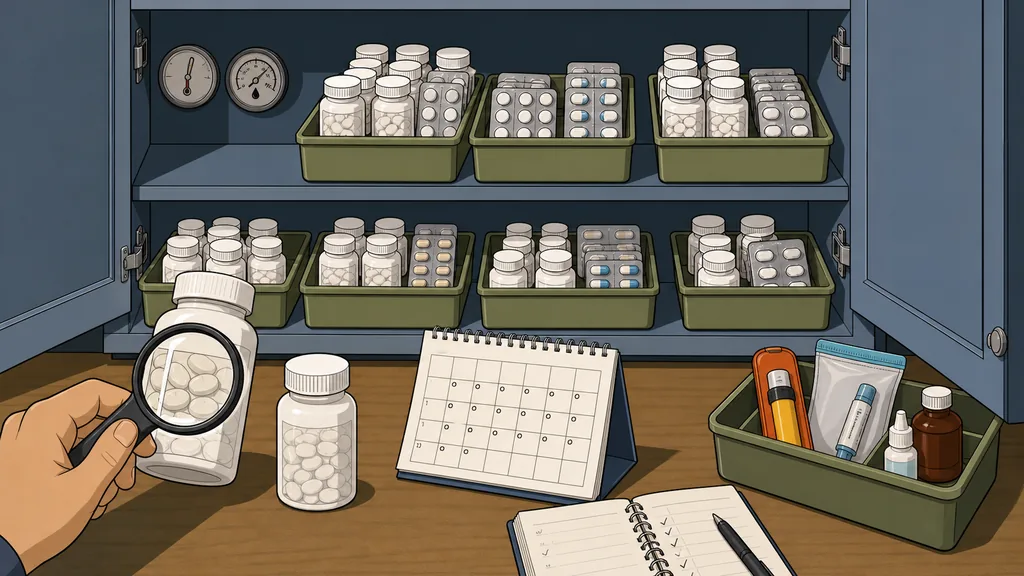
For a prepper, the takeaway isn’t “ignore expiration dates.” It’s this: rotate your stock, but stop treating the printed date as a demolition timer. Most of your solid medications are good well past it, so you don’t need to churn your whole cabinet on a manufacturer’s conservative schedule. But keep the criticals — nitroglycerin, epinephrine, insulin, eye drops, anything liquid — genuinely current, because those are the ones where a weak dose is a failed dose.
For the drug-by-drug breakdown of what extends, roughly how far, and what doesn’t, see the reference table: Which meds extend, and which don’t. And when it actually counts, ask a pharmacist — they can tell you which of your medications keep and which don’t.