


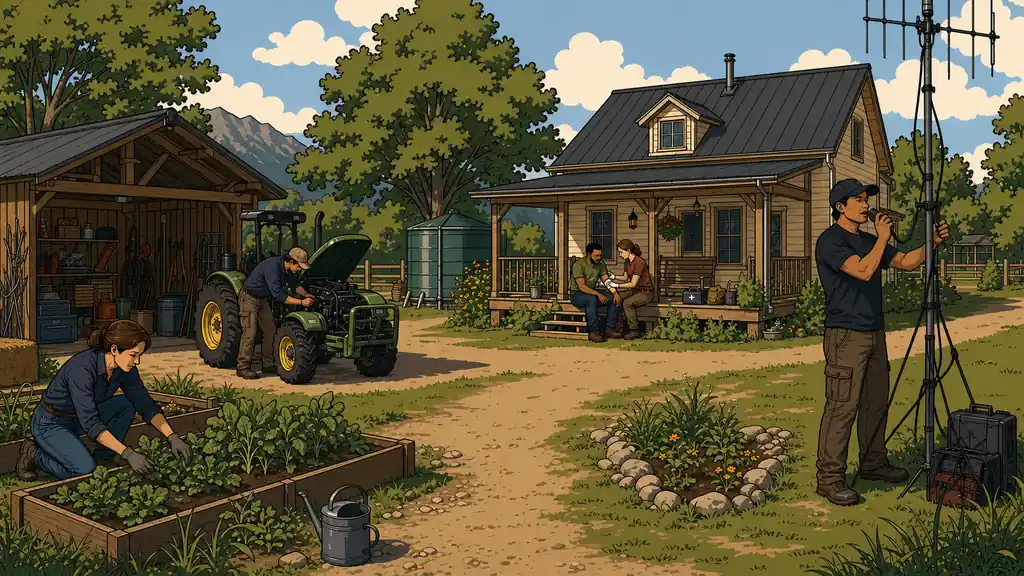
There’s a fantasy at the center of a lot of prepping: the self-reliant individual who can do it all — grow the food, treat the wound, fix the engine, stand the watch, and read the terrain. Now, don’t misunderstand me - everyone should have some knowledge in all these skills. But expecting one person to be an expert in all of them is unrealistic.
I’ll use myself as an example. I grew up on a farm and am proficient with gardening and animals, have backpacked, biked, rafted and canoed over all the terrain of this continent, can fix nearly anything, have beyond average medical skills, a ham radio operator, a competitive shooter in 3-gun and long range rifle, and can drive nearly anything with wheels (and several without). But I also have to sleep.
When you start looking at the details, you realize that the math doesn’t balance. A single person has the same 24 hours a day and the same one body as everyone else. Even if that person is a survival superhero, you still get someone who’s asleep for a third of the day and can only do one thing at a time while they’re awake.
The honest way to think about capability isn’t “what can I learn?” It’s coverage — how many critical domains are answered, and by how many people. One person, even a skilled one, is a single point of failure in every one of them.
Count the domains, not the courses
A group that intends to make it through a long event has to answer for a handful of hard capability areas. The framework’s category planners map these out, but the short version is familiar: medical, food production, water, power and heat, repair and fabrication, security, and communications. Each of those is a career’s worth of depth if you go all the way in.
Self-reliance measured in skills is a trap. Measured in coverage — how many domains, backed by how many people — it becomes achievable.
Now do the staffing math. Real medicine is a full-time competence. So is growing enough calories to matter. So is keeping equipment running. No individual holds all of those at a useful level and has the hours to apply them simultaneously during a crisis, when several of them are needed at once. More important than a wish list is a staffing chart.
Redundancy is the point, not just breadth
Breadth across a group solves the “can’t do everything” problem. But there’s a second failure a group has to design against: the one person who holds a critical skill getting hurt, leaving, or being somewhere else when it’s needed.
If exactly one person in your group can suture a wound, rebuild a pump, or use the radio to request help, that skill has the same fragility as a single stored gallon of water — fine until it’s gone. The fix is deliberate overlap: at least two people, ideally three, with a working level of every critical skill. Not everyone needs to be the expert. Everyone needs a backup.
This reframes what “learning a skill” is for. You’re not trying to personally master medicine. You’re trying to make sure the capability survives any one person having a bad day.
Trade skills the way you’d trade goods
Skills also move between people who trust each other — and that’s a reason to build relationships around capability, not just proximity. If there are people near you who’ve mastered a lost art — old-world food preservation without refrigeration for example — the time to build that relationship and learn from them is now, in ordinary time, not when you’re desperate. One idea in this area is the Amish if you have them in your area. They’re slow to trust outsiders, so it’s all the more important to build relationships before you need them.
The same logic runs inside your own household and group. Cross-train on purpose. Have the gardener teach the basics of the beds. Have the person with medical training run a real class, not a lecture. Skills you can’t personally hold, you hold through other people — but only if you’ve done the work to connect and to practice before it counts.
Bottom Line
- Measure coverage, not courses. The question isn’t what one person can learn — it’s how many critical domains are answered, and by whom.
- A single-skill holder is a single point of failure. Build at least two-deep on every critical capability: medical, food, water, power, repair, security, comms.
- Cross-train on purpose. Skills you can’t hold yourself, you hold through people you’ve connected with and practiced with beforehand.
- Recruit for capability. Know who around you could fill each seat, and build the relationships now.
Use the category planners to see which capability areas you actually cover today, then turn the gaps into a plan with Category Planning.