


Many preppers naturally tend toward being a “lone wolf” – they are either naturally anti-social, or they understand the nature of man and don’t want to take that risk. While I get that inclination (I’m a natural introvert), I think it’s a mistake.
Survival is a lot of work
When you consider all the things that need to get done you can see why early settlers had such large families – it’s essentially a requirement. And even if you happen to have all the supplies you would ever need, so gardening and tending to animals isn’t required, you still have to sleep sometime. You need someone to keep watch, etc. while you sleep.
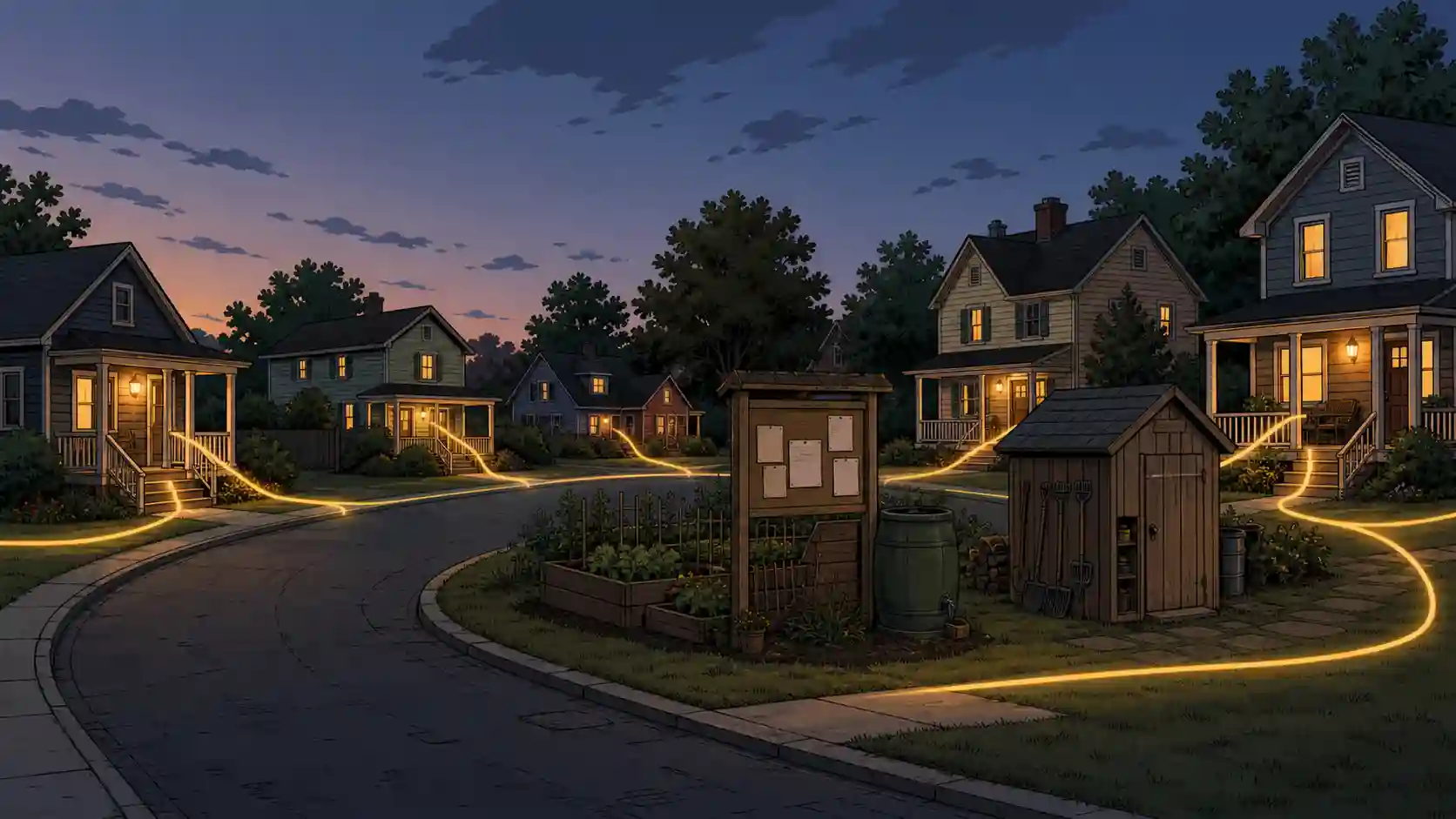
For these reasons you need to cultivate a “community” to survive with. These could be your neighbors or other members of a mutual-assistance group. No matter the scenario, ensure you place a high emphasis on building a community around you to help you all deal with any disaster.
For this community, it can’t just be two families, or one big family – that’s still not enough in most circumstances. You need to evaluate your situation and determine truly how many it will take to survive. Once you have this you need to figure out how to make it happen.
“If you can’t run, you crawl. And if you can’t crawl… you find someone to carry you.” — Captain Malcolm Reynolds, Firefly (2002)
Community matters for the mundane, too
It’s easy to frame this around the end of the world, but the truth is you’ll cash in on community far more often for the ordinary emergencies. A house fire at 2 a.m. is made much easier by the neighbor who lets your family sleep in their spare room, not by a pallet of freeze-dried food. A deep freeze that knocks the power out for three days is an adventure if the family down the road has a wood stove and an open door — and a genuine danger if you don’t know their name. A broken leg, a stranded car, a sick child while both parents are working: these are the emergencies that actually happen, and community is what carries you through nearly all of them.
That’s the quiet argument for community that the dramatic scenarios drown out. You’re not building it for the one-in-a-thousand event. You’re building it for the ordinary Tuesday that goes wrong.
The depth of the relationship is the whole point
There’s an old line: “a friend will help you move, but a true friend will help you move a body.” It’s a joke, but it’s pointing at something real. The value of a relationship in a crisis is exactly as deep as the relationship itself. So it’s worth some honest self-reflection:
- Friends. How deep do your friendships actually run? Would they show up for you if it cost them something? Would you do the same? Those are the relationships that matter when it counts.
- Acquaintances. Who else do you spend your time around, and what are they doing to you? “Bad company corrupts good character” (1 Corinthians 15:33). Ideally the people around you are good in both character and capability. If they’re neither helping you nor of good character, it’s worth asking why they’re there.
- Neighbors. I believe neighbors will be among the most important people to you in a real emergency — and most of us don’t even know their names. Picture the same disaster two ways: once with strangers next door, once with a neighbor who’d help you “move a body.” The gap between those two scenarios is enormous, and it’s built entirely in the ordinary times before anything goes wrong.
You can’t manufacture that kind of trust in the middle of a crisis. It has to already exist. Which means the work of building community isn’t something you do when the sirens start — it’s something you do now, slowly, over shared driveways and borrowed tools and dinners, so the relationships are already there when you finally need them.
Bottom Line
The lone-wolf fantasy fails on the simplest math: one person cannot do all the work, keep all the watches, and survive every injury alone. Resilience is a group project.
- Decide how many. Honestly assess how many people it takes to cover the work and the watch for your situation — it’s almost always more than one family.
- Build it before you need it. Trust is grown in ordinary time. Start with the neighbors you already have.
- Count on it for the small stuff. Community pays off most in the everyday emergencies, not just the collapse. That’s a feature, not a consolation prize.
The framework’s process for identifying the people around you is where this starts — you can’t build a community you haven’t taken the time to understand.