


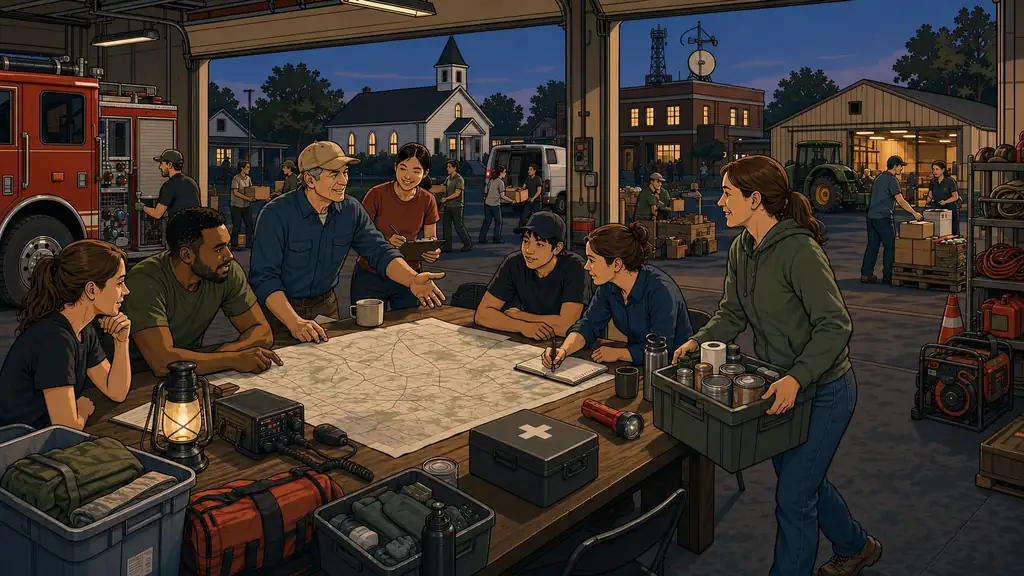
The standard advice to “build a community” makes it sound like you’re starting from an empty field — recruiting members, forming a group, drawing up bylaws. For a few people that’s the right project. For most, it’s the wrong mental model, because it ignores something obvious: your town is already full of organized groups of people, most of them built around exactly the kinds of mutual support a crisis demands. You don’t have to build a network from nothing. You have to join the ones already standing and become a real member before you need them.
The infrastructure is already there
Look around your area with this lens and the existing mutual-aid structure comes into focus:
- Churches and faith communities — arguably the oldest mutual-aid institution there is, built on the explicit obligation to care for neighbors. They have buildings, kitchens, phone trees, and a membership that already shows up for each other in hard times.
- Volunteer fire departments and EMS — in much of rural America, these are the emergency-response system. Joining connects you to trained people, real equipment, and the county’s actual crisis machinery.
- Amateur radio clubs — a ready-made communications network and the people who keep it running when the cell towers don’t.
- Farm co-ops, and gun clubs — skills, land, equipment, and people who already know how to do hard practical things.
- Neighborhood and civic groups — the low-drama backbone of knowing the people on your own street.
You don’t have to build a community from scratch. Most of the structure is already standing — your job is to become a real member before you need it.
None of these were created for “prepping,” and that’s the point. They’re durable, they’re already trusted locally, and they run on relationships that formed long before any emergency. That’s not a network you have to build; that’s one you have to earn your way into.
Membership has to be real, and it has to be early
The catch is that a name on a roster buys you nothing. These groups extend their support along lines of genuine participation — the people who showed up, pulled their weight, and became known. You cannot parachute in during a crisis and expect to be treated as one of the group just because your name is on a list. The trust that makes mutual aid work is built the same slow way everywhere: over shared work, in ordinary time.
So the work is straightforward and unglamorous: pick one or two groups that genuinely fit you, and actually join. Show up. Contribute. Take on a role. You get three things at once — a support network, a way to meet the skilled and trustworthy people worth knowing, and standing you’ll be glad to have if you ever need to help direct a response.
Map them like any other resource
Treat these institutions as layers on your map, the same as water and routes. Where’s the nearest church that runs a real benevolence ministry? Do they have a food bank too? The volunteer fire hall? The club with the land and the generators? Mark them in Area Recon so your plan knows where the organized help is — and so you know which ones to invest in now.
Bottom Line
- Stop building from scratch. Most of the mutual-aid structure your area needs already exists — churches, fire departments, radio clubs, granges, co-ops.
- Join the ones that fit, early. A roster name buys nothing. These groups support the people who genuinely participate, and that trust takes ordinary time to build.
- You get three things at once. A support network, a way to meet skilled and trustworthy people, and standing to help lead a response.
- Map them. Know where the organized help is before you need it, and invest in the ones worth being inside of.
Open Area Recon and mark the churches, fire halls, and clubs around you — then pick one to actually join this month.