


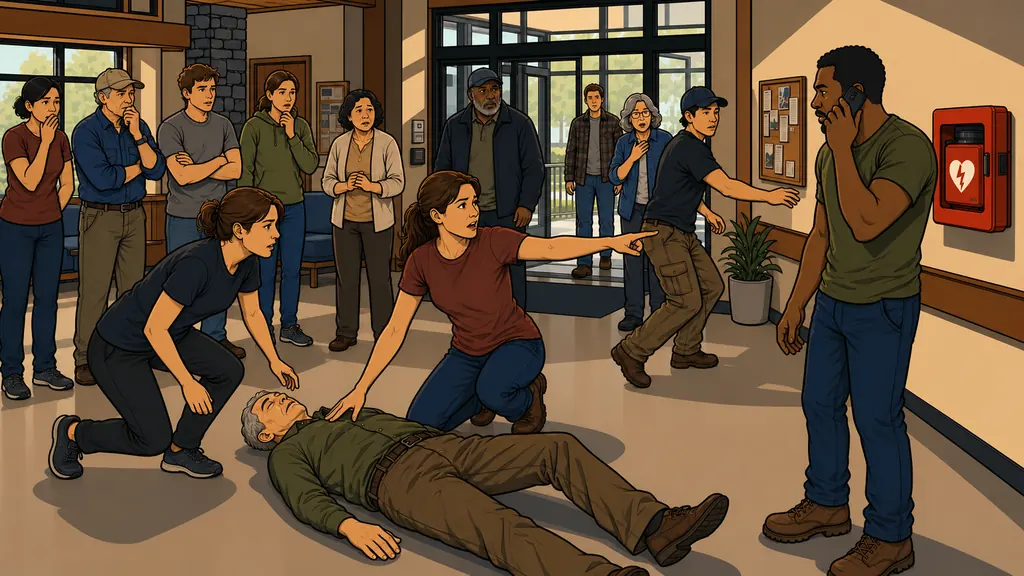
Watch what actually happens when someone collapses in a public place. A crowd forms. And the crowd does nothing. No one calls for help, no one starts CPR, no one even checks on the person — increasingly, people pull out a phone and record instead. This isn’t rare, and it isn’t a sign that those people are cruel. It’s the bystander effect, and it’s one of the most reliably documented patterns in how humans respond to an emergency. The default setting for a group facing something it doesn’t know how to handle is to freeze and wait to be told what to do.
That’s the uncomfortable premise underneath every plan that depends on other people: in the first minutes of a real emergency, most of them won’t act on their own. Which means a prepared community usually needs one person to break the freeze before anyone else moves. The only useful question is whether you’ve decided, in advance, to be that person.
Freezing is the default, and it’s beatable
The reason the freeze happens is worth understanding, because understanding it is how you override it. People are wired toward normalcy and toward doing what’s easy — and in a crowd, the easy thing is to assume someone else will handle it, or to wait for a signal. Everyone waits for the same signal. Nobody sends it. The group stalls.
A prepared community usually needs one person to break the freeze before anyone else will move. Decide now that it’s you.
The break comes from a single person taking initiative and, crucially, assigning specific tasks to specific people. Not “somebody call 911” — that’s another diffuse request the crowd will ignore. It’s “You, in the blue jacket, call 911 right now. You, find a defibrillator. You, help me.” Named people follow direct instructions in the moment. The key is simple: if people are waiting for direction, you become the source of direction. That’s not arrogance; that’s the mechanism.
The decision is made now, not then
You cannot improvise the willingness to step forward. Under stress you fall back on whatever you rehearsed, and if you’ve never decided to act, the default — freezing — is what you’ll default to. This is why “be the one who acts” belongs in your preparations as concretely as water storage does. It’s a decision you make in calm, then reinforce until it’s reflex.
Take a real first-aid course so your hands know what to do. Run the scenario in your head. Decide today that when the crowd freezes, you’re the one who starts giving jobs out — because the version of you standing in that crowd won’t have time to decide.
Someone will lead — make sure it’s not the wrong someone
There’s a harder edge to this. If you don’t step into the leadership vacuum, it doesn’t stay empty forever. Someone will fill it eventually — and it may be the loud, ego-driven person who wants control more than they want a good outcome. Survival is too important to hand to someone whose motive is dominance rather than the group’s welfare.
The way you earn the standing to lead when it counts is by holding it before it counts. Get involved in the organizations that steer how your area responds: city government, civics organizations, volunteer roles, neighborhood groups, whatever gives you a real seat. Competence and relationships built in ordinary time are what make people follow you in a crisis instead of the person who’s just the loudest.
Bottom Line
- The freeze is the default. In an emergency, most people wait to be told what to do. That’s the bystander effect, not a character flaw.
- Breaking it takes named tasks. “Somebody help” gets ignored. “You — call 911 now” gets action. Direct specific people.
- Decide in advance. Under stress you run on reflex. Train and pre-decide so your reflex is to act, not to freeze.
- The vacuum gets filled either way. Build the competence and standing now so the person leading your community is you, not whoever’s loudest.