


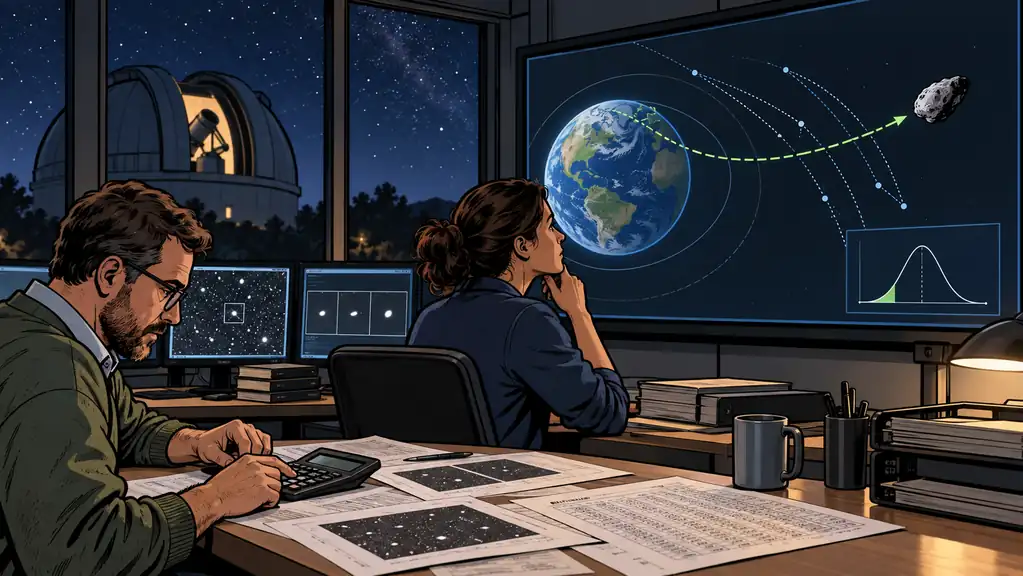
Every serious prepper eventually has to swallow a counterintuitive truth: real preparedness is about where you put finite resources, and sometimes the correct amount to put on a threat is zero — even the most catastrophic one you can name. The asteroid is the cleanest case of this there is. It carries the highest consequence on any threat list, and handled with real rigor, it earns one of the smallest budgets on it. Working through why, with actual numbers, is worth more than any stockpile — because the same framework that zeros out the asteroid is the one that correctly sizes every other threat you face.
Asteroid impact scores impact 9 of 9 and likelihood 1 of 9 — the far ends of both scales. The advanced job is to model the physics and the statistics honestly, run the allocation math out loud, account for the shift from personal survival to detection-and-deflection, and pull out the transferable lesson.
Quantifying “rare”
Impact risk follows a steep size relationship: the bigger the object, the exponentially rarer the strike. Walk the regimes with the real events attached:
- A meter across and below: frequent; they burn up in the atmosphere and do nothing.
- Tens of meters: big airburst or local damage; recurrence on the order of centuries to millennia. The 1908 Tunguska airburst — a 50–60 m object releasing an estimated 3–15 megatons — flattened roughly 2,000 km² of Siberian forest. The 2013 Chelyabinsk airburst — a ~20 m object, about 440–500 kilotons — blew out windows across a city and sent about 1,500 people for medical care, mostly cuts from flying glass. Regionally serious; globally trivial.
- Hundreds of meters: regional to sub-global devastation; recurrence on the order of many millennia.
- A kilometer and up: the threshold where the effects go global, through the atmosphere and climate; recurrence on the order of hundreds of thousands to millions of years.
- Around 10 km: civilization- and extinction-class; by NASA’s estimates, the odds of occurrence are about 1 in 100 million.
It’s a 9, but only if it affects you directly
It’s common-sense, but it’s worth mentioning. For smaller asteroids, unless you’re near the point of impact (or where they explode overhead), there is no effect upon you.
But for those in the affected area, it’s catastrophic. The airburst of a relatively small asteroid can destroy an entire city. That’s going to be bad if it’s your city.
For the larger asteroids, the impact area grows, but it’s not as large as many would expect. If a 1,000 ft diameter rock hit New York City, it would kill about 15 million people. But Albany, Boston, and Baltimore would be essentially unaffected. A 1,000 ft rock hitting the ocean only creates a tsunami of about 200 ft, affecting only a few miles inland. Yes, these are bad, but the point is that the impact is still essentially localized. A 1,000 ft asteroid could take out NYC and I wouldn’t know about it in Missouri until I saw it on the news…
The really big objects do have a global effect. And there are two stages:
- The thermal pulse. A large strike throws vaporized rock high enough that it rains back down across the whole planet, heating the sky worldwide and lighting fires.
- Impact winter. Fine dust and soot get injected high into the atmosphere and cut the sunlight reaching the ground for an extended period. Photosynthesis stalls, and farming collapses globally. That — not the blast — is the main thing that kills the biosphere and would kill a human population. It’s essentially an extreme, planet-wide version of nuclear-winter physics.
If you want to explore the impact details further, I recommend you check out our asteroid impact simulator. This tool lets you simulate impacts anywhere as well as provides what-if analysis for several known asteroids that will pass by earth over the next decade like 9942 Apophis. As of this writing, I know of no asteroids that are projected to impact earth.
The allocation math, done out loud
Rational prep spends against the odds times the consequence times whether prep even helps — not against raw size of disaster. Run the asteroid through it:
- Odds: astronomically low for one that affects you.
- Consequence: maximal.
- Does household prep help at the worst case? Essentially not at all — either you’re dead because you were in the impact zone or the impact-winter/farming-collapse mechanism defeats any stockpile. It’s an all or nothing situation.
Multiply and two of the three terms are nearly zero — the odds and whether prep helps — so the product is negligible despite the maximal consequence. That is the rigorous version of “score it high, fund it at zero.”
The planetary preparations
While the result is low for any of us, it gets much larger when you look at it from a planetary level, and this is what NASA and other groups have been doing. They’re specifically working this problem from two angles:
Detection. Comprehensive near-Earth-object surveys catalog the big population and project their orbits years to decades ahead. The civilization-enders are, by size, the most detectable class — so a genuine large threat would almost certainly arrive with lots of warning, through authoritative channels, not as a surprise.
Deflection. The answer to a detected threat has moved into engineering — nudging the object’s path with enough lead time. In September 2022, NASA’s DART spacecraft deliberately slammed into the asteroid moonlet Dimorphos and shortened its orbit by about 32 minutes — the first proof that a kinetic hit can measurably change an asteroid’s path.
What preparedness actually looks like
Measured, correctly, in almost nothing asteroid-specific:
- Zero specific spend. No dedicated reserves, plans, or attention beyond noting the threat. Given the math above, specific investment is waste by definition.
- All-hazards depth as the universal rare-catastrophe hedge. The broad reserves you build for likely threats are the only rational preparation for any rare catastrophe, the survivable smaller-impact case included. Built for the storm; incidentally the best available answer to the rock.
- Passive awareness of legitimate tracking news through authoritative channels — the shared detection layer does the watching.
- Deliberate reallocation of the attention and anxiety this maximal scenario tries to hijack, redirected to threats with real odds and real answers. That redirection is the operative action and the whole point of scoring the asteroid.
Bottom Line
- Quantify the rarity — a steep size-frequency relationship puts the civilization-class strike at roughly once per 100 million years: about 1-in-100-million a year, under 1 in a million across a life.
- The worst case kills through direct impact or global farming collapse (impact winter) — against which household prep has essentially no effect, separate from the odds.
- Spend against odds × consequence × whether-prep-helps, not raw disaster size — two near-zero terms zero out the budget despite the maximal 9.
The asteroid is the exam question for a prepper’s judgment: name the biggest catastrophe conceivable, then have the discipline to fund it at zero and spend the day on something real. Get that right and you can score everything else.
Find the threats that actually rank where you live with the county Threat Report and build the all-hazards depth that hedges every rare catastrophe with Food & Water Storage.